8.2 Types of dunes in Rub’ al Khali



目次
Contents
| 前書き | Preface |
| 現在のルブア・ハーリー沙漠(الربع الخالي)が形成され始めてからの約6,000年の間に、いくつかの異なる種類の砂丘が、それぞれ特徴ある形に発達してきました。 | During roughly 6,000 years since formation of present Rub’ al Khali (الربع الخالي), several different types of dunes have developed into their own distinctive shapes. |
| 砂丘の種類は、砂の供給量、砂の粒径と組成、表面の粗さ、風の速度・方向・持続時間・変動性、湿度、そして地下の性質や植生によって異なります。砂丘の形成は、障害物の存在や地表の起伏の変化によって、砂を運ぶ風の流れが中断されることで起こると考えられています。 | A type of dune depends on sand supply, particle size, composition, surface roughness, wind (velocity, direction, duration and variability), humidity, subsurface conditions, and vegetation. Dune buildup is considered to occur when sand‑laden wind flow is interrupted by obstacles or by changes in ground relief. |
| ルブア・ハーリー沙漠(الربع الخالي)の風成砂丘群も、大きく分けると縦砂丘、横砂丘、そして星形砂丘に分類されます。縦砂丘には、後述するさまざまな線形砂丘群が含まれます。横砂丘は、本来バルハン砂丘、バルハン型リッジ、横列砂丘の3つのサブタイプに分けられます。 | Aeolian dunes of Rub’ al Khali (الربع الخالي) can be broadly divided into longitudinal dunes, barchanoid‑type dunes, and star dunes. Various linear dune groups described below are included in longitudinal dunes. Barchanoid‑type dunes are originally divided into three subtypes: barchan dunes, barchanoid ridges, and transverse dunes. |
| しかしながら、ルブア・ハーリー沙漠(الربع الخالي)では巨大なメガバルハンが卓越して多く、一方で小さなバルハンも独立して、あるいは副次的に良く発達しています。このため、横砂丘の分類としては、バルハン、メガバルハン、そしてそれらが複合したバルハン型リッジの3つとしました。 | However, in Rub’ al Khali (الربع الخالي), giant megabarchans are abundant, while smaller barchans are also well developed either independently or secondarily. For this reason, barchanoid‑type dunes are classified into three types in this chapter: barchan, megabarchan, and barchanoid ridge, which is a complex of previous two. |
| 星形砂丘のうち、高さが100〜200 mを超える大規模なものは、アーホードともピラミッド砂丘とも呼ばれます。この章では、ピラミッド型砂丘と星形砂丘にドーム砂丘を加え、これらをまとめて「砂山砂丘」と呼んでいます。 | Large star dunes with heights exceeding 100–200 meters are also called rhourd or pyramidal dunes. In this chapter, pyramidal dunes and star dunes are grouped together with dome dunes and referred to as sand‑mountain dunes. |
| 縦砂丘は二方向の風によって形成され、横砂丘は一方向の風によって形成されます。砂山砂丘は、風向がさまざまに変化するため、二つ以上の砂丘タイプが組み合わさって作られます。 | Longitudinal dunes are formed by two‑way winds, whereas barchanoid‑type dunes are formed by one‑way winds. Sand‑mountain dunes are created by combinations of two or more dune types due to variable wind directions. |
| ルブア・ハーリー沙漠(الربع الخالي)の代表的な地形の大部分は、ドラア級ウルーク(大規模な砂丘山嶺)によって占められています。これらは、見かけの風の流れと平行する縦方向に、長い尾根がいくつもほぼ平行に並ぶ場合もあれば、風向に対して垂直となる横方向の山並みが、大きな砂の波のように縦方向へ幾重にも重なる場合もあります。 | Most typical landscapes of Rub’ al Khali (الربع الخالي) are occupied by large dune ridges, known as draa‑class uruqs. These ridges may consist of multiple long crests arranged longitudinally, almost parallel to prevailing wind direction. In contrast, barchanoid ridges are formed horizontally, perpendicular to prevailing wind direction, and they overlap in a longitudinal pattern like large sand waves . |
| 前者は縦砂丘に属する線形砂丘群で、ルブア・ハーリー沙漠(الربع الخالي)の中央東部から南西部にかけて広く分布しています。 後者は横砂丘に属するメガバルハン砂嶺で、ルブア・ハーリー沙漠東部の大半を占めています。筆者は、この東部地域でメガバルハン砂嶺を形成する風向には、ハジャル山脈(جبال الحجر)が大きく影響していると考えています。 | Former is a linear dune group, a type of longitudinal dunes, and it extends widely from central‑eastern Rub’ al Khali to southwestern Rub’ al Khali. Latter is a megabarchan ridge, occupying most of eastern Rub’ al Khali, and it is a type of barchanoid‑type dunes. Author considers that wind directions in eastern Rub’ al Khali, where megabarchan ridges develop, are strongly influenced by Hajar Mountains. |
| 砂山砂丘では、ルブア・ハーリー沙漠(الربع الخالي)中央部の南縁にドーム砂丘が見られ、ピラミッド型砂丘や星形砂丘は、ルブア・ハーリー沙漠東南部に多く分布しています。 | Within isolated dune massifs, or qa’aid, dome dunes appear along southern margin of central Rub’ al Khali, while pyramidal dunes and star dunes are common in southeastern Rub’ al Khali. |
| なお、ドラア級ウルークとされる巨大な砂丘は、通常、より小さな二次砂丘パターンで覆われているため、複合砂丘とも呼ばれます。 | Draa‑class uruqs, as well as megabarchans, are generally referred to as compound dunes because they are usually covered with smaller secondary dune patterns. |

| ウルーク・バニ・ムアーリドは、ルブア・ハーリー沙漠南西部に位置するドラア級ウルーク(線形砂丘)です。 | ドラア級ウルークとメガバルハンは、通常、より小さな二次砂丘パターンに覆われているため、一般に複合砂丘と呼ばれます。 |
| Uruq Bani Mu’arid: A draa‑class uruq (linear dunes) in southwestern Rub’ al Khali | Draa‑class uruqs, as well as megabarchans, are generally referred to as compound dunes because they are usually covered with smaller secondary dune patterns. |
| 1.縦砂丘 | 1. Longitudinal dune |
| 1.1 線形砂丘群 | 1.1 Linear dunes group |
| ルブア・ハーリー沙漠(الربع الخالي)で支配的なのは線形砂丘群です。 ルブア・ハーリー沙漠の卓越風はシャマールで、夏と冬の両方に発生します。これらの風は、それぞれ北西から南東、北東から南西へと吹きますが、カタール半島以南では貿易風などの影響を受けて西南西へと転じていきます。シャマールは5月下旬から7月上旬まで非常に持続的で強力です。もう一つの重要な風が、南西モンスーンに由来するハーリフ(خارف)です。 | Linear dune groups are dominant in Rub’ al Khali. Prevailing winds in Rub’ al Khali are shamals, occurring in both summer and winter. These winds blow from northwest to southeast and from northeast to southwest, respectively, but south of Qatar Peninsula they shift to west‑southwest under influence of trade winds. Shamals are very persistent and powerful from late May to early July. Another important wind is kharif (خارف), produced by southwest monsoon. |
| これらの風によって、ルブア・ハーリー沙漠(الربع الخالي)中央東部から、同沙漠南西部を縁取るアラダ崖地(جرف الأرَض)およびハドラマウト・アーチ(قوس حضرموت)へと、西南西方向にほぼ平行して延びる数百の巨大な線形砂丘ウルーク群が形成されています。ルブア・ハーリー沙漠(الربع الخالي)の南部および南西部の広い地域は、稜線間隔が平均 2 km から最大 6 km、並行する長さが最大 260〜300 km(平均 150 km)に達する、これら巨大な線形砂丘ウルーク群によって覆われています。このような巨大なウルークは、巨大な砂丘を意味するドラア(درع)とも呼ばれ、ルブア・ハーリー沙漠(الربع الخالي)南西部では高さ 250〜300 m に達することがあります。また、このような線形型のドラア級ウルーク砂丘の上に、バルハン砂丘が二次砂丘として形成されることもよくあります。 | These winds create hundreds of huge linear dunes extending west‑southwest, almost parallel to one another, from central‑eastern Rub’ al Khali (الربع الخالي) toward Aradh Escarpment (جرف الأرَض) and Hadramawt Arch (قوس حضرموت), which frame southwestern Rub’ al Khali (الربع الخالي). Wide areas of southern and southwestern Rub’ al Khali (الربع الخالي) are covered by these giant uruqs of linear dunes, with ridge spacing ranging from an average of 2 km to a maximum of 6 km, and parallel lengths reaching 260–300 km, with an average of about 150 km. Such giant uruqs, also called draa (درع), meaning a huge dune, can reach heights of 250–300 m in southwestern Rub’ al Khali (الربع الخالي). It is also common for barchan dunes to form as secondary dunes on top of these linear‑type, draa‑class uruq dunes. |
| 線形型のドラア級ウルークは、このほかに、ルブア・ハーリー沙漠(الربع الخالي)最北東部の、アラブ首長国連邦(الإمارات العربية المتحدة)のアラビア湾(الخليج العربي)とハジャール山脈(جبال الحجر)の間で、西北西から東南東へと発達しています。 | Linear‑type draa‑class uruqs have also developed from west‑northwest to east‑southeast in the most northeastern Rub’ al Khali (الربع الخالي), between Arabian Gulf (الخليج العربي) in United Arab Emirates (الإمارات العربية المتحدة) and Hajar Mountains (جبال الحجر). |
| ルブア・ハーリー沙漠(الربع الخالي)で見られる線形砂丘群には、このようなセイフ砂丘のほかに、ジバール砂丘(كثبان زيبَار)〔羽状砂丘〕、シグモイド砂丘(كثبان متعرجة)〔S字状砂丘〕、フィッシュフック砂丘(كثبان خطافية)〔釣り針状砂丘〕、スモールリニア砂丘(كثبان خطية صغيرة)〔小線形砂丘〕、収束砂丘(كثبان متقاربة)〔先収束型砂丘〕、発散砂丘(كثبان متباعدة)〔先別れ型砂丘〕などがあります。 | In addition to these seif dunes, linear dunes found in Rub’ al Khali (الربع الخالي) include zibar dunes (كثبان زيبَار), sigmoidal dunes (كثبان متعرجة), fishhook dunes (كثبان خطافية), small linear dunes (كثبان خطية صغيرة), convergent dunes (كثبان متقاربة), and divergent dunes (كثبان متباعدة). |
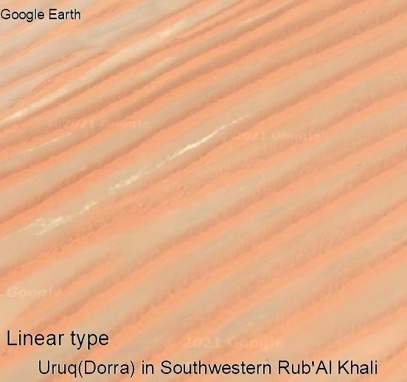
| ルブア・ハーリー沙漠南西部に分布する線形型ウルーク(ドラア) | Linear‑type Uruq (Dorra) in southwestern Rub’ al Khali |
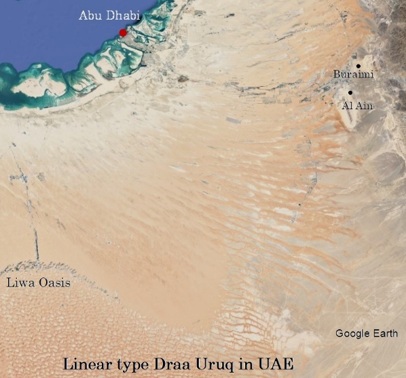
| アラブ首長国連邦に分布する線形型ドラア・ウルーク | Linear‑type Draa Uruq in UAE |
| ドラア(درع)よりも小さな線形砂丘はセイフ砂丘(كثبان سيف)と呼ばれ、ルブア・ハーリー沙漠(الربع الخالي)中央部の大部分はセイフ砂丘群で占められています。また、線形型のドラア砂丘帯でも、小さなセイフ砂丘が斜めに結合することがよくあります。 | Linear dunes smaller than draa (درع) are called seif dunes (كثبان سيف), and most of central Rub’ al Khali (الربع الخالي) is covered by seif dunes. In linear‑type draa dunes, small seif dunes also often join diagonally. |
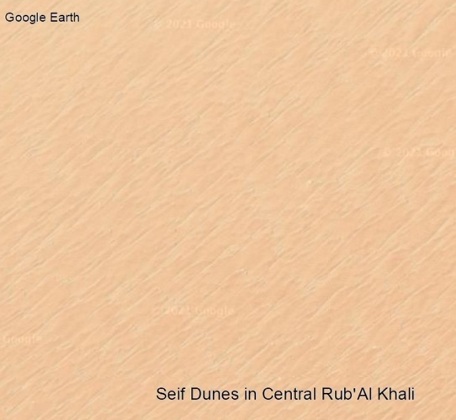
| ルブア・ハーリー沙漠中央部のセイフ砂丘 | Seif Dunes in Central Rub Al Khali |
| 1.1.2 ジバール砂丘(羽状砂丘) | 1.1.2 Zibar (feather dunes) |
| 並行する砂丘間の風の速度が遅いと、砂丘間には滑り面ができず、しばしば三日月形の粗い砂からなる低い砂の尾根が形成されます。この尾根がジバール(زئبر)です。ジバールは、ルブア・ハーリー沙漠(الربع الخالي)の砂丘間地域のおよそ4分の3で一般的に見られると言われています。スライル(السليل)の東北東およそ 280 km 付近では、多数の砂丘尾根が風下側で結合して単一の尾根となるジバール砂丘が見られると言われています。しかし、Google Mapではあまり明確ではありません。 | When wind velocity between parallel dunes is slow, slip surfaces do not form between dunes, and low ridges of coarse, crescent‑shaped sand often develop. This ridge is called zibar (زئبر). Zibar is said to be common in interdune areas of about three‑quarters of Rub’ al Khali (الربع الخالي). At around 280 km east‑northeast of Sulayyil (السليل), a zibar made of many dune ridges that join leeward to form a single ridge is said to occur, although it is not very clear on Google Maps. |
| ジバール砂丘の成り立ちが比較的よく分かるのが、シュカーン(الشقان)地域に見られる枝分かれした羽毛状砂丘です。 | Branching plumate dunes in Shuqan (الشقان) region show formation of zibar dunes more clearly. |
| シュクカーン(الشقان)地域は、ハラド(حرض)の南 100 km にあるヤブリーン(يبرين)オアシスから、さらに南へ 140〜250 km 下った地域です。ここでは、画像上部に見られるように、わずかに発散する多数の砂丘のほかに、小さなバルハン(三日月形砂丘)が風下に進むにつれていくつも合体し、枝分かれした羽毛状砂丘になっています。この羽毛状砂丘は、さらに風下では狭まり、単一の線形砂丘の尾根になっています。それぞれの砂丘の長さはおよそ 10〜60 km です。 | Ash Sguqqan (الشقان) is a region located about 140–250 km south of Yabrin Oasis (يبرين), which lies 100 km south of Haradh (حرض). In Ash Sguqqan, as seen at top of image, many slightly divergent dunes appear together with small barchan dunes (crescent dunes). These small barchan dunes merge as they move downwind and become branching, feather‑shaped dunes. Further downwind, these feather‑like dunes narrow and form a single linear dune ridge. Each dune is about 10–60 km long. |
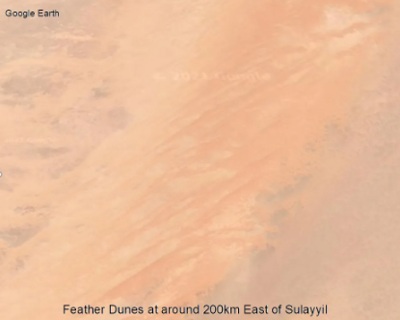
| スライル(السليل)の東およそ 200 km 付近には、羽状砂丘があります | Feather dunes at around 200 km east of Sulayyil (السليل). |
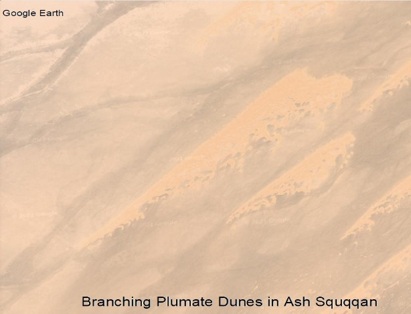
| 羽毛状砂丘(كثبان ريشية متفرعة) | Branching plumate dunes (كثبان ريشية متفرعة) |
| 1.1.3 シグモイド砂丘(S字状砂丘) | 1.1.3 Sigmoidal dunes |
| S字状砂丘とも呼ばれ、平面形がギリシア文字のςあるいはS字型をした砂丘です。風向が少し変動し、風がその長さに対して斜めに交互に吹く場合に形成され、ルブア・ハーリー沙漠南西部で見られるといいます。図はウルーク・ムンダファン(عروق المندفن)にあるシグモイド砂丘です。 | S-shaped dunes are also known as ς-shaped dunes, and their plan view is shaped like Greek letter ς or letter S. They form when wind direction changes slightly and winds alternate diagonally along their length, and they appear in southwestern Rub al Khali (الربع الخالي). Figure shows a sigmoidal dune in Uruq al Mundafan (عروق المندفن). |
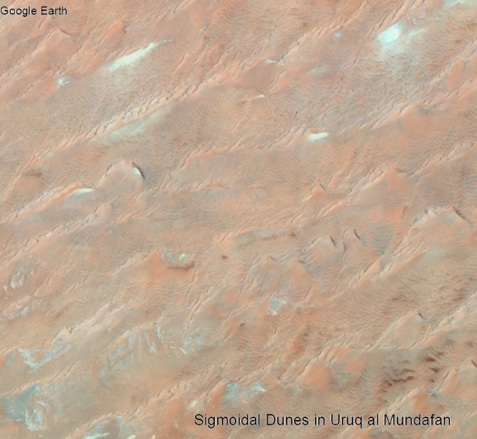
| ウルーク・アル=ムンダファン(عروق المندفن)のシグモイド砂丘 | Sigmoidal dunes in Uruq al Mundafan (عروق المندفن) |
| 1.1.4 フィッシュフック砂丘(釣り針状砂丘) | 1.1.4 Fishhook dunes |
| ルブア・ハーリー沙漠(صحراء الربع الخالي)中央南部の広い地域でよく見られる線形砂丘の一種が、釣り針砂丘です。多くの場合、別々の三日月形の砂丘と線形の砂丘として始まり、その後に合体して特徴的な釣り針の形となり、長くて直線的な尾根をつくります。見かけの横方向の起源にあたる末端の三日月形の北東端で、軸となる部分が形づくられます。1つまたは複数の三日月形の部分には、最大で数mの高さとなる滑り面があります。 | A type of linear dunes commonly found in large areas of south‑central Rub’ al Khali (صحراء الربع الخالي) is fishhook dunes. It often begins as separate crescent‑shaped dunes and linear dunes, and later joins to form a characteristic hook shape that creates a long, straight ridge. A shaft forms at northeastern end of crescent shape at end of apparent lateral origin. One or more crescent‑shaped parts have a slip face with height up to several meters. |
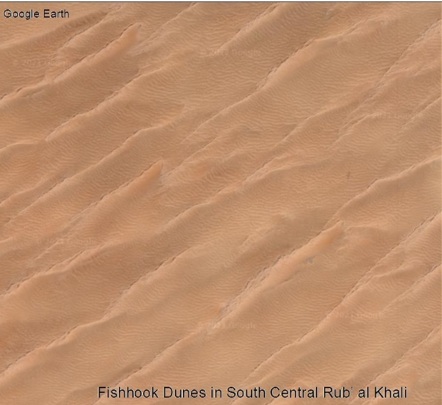
| ルブア・ハーリー沙漠中央南部のフィッシュフック砂丘 | Fishhook Dunes in South Central Rub’ al Khali |
| 1.1.5 発散砂丘(先別れ型砂丘) | 1.1.5 Divergent dunes |
| 図に示すラムラト・アル=クサイイイブ(رملة الكثيب)のように、1つの線形砂丘が北東に2つまたは3つの砂丘の尾根に分岐しています。 | One linear dune branches northeast into two or three dune ridges, as shown in figure of Ramlat al Kuthayyib (رملة الكثيب). |
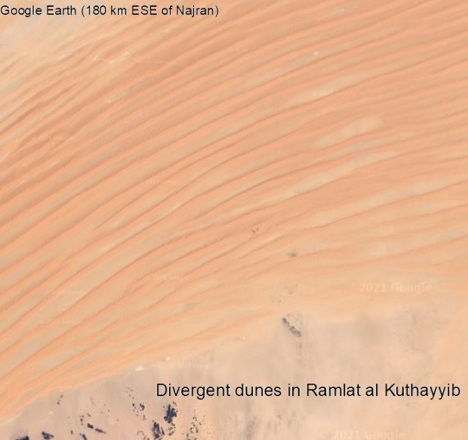
| ラムラト・アル=クサイイイブで見られる発散砂丘 | Divergent dunes in Ramlat al Kuthayyib |
| 1.2 線形砂丘複合体のピラミッド型砂丘群 | 1.2 Pyramidal dunes of linear dunes complex |
| 別のタイプの線形砂丘複合体であり、ラムラト・ミーターン(رملة الميتان)で見られるピラミッド型砂丘の整列した帯です。 | Another type of linear dune complex is seen as aligned belts of pyramidal dunes in Ramlat al Mitan (رملة الميتان). |
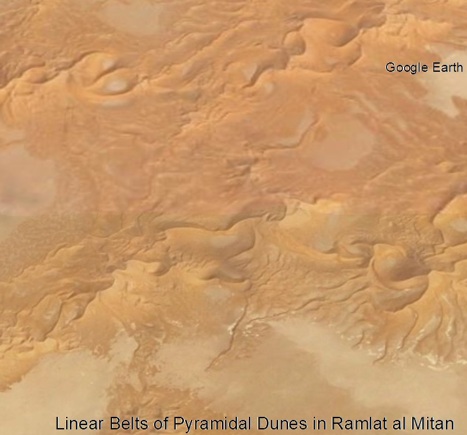
| ラムラト・ミーターン(رملة الميتان)のピラミッド型砂丘 | Linear Belts of Pyramidal Dunes in Ramlat Mitan |
| 2. 横砂丘 | 2. Barchanoid type dune |
| 2.1 メガバルハン砂丘 | 2.1 Megabarchans |
| ルブア・ハーリー沙漠(صحراء الربع الخالي)で最も高く大きな砂丘は、巨大な三日月形の砂丘であるメガバルハン砂丘です。高さは230 mにも達し、約38,000平方km、すなわち沙漠の約6%を占めます。しかし、その多くはウルーク・ムウタリダ(عروق الموطريد)とウルーク・シャイバー(عروق الشيبة)に集中しています。 | Tallest and largest dunes in Rub’ al Khali (صحراء الربع الخالي) are megabarchans, which are huge crescent‑shaped dunes. Megabarchans reach over 230 meters in height and occupy about 38,000 square kilometers, or about 6% of area of Rub’ al Khali. Most of them concentrate in Uruq al Mutaridah (عروق الموطريد) and Uruq ash Shaybah (عروق الشيبة). |
| これらは南側または南東側に大きな滑り面を持つ巨大な三日月形となり、通常の長さは2〜4 kmです。メガバルハンの風上側には、巨大縦砂丘ウルークと同じように、多くの小さなバルハン砂丘やシグモイド砂丘などの二次砂丘が形成されます。 | They take a huge crescent shape with a large slip face on south or southeast side, usually 2 to 4 km in length. On windward side of megabarchans, many small secondary dunes such as barchan dunes and sigmoidal dunes are formed, similar to what occurs on a huge linear dune. |
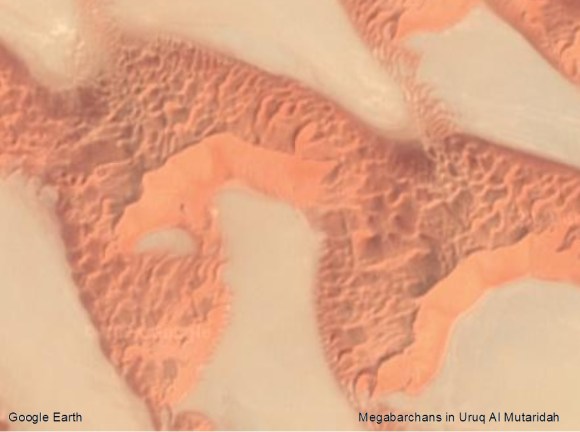
| ウルーク・ムウタリダのメガバルハン砂丘 | Megabarkhans in Uruq Al Mutaridah |
| 2.2 バルハン状砂丘の尾根 | 2.2 Barchanoid ridges |
| バルハンとメガバルハンは、横方向に結合してバルハン状砂丘の尾根を形成することがあります。これらはアラブ首長国連邦南部のリーワー地域(ليوا)で特に多く見られ、少なくとも70の砂丘の尾根があります。 | Barchans and megabarchans can combine laterally to form barchanoid ridges. These are especially common in Liwa area (ليوا) in southern UAE, with at least 70 dune ridges. |
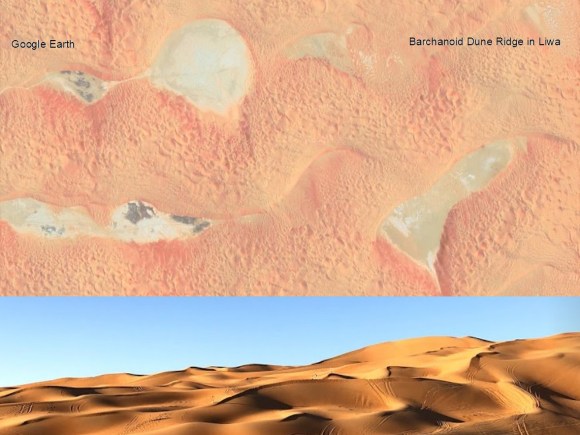
| リーワー地域のバルハン状砂丘の尾根 | Barchanoid Dune Ridge in Liwa |
| 3. 星型砂丘 | 3. Star dunes |
| 孤立した砂山砂丘は、主に星型砂丘とドーム型砂丘です。星型砂丘は、砂丘が比較的安定するまで、風がさまざまな方向からつくるいくつかの砂丘の尾根が収束して形成されます。その中でも高さが100〜200 mを超える大きなものは、アーホードまたはピラミッド砂丘とも呼ばれ、ひときわ目を引く存在です。 | Lonely isolated sand mountains are mainly star dunes and dome dunes. Star dunes form by convergence of several dune ridges that winds create from different directions until dunes become relatively stable. Among them, large ones with height over 100 to 200 meters are striking and are called rhourd or pyramidal dunes. |
| ピラミッド型の砂丘は、主に南東部のルブア・ハーリー沙漠(صحراء الربع الخالي)の内部ドファール(ظفار)に隣接する部分に沿って見られます。これらは、2つ以上のS字状の尾根が収束して形成され、比較的安定した後、漂流する砂の堆積によって成長するように見えます。そのため、「風が方位盤のまわりを吹くと、シグモイド砂丘からピラミッド型砂丘が形成される」と言われています。 | Pyramidal dunes can be found mainly along southeastern Rub’ al Khali (صحراء الربع الخالي) adjacent to inner Dhofar (ظفار). They form by convergence of two or more S‑shaped ridges and appear to grow through deposits of drifting sand after becoming relatively stable. That is why it is said that “when wind blows around a compass, pyramidal dunes are formed from sigmoidal dunes” |
| これらの大きな砂丘は、しばしば砂山と呼ばれ、直径は0.5〜2 kmで、高さは150 mに達します。ルブア・ハーリー沙漠(صحراء الربع الخالي)南東部では、ラムラト・ファサド(رملة فسد)に見られるように、個々のピラミッド型の砂丘が一列に並んでいます。 | These large dunes, often called sand mountains, are 0.5 to 2 km in diameter and reach a height of about 150 meters. In southeastern Rub’ al Khali (صحراء الربع الخالي), pyramidal dunes line up in linear belts, as seen in Ramlat Fasad (رملة فسد). |
| ドファール(ظفار)内部では、これらの砂丘は南または南東から内陸に吹く風によって形成され、風下側は常に北になります。そして、ルブア・ハーリー沙漠(صحراء الربع الخالي)南部の一般的な風の循環の一部である北東の風によって整列します。孤立した砂丘の山塊、すなわち カーアイド(قاعيد) は、ルブア・ハーリー沙漠南東部のガーニム・サンド(غانم ساند)で知られています。 | Inside Dhofar (ظفار), these dunes form by inland winds from south or southeast, with leeward side always facing north. They are aligned by northeastern winds, which are part of general wind circulation in southern Rub’ al Khali (صحراء الربع الخالي). An isolated dune massif, or qa’aid (قاعيد), is known in Ghanim Sand (غانم ساند) in southeastern Rub’ al Khali. |
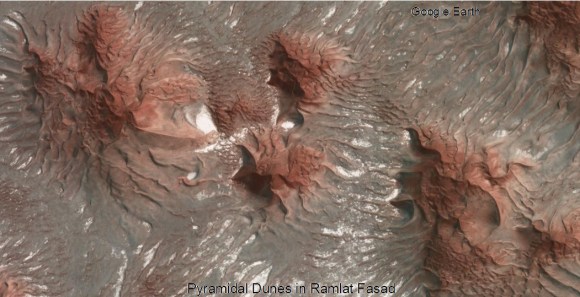
| ラムラト・ファサドのピラミッド砂丘 | Pyramidal Dunes in Ramlat Fasad |
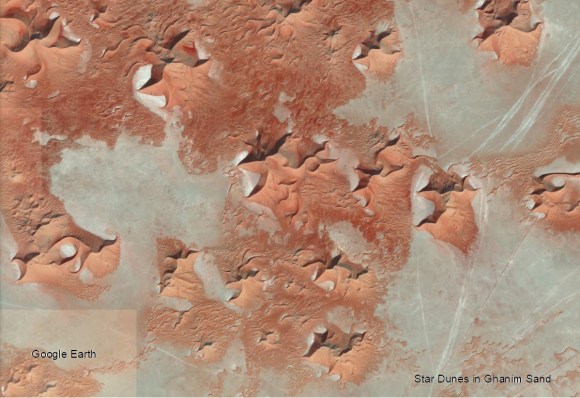
| ガーニム砂沙漠のピラミッド砂丘 | Pyramidal Dunes in Ghanim Sand |
| 4. ドーム型砂丘 | 4. Dome dunes |
| もう一つの孤独な砂丘がドーム型砂丘です。直径2 km、高さ60〜100 mの大きな円形または楕円形のドーム型砂体(円錐台または楕円錐台)からなるドーム砂丘は、ハドラマウトアーチ北部に隣接するルブア・ハーリー沙漠(صحراء الربع الخالي)中央部西の南縁部に並ぶラムラト・ウム・ガリブ(رملة أم غريب)とラムラト・ハザール(رملة حزر)で特に発生しています。 | Another type of lonely dune is dome dunes. Large circular or oval mounds, 2 km in diameter and 60 to 100 meters in height, occur especially in Ramlat Umm Gharib (رملة أم غريب) and Ramlat Hazar (رملة حزر), which line southern edge of central western Rub’ al Khali (صحراء الربع الخالي). These locations are adjacent to northern Hadramawt arch. |
| これらのドーム砂丘は、局所的にランダムに変化する風のパターンと、比較的制限された砂の供給が組み合わさって形成されると考えられます。その形から、涙型砂丘と呼ばれることもあります。このタイプの砂丘は、ルブア・ハーリー沙漠(صحراء الربع الخالي)のごく一部を占めるにすぎません。 | These dome dunes form due to a relatively limited supply of sand combined with randomly changing local wind patterns. Because of their shapes, they are sometimes called tear‑drop dunes. This type of dune occupies only a small part of sand dunes in Rub’ al Khali (صحراء الربع الخالي). |
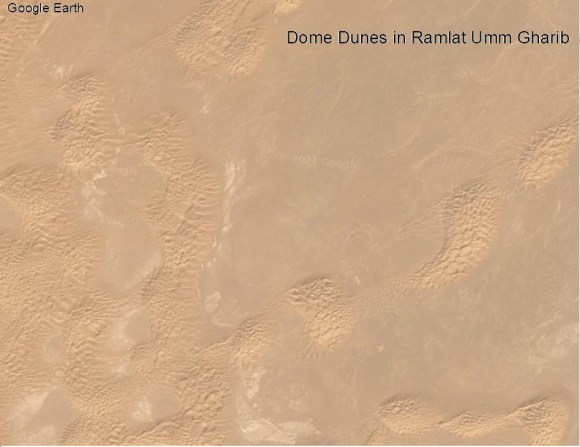
| ラムラト・ウム・ガリブのドーム型砂丘 | Dome Dunes in Ramlat Umm Gharib |

