Storms on the Arabian Peninsula



目次 (Index)
1 概要
2 沙嵐の呼び方
2.1 シムーン (سموم)
2.2 ハムシーン (خمسين)
2.3 シャマール (شمال)
2.4 ジュノービーヤ(جنوبية)
2.5 カウス (قوس) とシャルキー (شرقية)
2.6ハブーブ (هبوب)
2.7 ハーリフ (خارف)
3 沙嵐を駆動させる風成作用
4 沙嵐で運ばれる砂と砂塵
5 沙嵐の季節
5.1 夏のシャマール
5.2 夏の南西モンスーン
5.3 冬のシャマール
5.4 カウス
6 沙嵐の風力を増大させる要因
6.1 超熱帯の上層階の気圧の谷の浸透
6.2 東西圧力勾配の増大
6.3 大気の不安定性に起因する多くの外部気象要因の影響
6.4 世界規模の大型沙嵐の発生
6.5 ハブーブ
7 地球温暖化の影響
7.1 降雪
7.1.1 零下12℃の大寒波
7.1.2 真夏のスーダ山に降雪
7.2 洪水をもたらす降雨
7.2.1 「この春は何故雨が多く寒いのか?」
7.2.2 ルブア・ハーリー沙漠北東部での洪水
7.2.3 ナジュドの鉄砲水
7.2.4 サウジ全域で降雨
7.2.5 フルマの洪水
7.2.6熱帯性サイクロン
1 Overview
2 Various names for the dust storm
2.1 Simoom (سموم)
2.2 Khamsin (خمسين)
2.3 Shamal (شمال)
2.4 Junoviyah (South wind) (جنوبية)
2.5 Kaus (قوس) and Sharqi (شرقية) (kaus)قوس)
2.6 Haboob (هبوب)
2.7 Kharif (خارف)
3 Aeolian processes that drives the storm
4 Sand and dust carried by a storm
5 Storm seasons
5.1 Shamal in summer
5.2 Southwest monsoon in summer
5.3 Shamal in winter
5.4 Kaus
6 Factors that increase the wind power of the sand dust storm
6.1 Penetration of troughs on the upper floors of the ultratropics
6.2 Increasing east-west pressure gradient
6.3 Effects of many external weather factors due to atmospheric instability
6.4 Outbreak of large-scale dust storm on a global scale
6.5 Haboob
7 Effects of global warming
7.1 Snowfall
7.1.1 Cold Wave at 12°C below zero
7.1.2 Snowfall on Mount Soudah in midsummer
7.2 Rainfall that causes flooding
7.2.1 “Why is it so rainy and cold this spring?”
7.2.2 Flooding in the northeastern Rub’ al Khali Desert
7.2.3 Flash flood in Najd region
7.2.4 Rainfall over entirely the Saudi Arabia
7.2.5 Flood of Khurmah
7.2.6 Tropical cyclones
1 概要
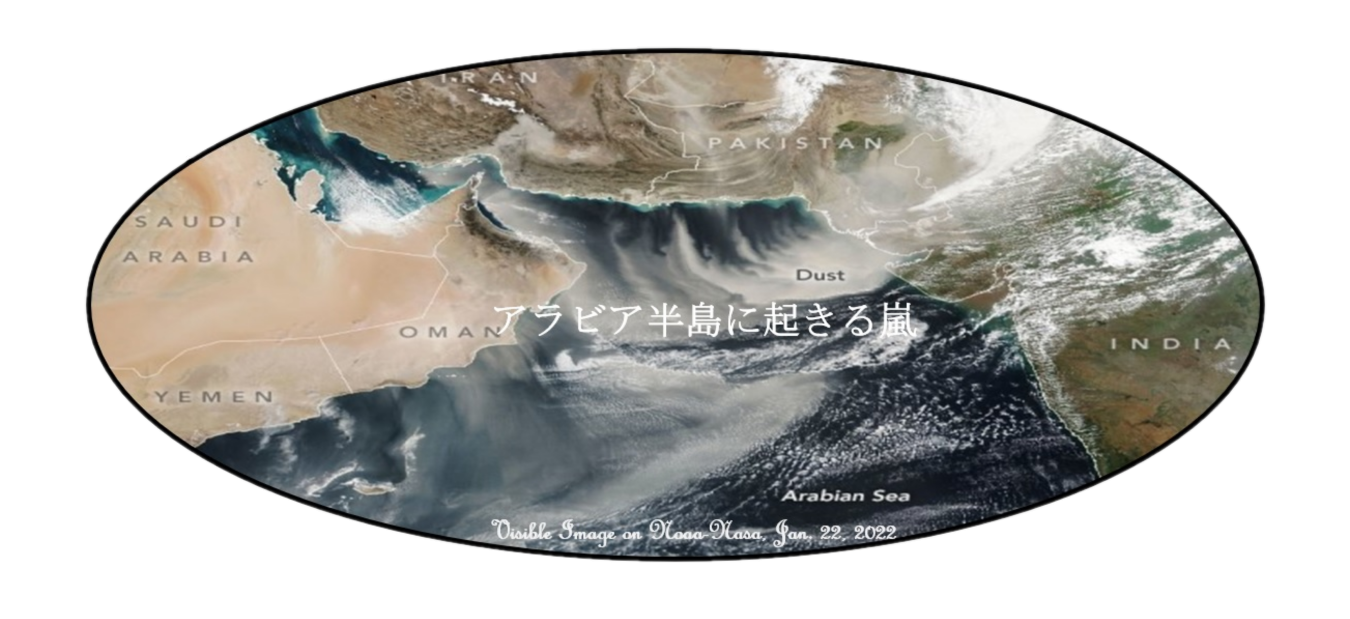
沙嵐は、アラビア半島を特徴づける最も重要な気象現象の1つです。この半島では、至る所で砂や砂塵を運ぶ沙嵐が頻繁に発生します。
沙嵐の駆動力は風です。この半島に吹く風は「2 アラビア半島に吹く風」で述べました様に季節風と地球規模の大気循環による偏西風と貿易風であり、さらに総観スケール駆動で移動する高気圧から低気圧にへ流れる風が加わります。少し複雑なのは、緯度的には貿易風圏にありながら、半島の北部は。地中海東部気候の影響を強く受けています。
沙嵐を駆動させる主力は、季節風で、冬に北東から吹くシャマール (شمال)と夏に南西から吹くモンスーンがあります。モンスーンは強風を伴う場合にはハーリフ (خارف)と呼ばれています。もう一つの季節風は晩春から初夏に渡って地中海東部気候の総観スケール駆動によって吹いてくる北西風です。やはりシャマールと呼ばれ、一般的にシャマールと言えば、この北西風を指している程、この半島ではこの季節の一般的な卓越風です。
南西からの夏の季節風は貿易風やザグロス山脈やハジャル山脈等の影響で半島主要部では北ヘと吹く南風(جنوبية)に向きが変えられ、沙嵐を起こすほど強く吹く場合は、カムシーン(خمسين)やシムーン(سموم)と呼ばれています。
これらの沙嵐(ダストイベント)を発生した総観スケール駆動現象は、高レベルの気圧の谷を伴う動きの速い寒冷前線に関連していました。寒冷前線の後ろで強風(15ms-1を超える速度)が発生し、大量の砂塵粒子が大気中に巻き込まれた。激しい砂塵を発生する強風につながった気象条件が特定されました。
1 Overview
Sand dust storm is one of the most important weather phenomena that characterizes the Arabian Peninsula. On this peninsula, there are frequent sand dust storms that carry sand and dust everywhere.
It is the wind that is the driving force of sand dust storm. As mentioned in “6.2 Winds blowing on the Arabian Peninsula”, the winds that blow on this peninsula are monsoons, westerlies due to global atmospheric circulation, and trade winds. In addition, there is also the wind that flows from the high pressure to the low pressure driven by Synoptic-scale climate.
It is a little more complication on the climate, that while this Peninsula is latitudinally located in the trade wind sphere, Its northern part is strongly influenced by the climate of the east Mediterranean.
The main force that drives sand dust storm is seasonal winds, with shamal (شمال) blowing from northeast in winter and monsoon blowing from southwest in summer. Monsoon is called a kharif (خارف) when accompanied by strong winds. The other seasonal wind is northwesterly wind, which blows from late spring to early summer due to Synoptic scale drive of east Mediterranean climate. It is also called shamal (شمال). This wind is prevailing wind commonly on the Peninsula, and it generally means shamal(شمال) as peoples’ understanding.
Monsoon is intercepted by trade wind and geographically influenced by the both Zagros and Hajar Mountains, and become south wind (junoviyah or janubia) (جنوبية). It blows northward in the main part of this Peninsula. If it blows hard enough to cause sand dust storm, it is called a khamsin (خمسين) or simoon (سموم).
The synoptic scale-driven phenomena, that generated sand dust storm (dust events), is associated with fast-moving cold fronts with trough of high levels of barometric pressure. Behind cold front, strong winds (speeds in excess of 15m/sec) are generated, and large amounts of dust particles are caught in atmosphere. It can be identified that this weather condition leads to strong wind generating severe dust.
2 沙嵐の呼び方
沙嵐の呼び名は、かならずも一定していません。地方いよってかなりの違いもあります。
2.1 シムーン (سموم)
温度が52~54℃を上回り、湿度が10%以下であるような砂塵を激しく巻き上げ、極端に乾燥した熱風を送り込む沙嵐は、シムームあるいはシムーン (سموم)と呼ばれています。この熱さでは汗をかいても体温の低下は望めず、突然に熱中症を引き起こさせるために「毒風」と言う意味から名づけられています。これには、「エジプトでペストが春に流行することが多く、シムーン季節がその最盛期となり、多く死者が出たので毒風と名付けられた。」との説もあります。
2.2 ハムシーン (خمسين)
エジプトでは地中海南部や北アフリカ沿岸部に沿って西から東へ低気圧が通過する際に膨大な量の砂塵を巻き上げて迫ってくる強い沙嵐であるシムーン (سموم)をハムシーン (خمسين)と呼んでいました。この砂嵐は、春に4月を中心に3~5月に発生します。エジプトではコプト正教の復活大祭が始まってから聖神降臨祭が終わるまでの49日後がこの沙嵐の発生と一致するので、「50日間隔」と信じられたこととか、春の50日間に渡ってエジプトで散発的に吹きすさぶとか、等の理由から「50日」即ちハムシーンと呼ばれていました。ナポレオンのエジプト遠征(1798 -1801)においてハムシーンが原因で苦戦を強いられ、また第二次大戦中(t1939-1945)の北アフリカ戦線でも枢軸国軍と連合国軍が共に悩まされたため、この名がよく知られ、普及するようになりました。
2.3 シャマール (شمال)
東風(رياحقرقية)、西風(رياحغربية)、北風(رياحقمالية)、南風(南風)(رياحجنوبية)の違いに関係なく、強風、 砂塵の嵐を引き起こすものは、シムーン(سموم)またはハムシーン(خمسين)と呼ばれていました。 アラビア半島では、夏は北西風と北風、冬は北東風と北風がすべてシャマールと呼ばれるため、風向きが細かく分かれていないようです。シャマールという名前はこの半島では非常に一般的であるため、北から来る砂塵嵐はシムーン(سموم)またはハムシーン(خمسين)ではなく、シャマール(خمسين)と呼ばれます。
2.4 ジュノービーヤ(جنوبية)
沙嵐を起こす強い風はシャマール (شمال)に次いで、南西から南東にかけた方向から吹くジュノービーヤ(南風) (جنوبية)が卓越しています。シャマールは一般的に北からの沙嵐を表す言葉とし普及し、シムーン (سموم)やハムシーン (خمسين)が、修飾語として使われることは殆どありません。「これに対してジュノービーヤは必ずしも沙嵐を表さないために南から吹く沙嵐に修飾語として付けられていたシムーン (سموم)やハムシーン (خمسين)が、南から来る沙嵐を表すようになってきた。」と筆者は解釈をしています。
2.5 カウス (قوس) とシャルキー (شرقية)
アラビア半島北東部やアラビア湾北部にはカウス (قوس)あるいは東を意味するシャルキー(شرقية)と呼ばれ、局地的な南東風による沙嵐があります。この南東風は、寒冷前線が近づくに連れて強度を増し、前線が通過してシャマールが始まる前に十分に強い風力に達します。強い南風のカウスは北や北西に向かって吹き、通常は12月から4月の間に発生します。さらに詳細は、「沙嵐の季節」をご参照ください。
2.6ハブーブ (هبوب)
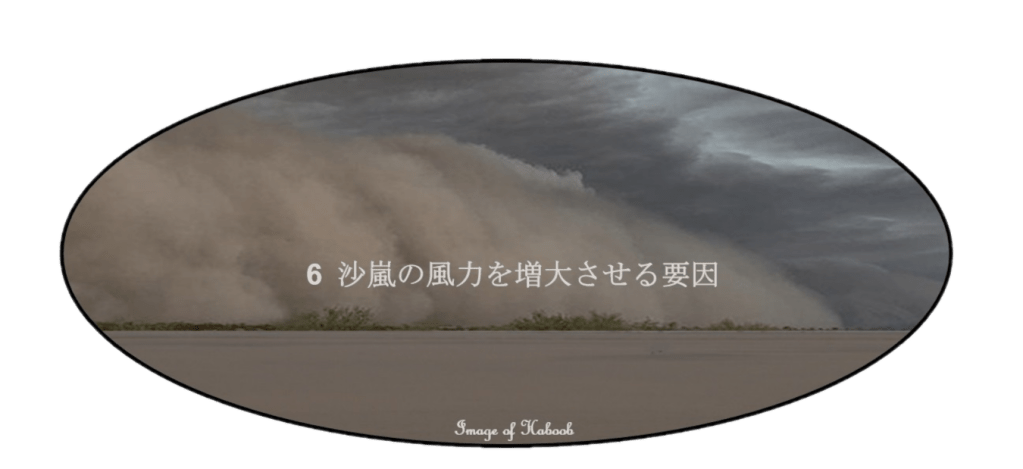
元々は、強い風を意味するアラビア語で北アフリカ、クウェート、イラクなどで使われていました。それがアメリカの沙嵐に使われるようになり、後述するダウンバーストに伴って発生する砂塵の壁のような状態を作り出す突風前線が表れる現象をハブーブ (هبوب)と呼ぶようになったと思われます。
2.7 ハーリフ (خارف)
モンスーンとは、ある地域で季節によって特に吹いてくる方角が卓越している風です。季節によって卓越風向が変化する風は、アラビア語で「季節」を意味するマウスィム (موسم)に由来するモンスーンと言う用語が使われてきました。アラビア半島のモンスーンとしてはシャマールがありますが、シャマールが改めてモンスーンと呼ばれることは余りありません。アラビア半島でモンスーンと呼ばれるのは、この半島の南岸沿いの南西から吹く季節風です。時として強風を伴い、ハーリフ (خارف)とも呼ばれます。
なお、「2 アラビア半島に吹く風」の「南東部キダン地方の風」では上記の名称が風の方向を指す為に使われていましたが、これはキダン地方での限定した使い方であるとご理解下さい。
2 Various names for the dust storm
Sand dust storm is not always called as the same name. It is called the considerable different name depending on the region.
2.1 Simoom (سموم)
Simoom (سموم) means such storm that violently winds up dust with the temperature exceeding 52 ~ 54 ° C and the humidity being 10% or less, and sends extremely dry hot air to the ground. Since body temperature cannot be decreased with this heat even with sweating, it is highly possible to causes a sudden heat stroke. Therefore, it is called Simoom which means “poisonous wind”.
There is another theory for this. Plague has become widespread in Egypt in spring. This stormy season has often coincided with the peak of the plague epidemic, causing many deaths. For that reason, this storm was named “poisonous wind”.
2.2 Khamsin (خمسين)
In Egypt, cyclones (low pressures) move from west to east along the southern Mediterranean and the North African coast. As a cyclone passes by, a strong sand dust storm winds up a huge amount of dust and approaches to Egypt. This dust storm is generally called simoom (سموم).
However, in Egypt it was called khamsin (خمسين). This sand dust storm occurs from March to May, mainly in April in the spring. In Egypt, 49 days between the start and end of Pentecost almost coincides with the occurrence of this sand dust storm. Therefore, it was believed that it would occur “every, 50 days”. It also sporadically blew and blows in Egypt over the 50 days of spring. For these reasons simoom was called “50 days” which is khamsin.
Napoléon Bonaparte’s expedition to Egypt (the Egyptian expedition, 1798 -1801) was forced to struggle due to khamsin. Also, on the North African Campaign during the World War II (1939-1945), both of the axis powers and Rome–Berlin axis were plagued by khamsin. For that reason, simoom is well known as khamsin that has become the name of sand dust storm.
2.3 Shamal (شمال)
Strong winds occur regardless of the difference between the east wind (رياح قرقية), the west wind (رياح غربية), the north wind (رياح شمالية) and the south wind (رياح جنوبية). The very strong winds that caused the sand dust storm were called simoom (سموم) or khamsin (خمسين). In the Arabian Peninsula, the northwest and north winds in summer and the northeast and north winds in winter are all called shamal (شمال), and the direction of the wind does not seem to be divided into small parts. The name shamal is so common on this peninsula that sand dust storms coming from the north are not called simoom (سموم) or khamsin (خمسين) , but are called shamal (شمال).
2.4 Junoviyah (South wind) (جنوبية)
Shamal (شمال) is the prevailing wind that causes a sand dust storm. After shamal, junoviyah (janubia) (south wind) (جنوبية), which blow from the direction between the southwest and southeast, is the second prevailing wind. Shamal is commonly used to describe sand dust storms from the north as well. Therefore, simoom (سموم) and khamsin (خمسين) are rarely used as names for sand dust storms from the north. On the other hand, junoviyah did not necessarily represent sand dust storm, but it was attached as a modifier to sand dust storm blowing from the south. For this reason, the author understands that over time, the simoom (سموم) and khamsin (خمسين) have become to represent sand dust storms coming from the south.
2.5 Kaus (قوس) and Sharqi (شرقية)
In the northeastern Arabian Peninsula and in the northern Arabian Gulf, there are sand dust storms caused by localized southeast winds. It is called kaus (قوس) or sharqi (شرقية) which means east. This south-easterly wind gradually increases in intensity as the cold front approaches. It is reaching a sufficiently strong wind force before the cold front passes through and Shamal begins to blow. Strong southerly winds blow northward or northwestward and usually occur between December and April. For more information, see “5 Storm seasons”.
2.6 Haboob (هبوب)
Originally, haboob (هبوب) was an Arabic word meaning strong wind. And it was used in North Africa, Kuwait, Iraq, etc. It came to be used for sand dust storms in USA. This can be the origin of that the phenomenon of gusty wind fronts that create a wall of dust that occurs with a downburst described later is called a haboob (هبوب).
2.7 Kharif (خارف)
Monsoon is the prevailing wind for each season in a region. The term monsoon is derived from the Arabic word mawsim (موسم). This word means “seasonal” and has been used as the word indicating the seasonal prevailing wind. Shamal is a most popular monsoon of the Arabian Peninsula, however the term monsoon has not been used for it instead of shamal. The so-called monsoon in the Arabian Peninsula is a seasonal wind that blows from the southwest along the southern coast of this peninsula. Sometimes it is accompanied by a strong wind. This strong wind is also called kharif (خارف).
In the ” Winds blowing in the Kidan area of the southeastern region ” in “2 Winds blowing on the Arabian Peninsula “, the above name was used to refer to the direction of the wind. However, please understand that they are the limited usages only in the Kidan region.
3 沙嵐を駆動させる風成作用
シャマール等の季節風が強い場合で、風速が毎秒10メートルを超えると、砂や砂塵の乾燥した表面に長期懸濁状態、短期懸濁状態、跳動およびクリープ(這う)の四つの作用が働き、砂や砂塵を移動させて沙嵐が発生します。
さらに風速が毎秒15~17.5メートルになると、砂塵を千メートルを超える高さまで舞い上げます。これが風成作用と呼ばれる作用です。風速がさらに毎秒15~17.5メートルを超えると砂塵が高度1,000メートルを超えて遠くまで飛んで行くようになります。大きな砂塵嵐では砂塵の舞い上がる高さは6,000メートルを超え、遠くインド洋や大西洋まで飛んでいきます。
3 Aeolian processes that drives the storm
When seasonal winds such as shamal are strong, and the wind speed exceeds 10 meters per second, four modes of aeolian transport commence to work as : Those are long-term and short-term suspensions (floating) in air, saltation, and creep. (Creep means that it makes for sand and dust to crawl forward on their own dry surface). Once, those transports work, the sand and dust are moved and soared in air to cause a sand dust storm.
Furthermore, when the wind speed is more than15 ~ 17.5 meters per second, dust is raised to soar a height exceeding 1,000 meters. This is called “aeolian transport”. If the wind speed exceeds 15~17.5 meters per second, the dust will fly far beyond the altitude of 1,000 meters. In large dust storms, the height of the dust rises exceeds 6,000 meters, and it flies as far away as the Indian Ocean and Atlantic Ocean.
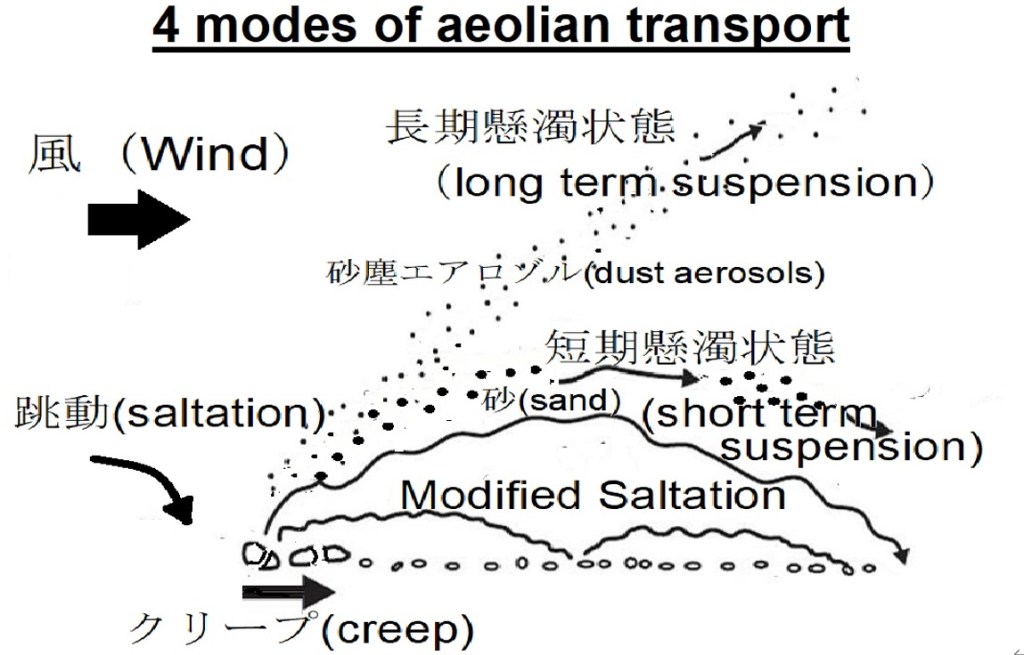
(第1部 大地の脈動を旅する6 砂丘地帯3 風成砂丘形成の「跳動と表面クリープ」を参照してください。)(懸濁状態となった砂塵の粒は、砂塵エアロゾルとも呼ばれます。)
緩く保持された砂の粒子を通過する砂塵の力が増加すると、砂や砂塵の粒子は最初に振動し始め、次に跳動して浮遊し始め、地面を横切って移動します。それらが繰り返し地面にぶつかると、砂や砂塵の小さな粒子を緩めて砕き、それらが再び跳動して浮遊状態で移動し始めます。風が最小の浮遊を引き起こす風速を超えると跳動とクリープに加えて浮遊する状態で移動する砂や砂塵の粒子がでてきます。また、砂や砂塵粒子の跳躍は摩擦によって静電界を誘発すので、跳動する砂や砂塵は地面に対して負の電荷を獲得します。それがさらに砂や砂塵の粒子を緩め、それらが跳動をさらに誘発します。この静電界の誘発は、静電気を考慮に入れずに予測された粒子の数を倍加させることがわかって来ています。
四つの作用が移動させられる砂・砂塵粒子の大きさは、長期懸濁液では直径20マイクロメートル以下、短期懸濁状態では直径20~70マイクロメートル以下、跳動のみでは直径70~500マイクロメートル以下、跳動とクリープでは直径500マイクロメートル以上となります。
Note: Please refer to 1.6.3 Formation of aeolian sand dunes (https://shvnjit.com/3-%e9%a2%a8%e6%88%90%e7%a0%82%e4%b8%98%e5%bd%a2%e6%88%90/).
Note: Particles of dust that have become suspended in air are also called dust aerosols.
When the force of dust passing through loosely held sand particles increases, sand or dust particles begin to vibrate and commence the above four modes of aeolian transports, then they move across the ground.
When they repeatedly hit the ground, they loosen and crush small particles of sand or dust, and let them also to begin the said four modes, as well. However, in order for sand and dust particles to move in aerial suspension in addition to saltation and creep, the wind must at least have sufficient speed to aerial suspension.
Also, since the leaping of sand and dust particles induces an electrostatic field by friction, jumping sand and dust acquire a negative charge against the ground. It further loosens the particles of sand and dust, which further induces a leap. This induction of an electrostatic field has been shown to double the predicted number of particles without taking static electricity into account.
The size of sand and dust particles, which are moved by four modes of aeolian transport, is 20 micrometers (20 μm) or less in diameter for a long-term suspension, 20-70 micrometers for a short-term suspension, 70-500 micrometers (70-500 μm) in diameter for saltation alone, and more than 500 in diameter for creep It is more than micrometer (500 μm).
4 沙嵐で運ばれる砂と砂塵
アラビア半島の沙嵐が運ぶ主要な砂や砂塵の源には、ティグリス川渓谷とユーフラテス川渓谷、イラクとクウェートに広がる沖積平野、アラビア湾沿いのジャーフーラ沙漠およびその後背地の石灰岩台地、ナフード沙漠を含むナジュド高原、ダフナー沙漠およびルブア・ハーリー沙漠(空白地帯)等が考えられます。
砂塵嵐で運ばれる砂塵粒子(直径50マイクロメートル未満)の源は、シリア東部、ヨルダン北部、イラク西部であり、アラビア楯状地の一部やアシール山脈の黄土堆積物を作り出しています。また、アラブ首長国連邦の沿岸地域と沙漠地域や紅海沿岸も含めて、遠くアラビア半島南部まで運ばれています。細かい砂塵はさらにインド洋や大西洋までも運ばれ、大洋の鉱物質養分の供給源にも成っています。
一方、砂嵐の場合、運ばれる砂は直径150~300マイクロメートル以上の大きな粒子です。この大きさの砂粒が懸濁状態で砂塵エアロゾルとなって移動することはありません。ほとんどの砂粒は跳動および表面クリープによって動きます。15メートル以上の高さまで吹き上げられ事は無く、沙嵐の風で懸濁状態になって運ばれることもありません。集落への侵入等の砂丘の移動が問題になる場合にの多くはこのような砂嵐に起因します。
この中間の直径50~150マイクロメートル上記の砂塵と砂粒の中間の粒子は短期懸濁状態と跳動で移動します。アラビア半島内で遭遇する沙嵐の多くが、この様な砂塵と砂の移動だと思っています。
4 Sand and dust carried by a storm
Major sources of sand and dust, carried by sand dust storm on the Arabian Peninsula, include the Tigris and Euphrates River Valleys, the alluvial plain across Iraq and Kuwait, the Jafurah Desert along the Arabian Gulf, the limestone plateaus of its hinterland. There are also the Najd Highland including the An Nafud Desert. In addition, there are the Ad Dahna and Rub’ al Khali Deserts (the Empty Quarters).
The sources of dust particles (less than 50 micrometers in diameter) carried by dust storms are in eastern Syria, northern Jordan and western Iraq, some parts of the Arabian shield and loess deposits in the Asir Mountains. It is also transported as far away as the southern Arabian Peninsula, including the coastal and desert regions of the United Arab Emirates and the coast of the Red Sea. Fine dust is also transported to the Indian and Atlantic Oceans, providing a source of mineral nutrients for the oceanic creatures.
On the other hand, in the case of sand storm, sand grains carried are large particles with a diameter of 150 ~ 300 micrometers or more. Sand grains of this size do not move as dust aerosols in the aerial suspended state. Most sand grains move by saltation and surface creep. They have never been blown up to a height of more than 15 meters, nor have been carried in aerial suspension by sand storm. Many cases. where the movement of the dunes becomes a trouble, such as sand invasion to villages, are due to such sand storms.
This intermediate particle of dust and sand grains between 50~150 micrometers in diameter moves in short-term aerial suspension and in saltation. The author understands that many of sand dust storms, encountered in the Arabian Peninsula, are such modes of aeolian transport.
5 沙嵐の季節
アラビア半島の沙嵐は年間を通じて発生しますが、半島の主要部では4月から5月までの春から初夏にかけての季節が沙嵐の頻度が最も多くなります。その次に沙嵐の多いのは7月から9月までの真夏から初秋にかけての季節です。しかしながら、沙嵐の時期に関しては、「1 脈動感に溢れる大地」の「2 アラビア半島に吹く風」で紹介しました様に地方によってずれがあり、統一した見解はありません。「この半島の南部の沙嵐は夏に頻発しますし、北部では主に春に発生します。」等、ここに挙げている季節は研究者それぞれの見解なので、必ずしも相互に一致していませんことをご理解してください。
この半島の中央部を軸に大きな部分を占めるサウジアラビアでは、4月と5月が沙嵐の頻度が最も多く、7月から9月までがそれに次ぎます。さらに10月が沙嵐の頻度の第3期間となります。北東部の場合は、夏の季節(6月から9月)と冬の季節(12月から3月)に分けられ、それぞれに春の移行期間と秋の移行期間が先行します。移行期間中の4月から6月上旬、さらに9月下旬から11月は、天候が不安定で、沙嵐が起きやすいと考えられています。南部のアデン湾やアラビア海の冬は東からの吹く風が多く、11月から4月までの間、北東から南西に向かう典型的な冬の風(冬のシャマール)が吹きます。
沙嵐を起こす季節風には「夏のシャマール (شمال)」、「冬のシャマール」、「夏の南西モンスーン」および「カウス」の四つがあります。「夏のシャマール」、「夏の南西モンスーン」と「冬のシャマール」とは、この半島でも知られた一般的な季節風ですが、「カウス(kaus)」は、半島北東部だけの独特な風です。
5.1 夏のシャマール
アラビア湾北部の夏は、総観スケールの現象でもあるモンスーン低気圧システムと地中海東部高気圧システムの影響を受けます。このモンスーン低気圧システムは、北西インドに中心を持ち、この湾の西部から南東部に広がっています。一方の地中海東部高気圧システムは、静止していて、この湾の西部に向かって南東に延びる気圧の尾根を持っています。この2つのシステムがぶつかって、この湾の北東部の上空に気圧の急な圧力勾配を作り出します。その圧力勾配が、夏のシャマールとして知られ、北風も含む北西風を生じさせます。シャマールは、毒を意味するシムーンと呼ばれる熱く乾燥し、砂塵交じりの沙嵐となって、数週間続くこともあります。この湾の北西にあるザグロス山脈を東から風が通過する際に、空気が断熱的に上昇と下降するで、シャマールの熱風が生じます。その風がチグリス川とユーフラテス川が作り出したメソポタミア氾濫原(95万平方キロ)を渡ってくる時に砂塵交じりとなります。この夏のシャマールは5月から6月によく発生します。
最近、シャマールに関しては、「南西アジアの亜熱帯低気圧と北アフリカの亜熱帯高気圧の間の東西の圧力勾配に起因して、アラビア半島を越えて半永久的に北風が吹いている。これがシャマールであり、年間を通じて沙嵐の主な気象要因である。その勢力は、圧力勾配が最も強い夏にピークがある。」との有力な説も出ています。
5.2 夏の南西モンスーン
アラビア半島でモンスーンと呼ばれるのは、アデン湾からアラビア海の沿岸に沿って、夏に吹く湿度の高い南西モンスーンです。時として強風を伴います。この強風は、ハーリフ (خارف)とも呼ばれ、ルブア・ハーリー沙漠まで広がり、ピラミッド型砂丘や各種線形砂丘の形成に寄与しています。
この南西モンスーンは、北東からの貿易風およびザグロス山脈やハジャル山脈等の影響で半島主要部では北ヘ押し上げられ、南から吹くジュノービーヤ(南風) (جنوبية)となります。その中の風が強くハーリフ (خارف)となったものが、ルブア・ハーリー沙漠を通過することで熱く乾燥した沙嵐となり、前述のシムーン (سموم)やハムシーン (خمسين)と呼ばれています。
このモンスーンのアラビア海に沿った流れは、湿気を陸上に運び、霧や露となって植物に生育に役立ちます。また、ハーリフ (خارف)が砂塵を伴ったシャマールと遭遇すると上昇気流を作り、積乱雲を生んで降雨をもたらすこともあります。この様な霧、露や雨等ハーリフの恩恵でもたらされる降水で育まれ、収穫される農作物はハーリフ作物と呼ばれます。
5.3 冬のシャマール
アラビア湾北部は、冬に東のほぼ定常的なシベリア高気圧システムに運ばれた冷たい空気に影響されます。この影響は、地中海東部で形成され、偏西風(寒帯前線ジェット気流)のため、南東に移動する前線システムに中断させられます。この前線システムは水分を帯びているので降雨をもたらします。この前線システムがアラビア湾へ移動すると、この後方の寒帯前線ジェット気流と前方の亜熱帯ジェット気流が合流して、前線システムを強めて湾北部を通過する辺りでは、風速が5倍にも発達し、湾中央では毎秒15~20メートルに達します。この風が冬のシャマールとして知られて、上空の気圧の谷の移動速度次第ですが、2~5日程度続きます。発生は11月から4月までの冬期間で、主に12月から2月の間です。
5.4 カウス
冬のシャマールは、寒冷前線通過後に発生し、南風が寒冷前線やシャマールに先行します。南風はイラク北部とシリアの冷たい空気の蓄積がチグリス・ユーフラテス渓谷を密度の流れとして押し寄せます。この南風は、ザグロス山脈による気流のチャネリングのために引き起こされます。北風がこの湾の軸を横切って吹いた時には主に局所的な地形からこの風が渦や渦の様な状態となり、南風を起こします。このため、南風のもっとも強い部分はこの湾の東側つまりイラン側に発生します。この南風がカウス (قوس)あるいはシャルキー (الشرقي)と呼ばれており、寒冷前線が近づくに連れて強度を増し、前線が通過してシャマールが始まる前に十分に強い風力に達します。強い南風のカウスは北や北西に向かって吹き、通常は12月から4月の間に発生します。
5 Storm seasons
Sand dust storm on the Arabian Peninsula occurs throughout the year. On the main part of this peninsula, sand dust storm occurs the most frequently from spring to early summer (from April to May). The next most stormy season is from midsummer to early autumn (from July to September). However, as for the timing of sand dust storm, there is a deviation depending on the region, as introduced in “1.6.2 Winds blowing on the Arabian Peninsula”. Moreover, there are slightly different expressions among researchers. “sand dust storms occur frequently in summer on the southern Arabian Peninsula”, “they occur mainly in spring on the northern Arabian Peninsula.” and so on. (https://shvnjit.com/2-%e3%82%a2%e3%83%a9%e3%83%93%e3%82%a2%e5%8d%8a%e5%b3%b6%e3%81%ab%e5%90%b9%e3%81%8f%e9%a2%a8/)
Saudi Arabia, which occupies a large part of the central Arabian Peninsula, has the highest frequency of sand dust storm in April and May, then followed by July and September. In addition, October is the third frequency period of sand dust storm. In the case of the northeastern Arabian Peninsula, it is divided into the summer season (June to September) and the winter season (December to March), preceding for each with a spring transition period or fall transition period. During the transition period (from April to early June, or from late September to November), the weather is unstable and it is thought that dust sand storms are likely to occur. Winters in the northern coasts of the Gulf of Aden and Arabian Sea (the southern Arabian Peninsula) are dominated by winds blowing from the east in winter. Particularly from November to April, there is a typical winter wind (Shamal in winter) from northeast to southwest.
Seasonal winds that cause sand dust storms, on this Peninsula, include “shamal in summer (شمال)”, “shamal in winter”, “southwest monsoon in summer” and “Kaus”. Although those shamals and this monsoon are common seasonal winds well known on this peninsula, “kaus” is a unique wind. “Kaus “occurs only on the northeastern Arabian Peninsula.
5.1 Shamal in summer
Summer in the northern Arabian Gulf is affected by the monsoon cyclone system centered in northwest India and the anticyclone system in the eastern Mediterranean. Those systems are the meteorological phenomenon of the synoptic scale. This monsoon cyclone system extends from the western to southeast Arabian Gulf. On the other hand, this anticyclone system is stationary with a pressure ridge extending from the southeastern to western Arabian Gulf. The two systems collide to create a steep pressure gradient of air pressure over the northeastern Arabian Gulf. Its pressure gradient, gives rise to northwesterly winds including northerly winds, known as shamal in summer. Shamal can last for weeks with a hot, dry and dusty sand dust storm called simoon. Simoon means poison. As the wind blows from the east and passes through the Zagros Mountains of the northwestern Arabian Gulf, its air adiabatically rises and falls, resulting in the hot air of shamal. The winds mingle with dusts as they cross over the Mesopotamian floodplain (950,000 square kilometers) created by the Tigris and Euphrates rivers. Shamal in summer often occurs from May to June.
Recently, the following influential theory is being developed for shamal; Due to the east-west pressure gradient between the subtropical cyclone in the southwestern Asia and the subtropical anticyclone in the northern Africa, the northerly wind blows semi-permanently across the Arabian Peninsula. This is shamal and is the main weather factor of sand dust storms throughout the year. Its intensity peaks in the summer when the pressure gradient is the strongest.
5.2 Southwest monsoon in summer
The so-called monsoon on the Arabian Peninsula is the humid southwestern monsoon, which blows along the Arabian Sea Coast from the Gulf of Aden in summer. Sometimes it is accompanied by a strong wind. This strong wind, also known as kharif (خارف), extends into the Rub’ al Khali Desert and contributes to the formation of pyramidal dunes and various linear dunes.
This southwestern monsoon is pushed up to northward by the trade wind blowing from the northeast Peninsula. This turn is also topographically affected by the Zagros and Hajar Mountains. Then, it becomes a junobiyah (south wind) (جنوبية) blowing to the north from the south. Among those winds, a strong kharif (خارف) passes through the Rub’ al Khali Desert and became a hot and dry sand dust storm, and is called as the aforementioned simoom (سموم) or khamsin (خمسين).
This monsoon, blowing along the Arabian Sea Coast, carries moisture ashore, and forms fog and dew to help plants grow. Also, when a kharif (خارف) encounters a dusty shamal, it becomes an updraft, which can create cumulonimbus clouds and bring rainfall. With that ways, kharif (خارف) brings precipitation such as fog, dew and rain. It gives the benefits to grow crops, which is called as kharif crops.
5.3 Shamal in winter
The northern Arabian Gulf in winter is affected by the cold air mass carried by the Siberia anticyclone system almost stationarily locating in the east of the Mediterranean Sea. This cold air mass is formed in the eastern Mediterranean and its formation is interrupted by the front system moving southeast due to westerlies (polar front jet stream). This frontal system is moist and causes rainfall. When this front system moves to the Arabian Gulf, the polar front jet stream behind it and the subtropical jet stream ahead merge to strengthen the front system. As the result, the wind speed develops five times as much as it passes through the northern Arabian Gulf, and reaches 15 to 20 meters per second in the central Arabian Gulf. This wind is known as Shamal in winter and lasts for about 2-5 days, depending on the speed of movement of the trough above the sky. This outbreak is in the winter period from November to April, mainly between December and February.
5.4 Kaus
Winter shamal occurs after a cold front has passed, and a southerly wind called kaus precedes the cold front and shamal. This southerly wind is a dense stream of cold air mass in northern Iraq and Syria through the Tigris and Euphrates Valley. This southerly wind is caused by the channeling of air currents by the Zagros Mountains. When a north wind blows across the axis of the Arabian Gulf, it becomes a vortex or vortex-like state, mainly due to local terrain, causing a southerly wind. For this reason, the strongest part of this southerly wind occurs on the eastern Arabian Gulf, that is, on the Iranian side. This southerly wind, called kaus (قوس) or sharqi (الشرقي). It increases in intensity as a cold front approach. This wind force is strong enough before the front passes and shamal begins. Strong southerly winds of kaus blow towards the north or northwest and usually occur between December and April.
 Desert peninsula