Ancient Arabian Alphabet


目次 (Index)
Nomenclature for languages and scripts
Linguistic Map of Pre-Islamic Arabia
Aramaic Language and Aramaic Alphabet
Origin of the Aramaic Language
The lingua franca of the entire Fertile Crescent
Development of Aramaic alphabet
To the lingua franca of the entire Orient
Establishment of Imperial Aramaic
はじめに
アラビア半島には様々な古代アラビア文字(Old Arabian Alphabet)で書かれた碑文が多くの場所で見つかっています。その大部分は、岩壁画(Petroglyph)と共に、古代の文明遺跡や交易路に沿って残されています。
この様な古代アラビア文字(Old Arabian Alphabet)は、南セム文字(South Semitic Script)と北西セム文字(North-West Semitic Script)に分類することができます。
南セム文字(South Semitic Script)は、南アラビア文字(South Arabia Alphabet) ムスナド(musnad)と古代北アラビア文字(Ancient North Arabian Script)に分かれれます。この章では主に、この南セム文字(South Semitic Script)について述べて行きます。
古代北アラビア文字(Ancient North Arabian Script)は、古代北アラビア諸文字(Ancient North Arabian)と呼ぶべきで、タイマー文字(Taymanitic Script)、ドゥーマ文字(Dumaitic Script)、ディーダーン文字(Dadanitic Script)、ヒスマー文字(Hismaic Script)、さらにサムード文字(Thamudic Script) B、C、D、ヒマー文字他)が含まれます。サムード文字(Thamudic Script)というのは誤った名称ですが、未整理の文字種についての仮称として長年使われて来ています。サムード文字E(Thamudic E Script)がヒスマー文字(Hismaic Script)に変わったように、研究が進んで特定できる段階になると適切な名前がつけられます。
一方北西セム文字(North-West Semitic Scriptは、アラビア半島のみならず、レヴァント(Levant)でも使用されている文字のグループです。北西セム文字(North-West Semitic Script)は、前6世紀に北西アラビアにもたらされました。具体的には、新バビロニア、アケメネス朝統治下での国際共通語・文字であったアラム語(Aramaic)の)とアラム文字(Aramaic Alphabet)です。これが、変化してのちにナバテア文字(Nabataean Scrip)となり、さらに4世紀ごろにそこからアラビア文字(Arabic Alphabet)が生まれました。
なお、「古代アラビア文字(Old Arabian Alphabet)」という表現を、この章では」古代アラビアで使用されていた複数のアルファベットを総称する意味で、便宜的に使っています。
アラビア語の転写(transcription)に関しては、このサイトでの統一性を考慮して、アラビア文字表記を加えた上で、各ページのヘッダー部分に掲載している「アラビア語の転写(Arabic Transcription)」を適用しています。
表現としては、参考資料よりは多少、断定的になっています。また、ハサー文字(Hasaitic Script)に関しては、筆者の感想を加味して記述しました。
Introduction
A lot of inscriptions written in various ancient Arabian alphabets have been found in many places on the Arabian Peninsula. Most of them, together with petroglyphs (rock arts), are preserved around the ancient ruins also rocky places along the old caravan routes.
Such Old Arabian alphabets can be classified into South Semitic Script and Northwest Semitic Script.
South Semitic Script can further be classified into South Arabia Alphabet (musnad) and Ancient North Arabian Script. This chapter mainly describes this South Semitic Script.
Ancient North Arabian Script means various Ancient North Arabian Scripts such as;
Taymanitic Script, Dumaitic Script, Dadanitic Script, Hismaic Script and Thamudic B, C, D as well as Hismaic Scrip.
Thamudic Script is a misnomer, but it has been used for many years as a tentative name for unsorted character types. Today, when the research of a certain script has progressed and can be identified its name, it is given such name. For example, the former Thamudic E Script is now called as Hismaic Script.
On the other hand, the Northwest Semitic Script has been a group of scripts used not only in the Arabian Peninsula but also in the Levant. The Northwest Semitic Script was introduced to the Northwest Arabia in the 6th century BC. Specifically, Aramaic and Aramaic Alphabet, which were the international lingua franca and script under the Neo-Babylonian and Achaemenid rules. This Aramaic Alphabet had been changed to Nabataean Scrip, and from Nabataean Scrip Arabic Alphabet was born until around the 4th century.
In this chapter, the expression “Old Arabian Alphabet” is used to collectively refer to the plurality of alphabets used in ancient Arabia.
Regarding Arabic Transcription, the writer would like to apply the method posted in the header of each page of this site, so it might differ from the original text in sometimes.
There are some ambiguous expressions in the original reference, but in such cases, this site expresses them somewhat categorically.
In addition, the writer add the writer’s own impressions on the Hasaitic-inscription.
用語 (Terminology)
言語とスクリプトの用語 (Terminology for languages and scripts)

A. 北アラビア語
A. North Arabian
A-I. 古代北アラビア語
イスラーム以前の h- (hn-) および明らかに「ゼロ」方言
i) オアシス北アラビア語
i-a) タイマー語
以前は、サムード語A (Thamudic A)あるいはタイマー語(Taymanite)と呼ばれていました。
i-b ディーダーン語
以前はディーダーン語 (Dedanite)やリヒヤーン(Lihyanite)語と呼ばれていました。
i-c) ドゥーマ語
以前はジョウフ語(Jawfian)と呼ばれていました。
i-d) 分散したオアシス北アラビア語
メソポタミア(Mesopotamia) (以前は「カルデア(Chaldaean)」と呼ばれていた) およびその他の場所から発見されている オアシス北アラビア語(ONA)文字の文章で、タイマー語(Taymanitic)、ディーダーン語(Dadanitic)、またはドゥーマ語(Dumaitic)として分類できないもの。
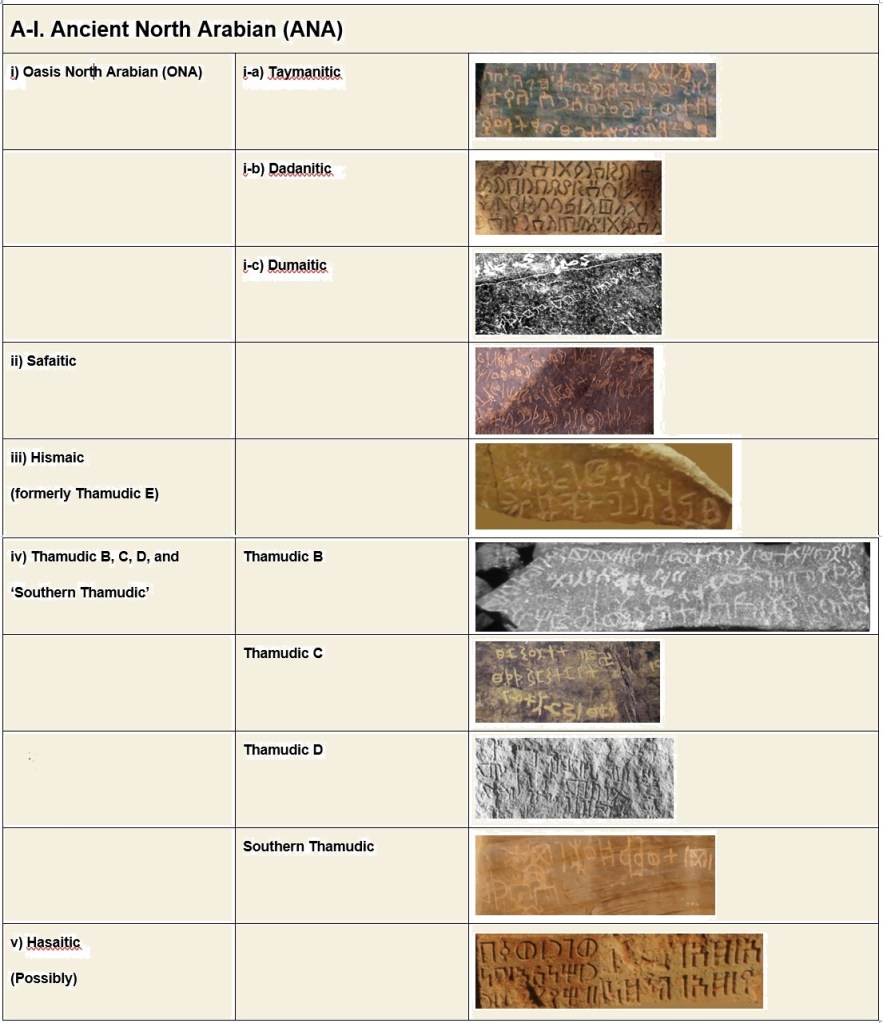
A-I. Ancient North Arabian (ANA)
pre-Islamic h- (hn-) and apparently ‘zero’ dialects
i) Oasis North Arabian (ONA)
i-a) Taymanitic
Formerly ‘Thamudic A’/’Taymanite.
i-b) Dadanitic
Formerly ‘Dedanite’ and ‘Lihyanite’.
i-c) Dumaitic
Formerly J’awfian’.
i-d) Dispersed Oasis North Arabian (ONA)
Texts in the ONA scripts from Mesopotamia (formerly called ‘Chaldaean’) and other places, which cannot be classified as Taymanitic, Dadanitic or Dumaitic.
ii) サファー語
iii) ヒスマー語
以前は、サムード語E (Thamudic E)や間違って、タブーク・サムード語(Tabuki Thamudic)又は南サファー語(South Safaitic)と呼ばれていました。
iV) サムード語B, C, Dおよび南サムード語
v) ハサー語
ii) Safaitic
iii) Hismaic
Formerly ‘Thamudic E’; also erroneously called ‘Tabuki Thamudic’ or ‘South Safaitic’.
iv) Thamudic B, C, D, ‘Southern Thamudic
v) Hasaitic
A-II. アラビア語
i) 古いアラビア語
i-a) 純粋の古いアラビア語の文章
全体が古いアラビア語(Old Arabic)ですが、シバ語(Sabaic)、ナバテア語(Nabataean)、初期のアラビア語(early Arabic)またはギリシャ語(Greek)の文字を使って書かれています。
A-II. Arabic
i) Old Arabic (pre-Islamic dialects)
i-a) Pure Old Arabic texts
Wholly in Old Arabic but written in the Sabaic, Nabataean, early Arabic or Greek scripts.
i-b) サファー語とアラビア語の混ざった文章
シバ・アラビア語(Sabaeo-Arabic)、ディーダーン・アラビア語(Dadano-Arabic,)、 ナバテア・アラビア語(Nabataeo-Arabic)、 アラム・アラビア語(Aramaeo-Arabic ):文章は、サファー語(Safaitic)、(シバ語(Sabaic))、 ディーダーン語(Dadanitic), ナバテア語(Nabataean)又は、その他のアラム語(other Aramaic)の言葉や文字を使って書かれていますが、古いアラビア語の特徴を持っています。
i-b) Mixed texts: Safaeo-Arabic
Sabaeo-Arabic, Dadano-Arabic, Nabataeo-Arabic, Aramaeo-Arabic: texts written in the Safaitic, Sabaic, Dadanitic, Nabataean, or other Aramaic languages and scripts but with Old Arabic features.
ii) 中期アラビア語
iii) 古典アラビア語
iv) 現代標準アラビア語
v) 会話用アラビア語の方言
ii) Middle Arabic
iii) Classical Arabic
iv) Modern Standard Arabic
v) Spoken Arabic Dialects
A-III 付録:未分化の北アラビア
(1) 純粋に区別されていない北アラビア語のテキスト (どの文字でもかまいませんが、古いアラビア語や特定の ANA 方言に割り当てることが出来なくとも、明らかに北アラビア語の言語ですあること。)
(2) 未分化の北アラビア語の混合のテキスト シバ・北アラビア語Sabaeo-North-Arabian (以前のシバ語(Sabaic)を使った疑似シバ語(pseudo-sabéen の言語と文字で書かれた文章ですが、古アラビア語または特定の古代北アラビア語 (ANA) に割り当てることができない北アラビア語の特徴を含みます。)
A-III Appendix: Undifferentiated North Arabian
(1) Pure Undifferentiated North Arabian’ texts (can be in any script, but are clearly North Arabian in language although they cannot be assigned either to Old Arabic or to a particular ANA dialect)
(2) Undifferentiated North Arabian Mixed’ texts Eg. Sabaeo-North-Arabian (formerly ‘pseudo-sabéen’: texts written in the Sabaic (etc.) languages and scripts but including North Arabian features which cannot be assigned either to Old Arabic or to a particular Ancient North Arabian (ANA)).
B. 南アラビア語
B. South Arabian
B-I. 古代南アラビア語
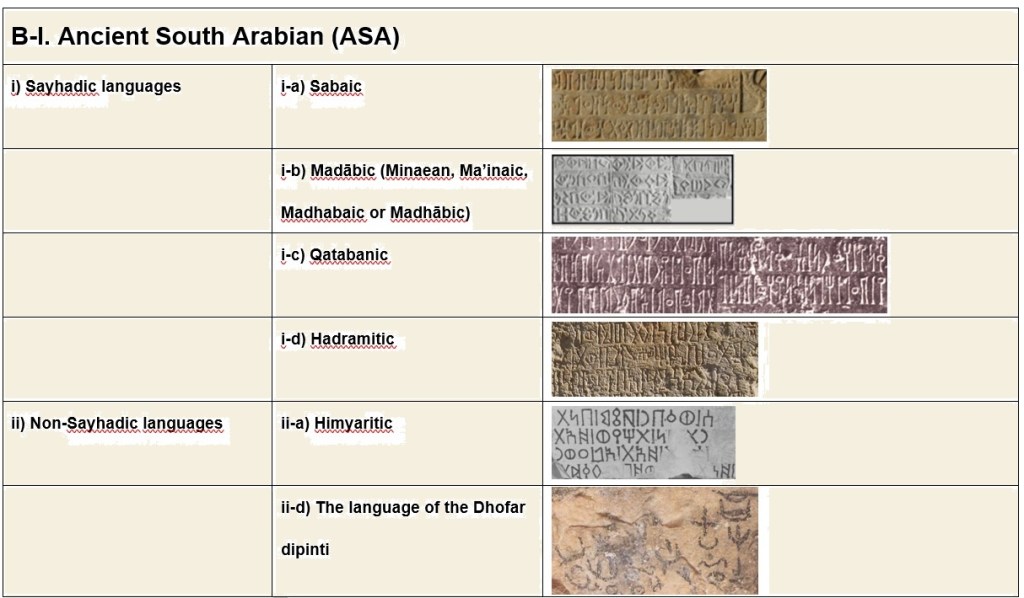
B-I. Ancient South Arabian (ASA)
i) サイハド語
i-a) シバ語
i-b) マザーブ語
以前は,マイーン語(Minaean / Ma’inaic)と呼ばれていました。イエメン(Yemen)のジャウフ(Jawf)地方の涸れ谷マダーブ(Wadı Madab)地域でマイーン族(Minaeans)が先住者から受け継ぎ、使用していたと思われる書き言葉です。
i-c) カタバーン語
i-d) ハドラマウト語
ii) Sayhadic
i-a) Sabaic
i-b) Madhabic
Madhabic was formerly called ‘Minaean’/‘Ma’inaic’. The written language used by the Minaeans and apparently inherited from their predecessors in the region of Wadı Madab, in the Yemeni Jawf).
i-c) Qatabanic
i-d) Hadramitic
ii) 非サイハド語
ii-a) ヒムヤル語
少数の可能な例が残っているヒムヤル族(Himyarites)の母語。
ii-b) その他の非サイハド語文
ii-c) 土着のマイーン語
これは、マイーン族(Minaeans)が話した言語について現れる可能性のある証拠に限定されるべきです。
ii-d) ドファール(Dhofar)考古学碑文(dipinti)の言語
現在は、未だ解読されていません。
ii) Other non-Sayhadic texts
ii-a) Himyaritic
Himyaritic is the native language of the Himyarites, of which a handful of possible examples remain.
ii-b) Other non-Sayhadic texts
ii-c) Native Ma’inaic
This should be restricted to any evidence that may appear for the language the Minaeans spoke.
ii-d) The language of the Dhofar dipinti
at present undeciphered
B-II 現代の南アラビア語 (Modern South Arabian (MSA))
バトハリー語
ハラスーシー語
フービユート語
シェフリー語
マフリー語
スクトリー語
البطحرية
الحرسوسية
هوبيوت
الشحرية
المهرية
السقطرية
Bathari
Harsusi
Hobyot
Shehr
Mehri
Scotri
言語
Languages
アラビア半島の古代言語と現代言語(the ancient and modern languages)は、北アラビア(North Arabian)と南アラビア(South Arabian)の 2 つのまったく異なる言語グループに分類されます。他のほとんどのセム語(Semitic languages)とは異なるいくつかの特徴を共有していますが、それらを互いに区別する多くの特徴があり、それらの関係は特に密接ではないことが現在認識されています。
The ancient and modern languages of the Arabian Peninsula fall into two distinct language groups: North Arabian and South Arabian. Although they share some characteristics that distinguish them from most other Semitic languages, it is now recognized that there are many characteristics that distinguish them from each other and that they are not particularly closely related.
イスラーム以前のアラビアの言語地図に反映させるための言語一覧表
List of Languages for Reflections on the linguistic map of pre-Islamic Arabia
A. 北アラビア語
A. North Arabian
現在一般的に使用されているこの用語は、以下をカバーする思慮深く、中立的なラベルです。
The term at present in general use is a sensible neutral label covering.
A-I. 古代北アラビア語
イスラーム以前の h- (hn-) と明らかに言語学上の ‘zero’ の方言を含む:
A-I. Ancient North Arabian (ANA)
It comprises the pre-Islamic h- (hn-) and apparently ‘zero’ dialects:
i) オアシス北アラビア語
i-a) タイマー語
i-b) ディーダーン語
i-c) ドゥーマ語
i-d) 分散したオアシス北アラビア語
ii) サファー語
iii) ヒスマー語
iv) サムード語B、C、Dおよび南サムード語
現在のところ、このグループの言語的特徴についてはほとんどわかっていないため、さらに細分化することはできません。
v) 恐らくはハサー語
i) Oasis North Arabian (ONA)
i-a) Taymanitic
i-b) Dadanitic
i-c) Dumaitic
i-d) Dispersed Oasis North Arabian (ONA)
ii) Safaitic
iii) Hismaic
iv) Thamudic B, C, D, and ‘Southern Thamudic’
Currently, little is known about the linguistic features of this group, so further subdivision is not possible.
v) Possibly Hasaitic
A-II. アラビア語
あらゆる形態のアラビア語とその発展のあらゆる段階。これらの段階の最も初期のものは、次の通りです:
i) 古いアラビア語
「古英語」、「古フランス語」などがこれらの言語の現存する初期の段階を指すのと同様に、古アラビア語はイスラーム以前の ɔl-方言を指し、その痕跡が少数のテキストや名前に残っています。
A-II. Arabic
All forms of Arabic and all stages of its development. The earliest of these stages are as follows:
i) Old Arabic (vieil arabe)
Just as “Old English”, “Old French”, etc. refer to the extant early stages of these languages, Old Arabic refers to the pre-Islamic ɔl-dialects, traces of which remain in a few texts and names.
イスラーム時代には、主に次のようなアラビア語の他の種類の証拠があります:
There is evidence of other types of Arabic in Islamic period, mainly:
ii. 中期アラビア語
iii. 古典アラビア語
iv. 現代標準アラビア語
v. アラビア語会話の方言
ii. Middle Arabic
iii. Classical Arabic
iv. Modern Standard
v. Spoken Arabic Dialects
A-III. 北アラビア語グループへの付録
部分的に北アラビア語ですが、両方に共通する機能のみを含むため、古いアラビア語(Old Arabic)または古代北アラビア語(ANA) として分類することはできません。より正確に分類できるようになるまで、これらには「未分化北アラビア人‘Undifferentiated’ North Arabian’」のラベルを付けてあります。
A-III Appendix to the North Arabian group
Although there are not few texts which are entirely or partly in a North Arabian language, it cannot be classified as Old Arabic nor Old North Arabic (ANA), as it contains only features common to both. Until they can de classified more precisely, they have been labeled as ‘Undifferentiated’ North Arabian’.
B. 南アラビア語
現代のイエメンとオマーンがカバーする地域の古代および現代の非アラビア語、セム語の両方を示す、明確で中立的な地理的用語。この全体的なグループ化の中で、2 つのサブグループを区別できます。
B. South Arabian
A clear, neutral geographic term referring to both ancient and modern non-Arabic and Semitic languages of the area covered by modern Yemen and Oman. Within this overall grouping, two subgroups can be distinguished.
B-I. 古代南アラビア語
「碑文南アラビア語(Epigraphic South Arabian)」は、書かれている資料によってのみ、言語グループを説明しています。また、「古い南アラビア語(Old South Arabian) 」は、現代南アラビア語(Modern South Arabian) の直接の祖先であることを (誤って) 暗示しています。このため、「古代南アラビア語(Ancient South Arabian)」と云う表現は、「碑文南アラビア語(Epigraphic South Arabian)」又は「古い南アラビア語(Old South Arabian) 」よりは、安全な用語だと思われます。この集合的なラベルは、2 つの細分類をカバーしています。
B-I. Ancient South Arabian (ASA)
“Epigraphic South Arabian” describes the language group only by the written material. Also, “Old South Arabian” is (wrongly) implied to be a direct ancestor of Modern South Arabian. For this reason, the expression “Ancient South Arabian” is probably a more safer term than “Epigraphic South Arabian” or “Old South Arabian”. This collective label covers two subdivisions.
i) サイハド語
サイハド語とは、すなわち伝統的に「碑文南アラビア語(Epigraphic South Arabian)」や「古い南アラビア語(Old South Arabian)などと呼ばれるものです。
i) Sayhadic language
Sayhadic languages are those traditionally called ‘Epigraphic South Arabian’, ‘Old South Arabian’’, etc.
i-a) シバ語
i-b) マザーブ語
マザーブ語またはマイーン語
i-c) カタバーン語
i-d) ハドラマウト語
ii) 非サイハド語
非サイハド語すなわち南アラビアの他の古い言語であり、これまでのところ、めったに垣間見ることができません。これらの中には、碑文にシバ語(Sabaic)を使用したヒムヤル(Himyarites)の話し言葉があります。現在、これはイスラーム時代の作家による報告からのみ知られていますが、おそらくカニヤ(Qāniya) (Qaniya)の太陽の女神への賛美歌(hymn)の言語です。現時点では理解できない他の 2 つのテキストの言語もこの見出しに該当するようであり、もし、例が見付かっていれば、おそらく「固有のマイーン語(Ma’inaic)」、つまりマイーン人(Minaeans)が話した言語 (彼らが書いたマザーブ語(Madhabic)とは対照的に) も同様です。ドファール(Dhofar)で最近発見された考古学碑文(dipinti)も含まれている可能性がありますが、まだ解読されていません。
i-a) Sabaic
i-b) Madābic
Minaean language also Ma’inaic, Madhabaic or Madhābic
i-c) Qatabanic
i-d) Hadramitic
ii) Non-Sayhadic languages
A non-Sayhadic or other ancient language of South Arabia, so far rarely glimpsed. Among these are the spoken Himyarites, which use Sabaic in their inscriptions. At present, this is known only from reports by authors of Islamic times, but it is probably the language of Qāniya (Qaniya), a hymn to the sun goddess. Two other currently incomprehensible textual languages also seem to fit under this heading, and, if examples can be found, they are probably the indigenous Ma’inaic i.e. the Minaeans. So did the language they spoke (as opposed to the Madhabic they wrote). It may also contain a recently discovered archaeological inscription (dipinti) at Dhofar, but has not yet been deciphered.
B-II. 現代南アラビア語
現代南アラビア(MSA)は、次の言語の様に、今日、または最近までオマーン、イエメン南東部、ソコトラで話されていた、非アラビア語のセム語で書かれていない言語の総称です;
i) バトハリー語
ii) ハラスーシー語
iii) フービユート語
iv) シェフリー語
V) マフリー語
Vi) スクトリー語
B-II. Modern South Arabian (MSA)
Modern South Arabia (MSA) is a collective term for non-Arabic, non-Semitic languages spoken today or until recently in Oman, Southeast Yemen, and Socotra, such as;
i) Bathari
ii) Harsusi
III) Hobyot
Iv) Shehri
V) Mehri
VI) Scotri)
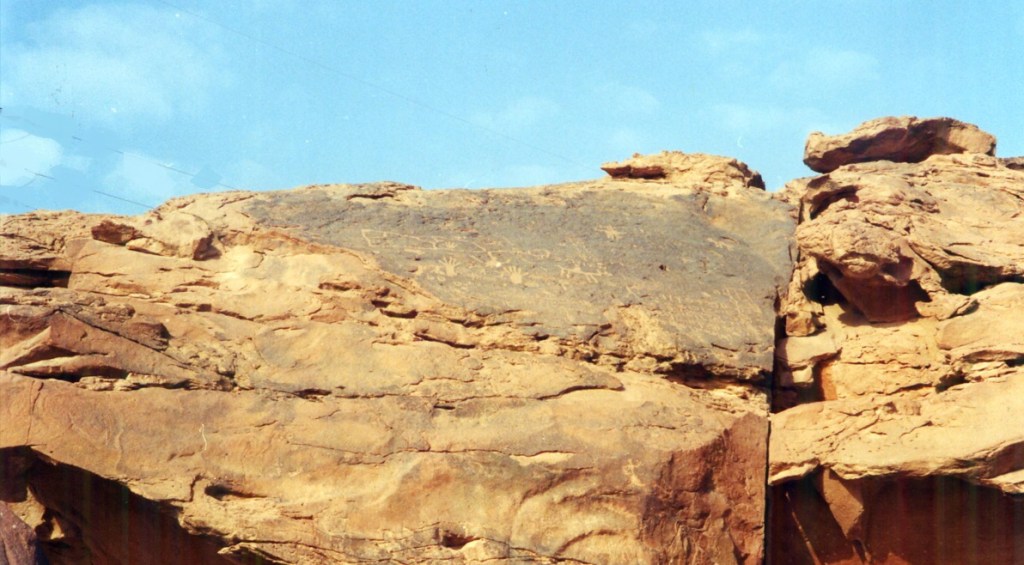
 Desert peninsula