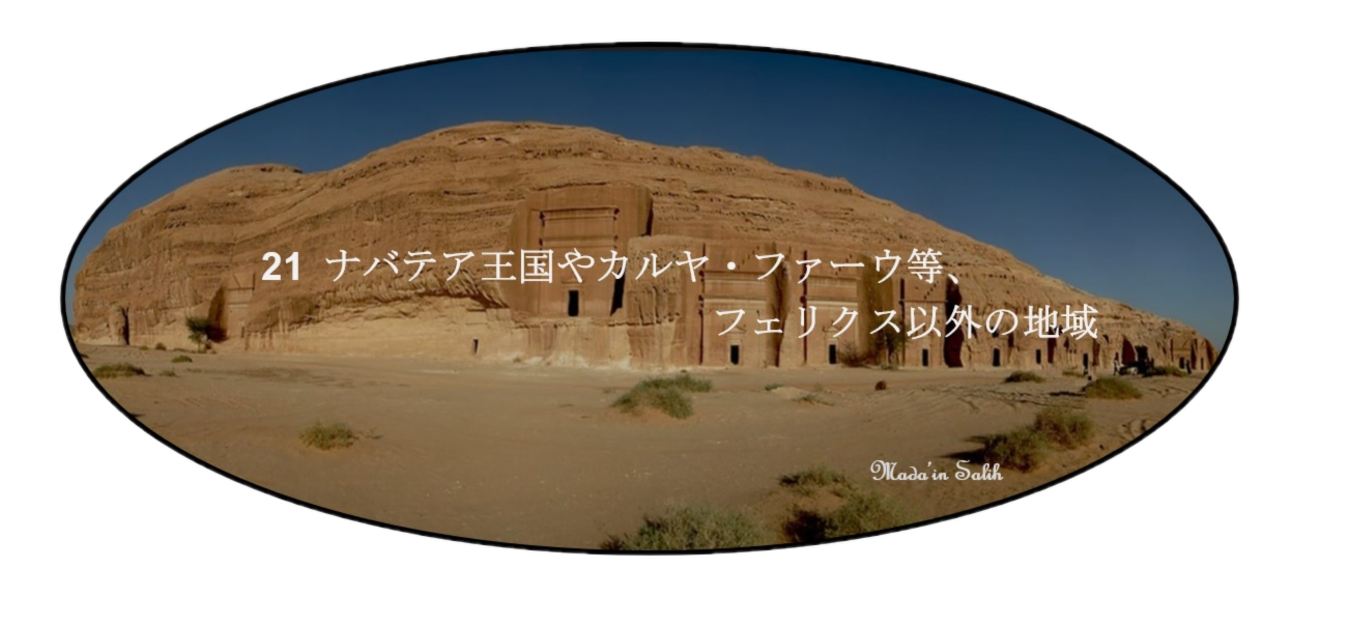
Regions other than Felix, such as Kingdom of Nabataea and Qaryat al Faw


目次(Index)
はじめに
Introduction
アラビア半島でアラビア・フェリクスとほぼ同じ時代に在った国には、ナバテア、ジャルハー、サージ、パルミラ、カルヤ・ファーウ等があり、何れも隊商交易で繁栄していました。
The countries on the Arabian Peninsula that existed at about the same time as Arabian Felix included Nabataea, Gerrha (جرهاء), Thaj (ثاج), Palmyra (Tadmor)、and Qaryat al Faw, all of which prospered from the caravan trade.
ナバテア王国
Kingdom of Nabataea
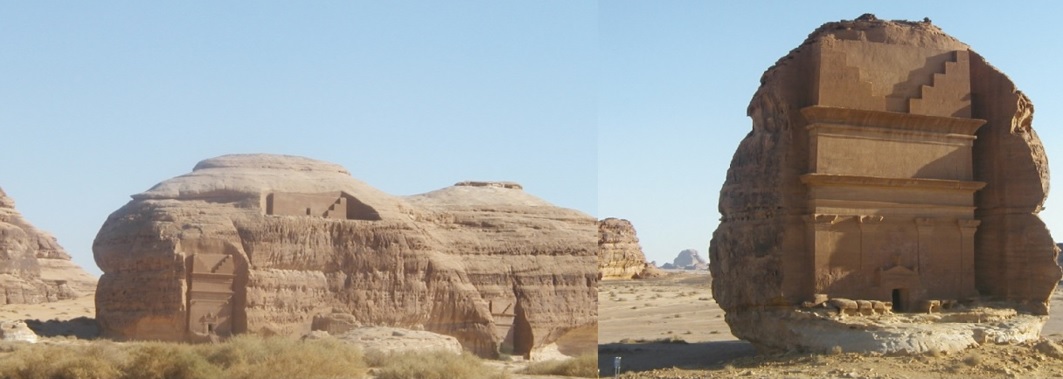
ナバテア王国が栄えたのは紀元前2世紀から紀元2世紀ですが、その祖先についてはナジュド、アラビア湾北岸、ヒジャーズ又はエドム(死海の南)から来た等の諸説があり、出所がはっきりしていません。いずれにしても、ナバテア人の祖先は、アラム語方言であるナバテア語を話し、遊牧生活を送り、羊の放牧、盗賊稼業や交易等を生業にしていました。紀元前4~2世紀前後の間に膨れ上った人口を遊牧生活では支えられずに定住生活に移行しました。死海とアカバ湾の間にあるアラバ渓谷の入り組んだ岩山の中にあるペトラを定住地に選び、住人だったエドム人を南に追いやりました。王国誕生は、ナバテア碑文に初代王アレタス1世が最初に記された紀元前2世紀前半と思われます。紀元前1世紀には現在のヒジュル(現マダーイン・サーリフ)、ドゥーマ・ジャンダル及び涸れ谷スィルハーンを支配下に置き、アラビア半島北部の交易を独占しました。シルクロードの要所となったペトラは、優れた灌漑・貯水機能を有して沙漠の都市にもかかわらず水に不自由することは無かったと云います。ナバテアはこの地域全体の戦略的な場所に町を築き、紀元前1世紀中期と少し前がペトラとヒジュルでフェリクスからの乳香交易等を支配して最も繁栄したと時代となりました。
The Kingdom of Nabataea (Anbat) flourished between the 2nd century BC and the 2nd century AD, but its ancestors were traced back to Najd, Gulf, Hejaz or Edom. (Please read Gulf as the Arabian Gulf and Edom as the southern shores of the Dead Sea, respectively). There are various theories where Nabataeans came from; therefore, Nabataeans source is not clear. In any case, the ancestors of Nabataeans spoke Nabataean, a dialect of Aramaic, and led a nomadic lifestyle, grazing sheep, banditry, trading, etc., for making a living.
The population that had swelled between the 4th and 2nd centuries BC was not able to be supported by nomadic lifestyles, and then Nabataeans transitioned to a sedentary lifestyle. Nabataeans chose Petra (البتراء) a settlement in the intricate rocky mountains of the Wadi Alaba between the Dead Sea and the Gulf of Aqaba, and drove the inhabitant Edomites south. The birth of the kingdom seems to be in the first half of the 2nd century BC, when the first king, Aretas I (Harthah, c. 168BC), was first mentioned in the Nabataean inscription. In the 1st century BC, it took control of Hijr (الحجر) (now Mada’in Salih), Dawmat Al Janda and Wadi’l-Sirhan. Then Nabataea monopolized the trade in the northern Arabian Peninsula. Petra, which became an important point on the Silk Road, has excellent irrigation and water storage functions, despite being a desert city, it is said that there was no shortage of water. Nabataea established their towns in the strategic locations throughout this region, and the mid-1st century BC and a little before the period was the most prosperous, dominating the frankincense trade from Felix, at Petra and Hijr.
オボダス3世治世下には前に述べました様に乳香交易に目を付けた初代ローマ皇帝アウグストゥスがエジプト総督ガルスに命じ南アラビア遠征を行わせ、ナバテア王にはその道案内を指示しました。当時の首相シッラエウスは乳香貿易の富みをローマが直接イエメンと交易して奪われる事を恐れ、様々な妨害を狡猾に行いました。その裏切り行為で処罰され、別の件でもローマを怒らせて崖から投げ落とされて殺されました。交易により巨万の富を築いたナバテア王国は、アレタス4世治世下の紀元1世紀前半には領土を広げ、メソポタミア、南アラビアから地中海にいたるほぼ全ての隊商路を掌握しました。しかしながら、マリシャス2世治世の時にローマ帝国が香料と香辛料の船積みをエジプトに変えた事で勢力が衰え始め、紀元106年にローマ皇帝トラヤヌスによりアラビア属州に完全に組込まれて滅びてしまいました。
Caesar Augustus (27BC~14AD), the first Roman emperor had caught his eyes on the frankincense trade as mentioned earlier. Obodas III ordered the governor of Egypt (26~24BC), Aelius Gallus, to conduct an expedition to the southern part of the Arabian Peninsula. Augustus instructed the king of Nabataea, Obodas III (59 to 30BC), to guide him on the way. Sillaeus, then Prime Minister of Nabataea, feared that Rome would be deprived of the wealth of the frankincense trade by trading directly with Yemen, and cunningly made various sabotages. Sillaeu was punished for his betrayal, and in another case, he angered Rome. Rome threw him off a cliff and killed. Thus, Nabataea could amass enormous wealth through trade and expanded its territory in the first half of the 1st century AD under the reign of Aretas IV (9BC~40AD). And Nabataea took control of almost all caravan routes from the Mesopotamia and Southern Arabia to the Mediterranean. However, during the reign of Malichus II (ca. 40~70AD), the Roman Empire changed the shipping of fragrances and spices to Egypt, and Nabataea’s power declined. Nabataea was perished in 106AD, when it was completely incorporated into the province of Arabia Petraea by Trajan. Trajan is Marcus Ulpius Nerva Traianus of the Roman Emperor (98~117AD).
都市国家ジャルハー
City-state of Gerrha
ジャルハーには南アラビアからの交易路がナジュラーンからカルヤ・ファーウ、アフラージュ、ハルジュ等を経由し、ナジュド沙漠南を横断して通じていました。都市国家ジャルハーは紀元前700年から紀元後の初め数世紀に渡ってイラクへ向かう交易路とアラビア湾から東地中海に至る交易路も支配して栄え、東部州に覇を唱えました。この都市国家の存在は古代の記録や硬貨の発見によって確認されていますが、その実在した場所に関しては確定出来ていません。サージ、カティーフ、ダハラーン、サフワーに近いアイン・ジャーワーン、ウカイルおよびウカイル北の塩採集場等の諸説があります。遺物の出土から「廃港ウカイル付近」との有力説もありますが、依然として謎に包まれたままで「幻の古代都市」とも言われます。
The trade route from the Southern Arabia to Gerrha ran from Najran (نجران) via Kalya Fau, Aflaj and Kharj, crossing the southern Najd Desert. The city-state of Gerrha flourished from 700 BC to the first centuries AD, controlling the trade routes to Iraq and the trade route from the Arabian Gulf to the Eastern Mediterranean, and claiming supremacy over the eastern Arabian Peninsula. The existence of this city-state has been confirmed by the ancient records and the discovery of coins, but its actual location has not been determined. There are various theories such as Thaj, Qatif (القطيف) and Dhahran (الظهران), ‘Ayn Jawan (عين جاوان) near Safwa (صفوى), Uqayr (العقير) and the salt quarries north of Uqayl. There is a strong theory that Gerrha is “near the abandoned port Uqayl ” from the excavation of the relics, but it is still shrouded in mystery. And so, it is also said that Gerrha is a phantom ancient city.
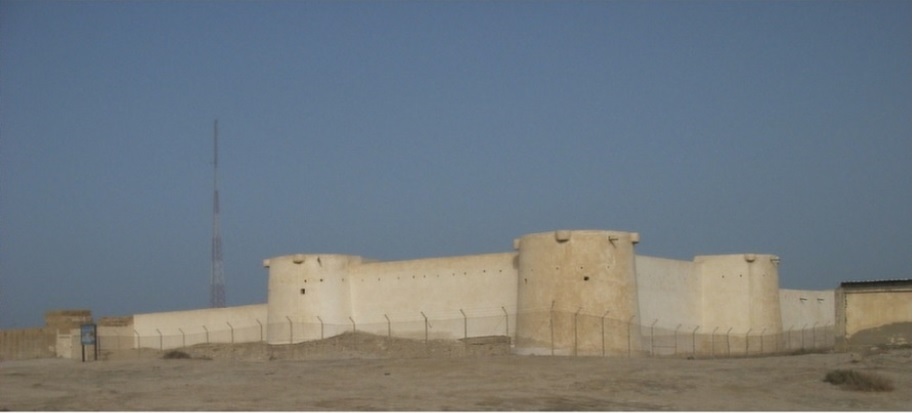
サージは涸れ谷ミヤーの中心サッラール東南東30kmにあるナツメ椰子林に囲まれた寒村です。かつてはイラク南部向かう主要交易路とハジュル・ヤマーマ(リヤード)へ通じるダルブ・クンフリー交易路とがサージで交差していました。サージは紀元前3世紀に建造され、門と塔を備え、総延長2.5kmの城壁で囲まれた都市であり、豊富な陶器の出土から紀元前300年から紀元1世紀に掛けて繁栄していた事が分かっています。アラビア半島で一番多くの黄金の出土品が発掘されおり、リヤードの歴史博物館に展示されています。この地域で王達の硬貨が発見された唯一の遺跡でもあり、上記のジャルハーであるとの説もあります。
Thaj is a lonely village surrounded by date palm forests and is located at 30km east-southeast of Sarrar (الصرار). Sarrar is the center of Wadi al-Miyah. The 2 main trade routes had been intersected at Thaj. One is the trade route to southern Iraq and the another is the Darb al-Kunhuri. The Darb al-Kunhuri is the trade route leading to Hajr al-Yamamah (present Riyad). Thaj was built in the 3rd century BC. This ancient city was walled of a total length of 2.5 km with gates and towers. Abundant pottery excavations indicate that it prospered from 300 BC to the 1st century AD. The largest number of golden finds in the Arabian Peninsula have been excavated and are on display in the Riyad History Museum. It is also the only site ,where coins of the kings have been found, in this area. And there is a theory that it is Gerrha as mentioned above.
パルミラ国
Palmyra
パルミラ国(タドムル)はシリア中央に位置し、 紀元前1世紀から紀元3世紀までシルクロードの中継都市として繁栄しました。「3世紀のローマ危機」の中でパルミラ出身のオダエナトゥスが自前の軍隊を率いて建国し、サーサーン朝からの攻撃への防御に当たっていました。ローマ皇帝ガリエヌスはオダエナトゥスを東方全域の司令官に任命しましたが、267年に刺殺されました。紀元270年頃には後妻ゼノービヤーが後継の女王として君臨し、ナバテア人の通商権やエジプトの一部を支配下に置いて絶頂期に至りました。しかし、パルミラの独立を恐れたローマ皇帝のアウレリアヌスによって攻撃され、紀元273年に陥落して廃墟と化しました。
Palmyra (Tadmor) is located in the center of Syria and prospered as a transit city on the Silk Road from the 1st century BC to the 3rd century AD. During the Crisis of the Third Century, also known as the Military Anarchy or the Imperial Crisis (AD 235~284), Septimius Odaenathus (260~267) from Palmyra led his own army to defend against attacks from the Sassanid Empire (224~651). The Roman Emperor Gallienus (c.218~268) appointed Odaenathus as the commander of the entire East, but was stabbed to death in 267. Around 270AD, his second wife Zenobia (240~after 274) reigned as the successor queen, taking control of the Nabataea trade rights and the parts of Egypt, and reached Palmyra’s climax. However, it was attacked by the Roman Emperor Aurelian (Aurelianus) (270~ 275), who feared the independence of Palmyra. Palmyra fell in 273 AD and fell into ruins.
カルヤ・ファーウ
Qaryat al Faw
古代にはカルヤ・ズー・カフルと呼ばれたカルヤ・ファーウは、駱駝隊商路に紀元前1世紀から紀元4世紀頃に栄えたキンダ族の支配下にありました。キンダ族はムナーズィラ族とガッサーン族と共にカフターン部族カフラーン族に属し、シバ王国を形成していました。紀元前25年にシバ王国がヒムヤル王国によって最初に征服された後、キンダ族の一部が駱駝隊商路の拠点であったカルヤ・ファーウに移住してきたと思われます。「この古代都市は8世紀に渡って住み続けられ、その間にシバ王国と数回にわたり戦った」との記述があり、復活して紀元275年まで続いたシバ王国との関係は良好ではなかった様です。交易によって裕福だった部族都市の精巧な遺構が、宮殿、寺院、防御壁、二階建てのスーグ(市場)、住居地区、井戸群を含めて灌漑された大きな農園や果樹園と共に発掘されました。この遺構遺跡は紀元前2世紀から遅くとも紀元5世紀の時代のものと思われます。ガラス、宝石、金属細工、織物の切れ端、木工細工、青銅、石像、碑文や壁画も出土し、貨幣まで鋳造して居り、その高度な文明を証明しています。この部族都市は交易路の1地点から南アラビアからナジュラーンを経てアレクサンドリア西のアラブ湾やメソポタミアへと延びる交易路の東部分の重要な交易地点へと発展しました。この都市は第一期キンダ王国の首都であるばかりではなく、半島中央の経済的、宗教的、文化的そして社会的中心であった様です。
Qaryat al Faw, known in ancient times as Qaryah dhat Kahl, was under the rule of the Kindah (كندة) tribe, which flourished on the camel caravan route from the 1st century BC to the 4th century AD. Kindah, together with Muntherids (المناذرة) and Ghassanids (الغساسنة), belonged to Kahlan Qahtan Arab, forming the Kingdom of Sheba. After the first conquest of the Kingdom of Sheba by the Kingdom of Himyar in 25 BC, it is likely that some members of Kindah tribe migrated to Qaryat al Faw, the stronghold of the camel caravan route. “This ancient city lived for 8 centuries, during which time it fought several times against the Kingdom of Sheba, and it seems that relations with the Kingdom of Sheba, which was revived and lasted until 275AD, were not good. Elaborate remains of a tribal city, that was wealthy through trade were excavated with palaces, temples, defensive walls, a two-story Souq (سوق), residential quarters. And large irrigated plantations and orchards, including wells, were also excavated. The ruins are thought to date from the 2nd century BC to the 5th century AD at the latest. Glass, jewelry, metalwork, pieces of textiles, woodwork, bronze, stone statues, inscriptions and murals have also been unearthed, and even coins have been minted, proving its advanced civilization. The tribal city developed into an important trading point in the eastern part of the trade route that ran from the Southern Arabian Peninsula through Najran to the Arab Gulf (west of Alexandria on Egypt) , and Mesopotamia. The city was not only the capital of the first Kindah Kingdom, but also the economic, religious, cultural and social center of the Central Arabian Peninsula.
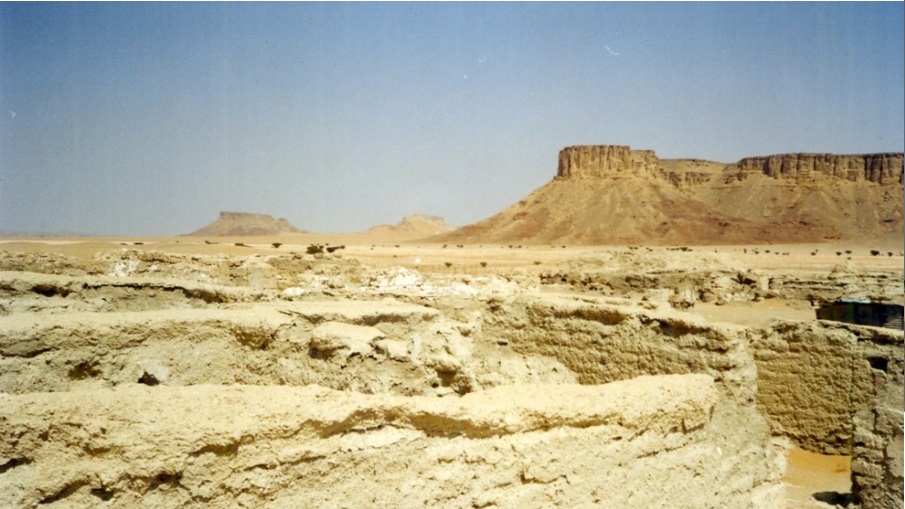
 Desert peninsula