Crusade Expeditions
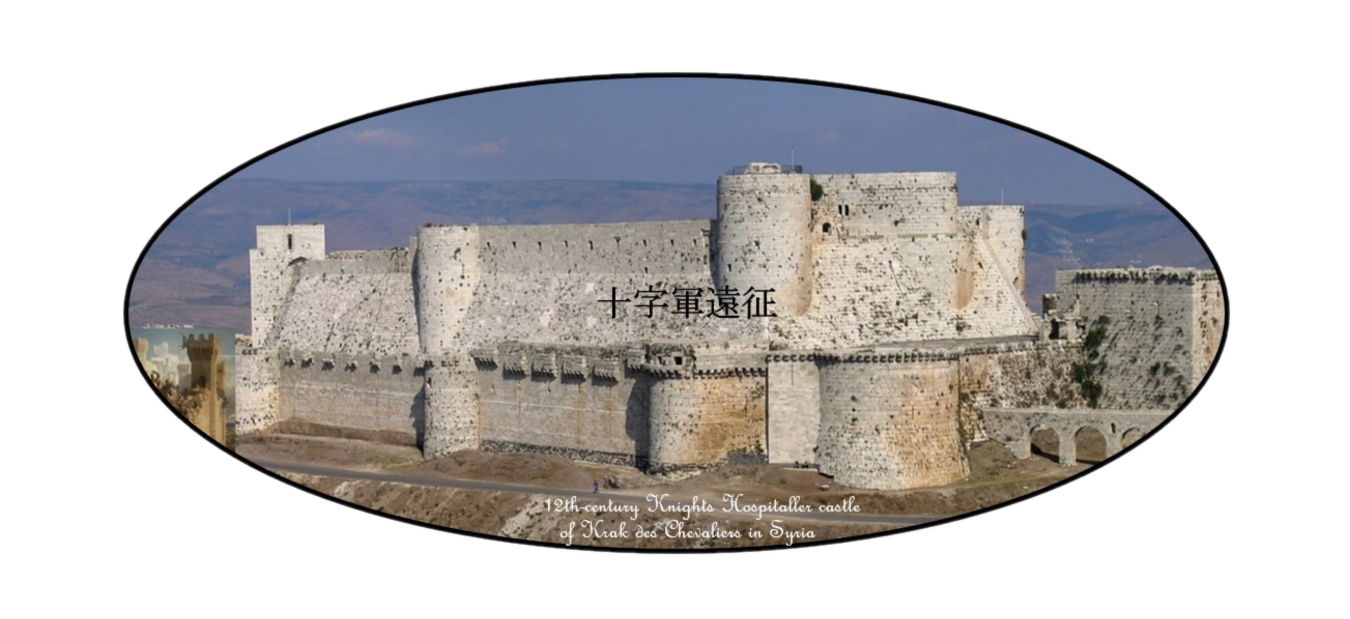
12th-century Knights Hospitaller castle of Krak des Chevaliers in Syria
https://en.wikipedia.org/wiki/Crusades



1055年にブワイフ朝(Buyid dynasty)を倒したセルジューク朝(Seljuq Dynasty)が聖地エルサレムを占領しました。ビザンチン皇帝アレクシオス1世コムネノス(Alexios I Komnenos) (r. 1081~1118)は、ローマ教皇に聖地エルサレムの領土奪回のために援軍を求めました。これに加えて、「キリスト教徒の聖地エルサレム巡礼をトルコ人が妨害している」とのウワサで1096年に聖地エルサレムの回復の為に第一回十字軍(1096~1099)が編制されました。その後も13世紀後半までに7回にわたって十字軍遠征は行われました。十字軍は、かならずしも宗教目的では無く、現実的利益も追及していた人達も多く参加していました。この為、目的地がイスラーム圏以外の宗派の異なるキリスト教に及ぶこともありました。中でも第四回十字軍(Fourth Crusade) (1202~1204) は、キリスト教国の東ローマ帝国(Eastern Roman Empire or Byzantium) (330/395~1453)を攻略し、コンスタンティノープル(Constantinople)を陥落させています。これ以降の十字軍遠征では、現実的利益が優先されていたと考えられます。十字軍遠征の底流としては、蒙古の征西やイスラーム帝国アッバース朝(Abbasid Caliphate)の弱体化がありました。また、十字軍遠征によるイスラーム文化との接触は、やがて西洋で花開いた文芸復興や産業革命に影響を与えました。
Seljuq Dynasty, who overthrew Buyid dynasty in 1055, captured the Holy City of Jerusalem. Byzantine Emperor Alexios I Komnenos (r. 1081~1118) asked the Pope for reinforcements to retake the territory of the Holy City of Jerusalem. In addition to this, the First Crusade (1096~1099) was organized in 1096 to restore the Holy City of Jerusalem due to rumors that “Turks were obstructing Christians’ pilgrimage to the Holy City of Jerusalem”. By the late 13th century, there were seven crusade expeditions. The Crusades were not necessarily for religious purposes, but also included many people who pursued real profits. For this reason, the destination sometimes extended to the Christianity of the different denominations outside the Islamic world. Among them, the Fourth Crusade (1202~1204) captured Christian Eastern Roman Empire (Byzantium Empire) (330/395~1453) and Constantinople was defeated and fallen. In the subsequent Crusade Expeditions, it can be assumed that realistic interests prevailed. The undercurrents of the Crusade Expeditions were the Mongol Expedition and the weakening of Abbasid Caliphate of Islamic Empire. In addition, contact with the Islamic Culture through the Crusade Expeditions influenced the literary revival (Renaissance) and Industrial Revolution that eventually blossomed in the West.
目次(Index)
イスラーム帝国に侵攻した十字軍遠征
イスラーム帝国に対する十字軍遠征一覧表
| 遠征名 | 遠征期間 | 遠征対象 | 主たる遠征地 |
| 第1回十字軍遠征 | 1096 ~ 1099 | イスラーム教徒 | アナトリア、シリア |
| (貴族十字軍) | (イスラーム世界の諸領主は策もなく壊滅) | エルサレム | |
| エルサレム王国、エデッサ伯国、トリポリ伯国、アンティオキア公国等十字軍国家設立 | |||
| 農民十字軍 | 1096 | イスラーム教徒 | アナトリア北西部 |
| (第1回遠征の1部) | (ルーム・セルジューク朝に容易く撃退される) | ||
| ユダヤ教徒 | |||
| ラインラントの虐殺 | ラインラント(ライン川沿いの西ドイツ) | ||
| 1101年の十字軍 | 1101 | イスラーム教徒 | アナトリア(聖地まで辿り着いた者は殆ど無し) |
| (大規模な聖地遠征) | (イスラーム同盟軍の反撃によって壊滅・逃走) | ||
| 第2回十字軍遠征 | 1145 ~ 1149 | イスラーム教徒 | アナトリア、レヴァント(エルサレム、ダマスカス等) |
| (ザンギー朝によるエデッサ公国占領が契機) | (イスラーム同盟軍の反撃によって敗走・撤退) | ||
| 第3回十字軍遠征 | 1189 ~ 1192 | イスラーム教徒 | レヴァント(エルサレム、アッカー、アルスーフ、ヤッファ) |
| (サラーフッディーンが征服した十字軍国家と聖地の奪回) | (休戦協定締結し沿岸部幾つかの港をエルサレム王国管理下、聖地をイスラームの統治下とした) | ||
| ドイツ十字軍 | 1197 | イスラーム教徒 | レヴァント(シドン、ベイルート等) |
| (皇帝の十字軍) | (神聖ローマ皇帝ハインリヒ6世が創設) | シドン、ベイルート等を攻略したが、ハインリヒ6世の死で撤退 | |
| (第3回遠征の1部) | |||
| 第5回十字軍遠征(ダミエッタ返還と8年間休戦協定) | 1217 ~ 1221 | イスラーム教徒 | アッカー(殆ど何もせず) |
| (アイユーブ朝カーミル) | エジプト(ダミエッタ攻略) | ||
| 第6回十字軍遠征(破門されたフリードリヒ2世主導) | 1228 ~ 1229 | イスラーム教徒 | アッカー(カーミルとアイユーブ朝保護の見返りで休戦条約) |
| (アイユーブ朝カーミル) | |||
| 小規模十字軍(フリードリヒ2世の休戦条約に不満) | 1239 ~ 1241 | イスラーム教徒 | アッカー(敵の内部争いに乗じエルサレム王国領土拡大条約) |
| (アイユーブ朝カーミル) | |||
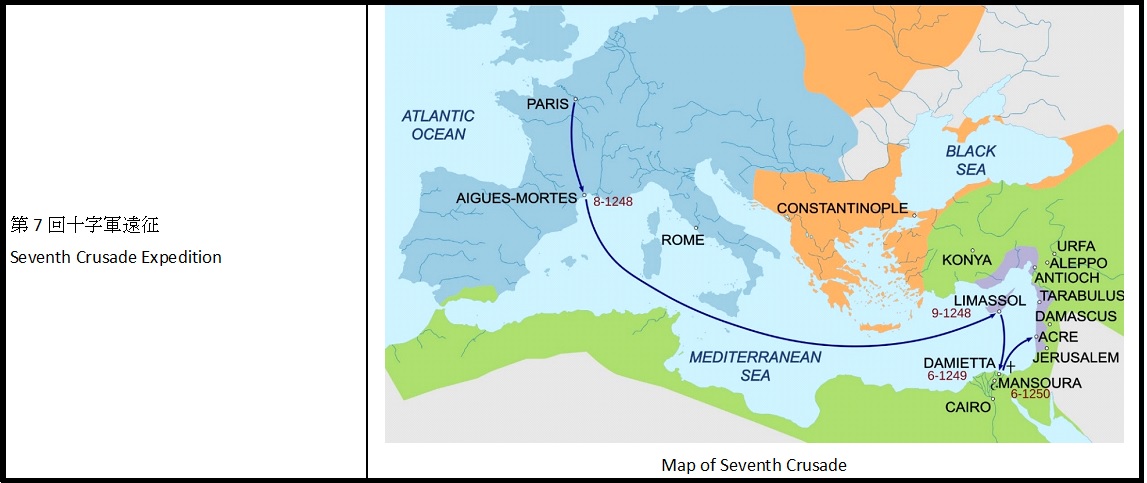
| 第7回十字軍遠征(フランス王ルイ9世が主導、敗北、占領地放棄、莫大身代金支払) | 1248~1254 | イスラーム教徒 | エジプト(ダミエッタとマンスーラ)、シリア、エルサレム(釈放後ルイ9世はエルサレム王国に赴き、防備補強) |
| (アイユーブ朝サーリフ死亡、シャジャル・アッ=ドゥッル差配、マムルーク朝創設) | |||
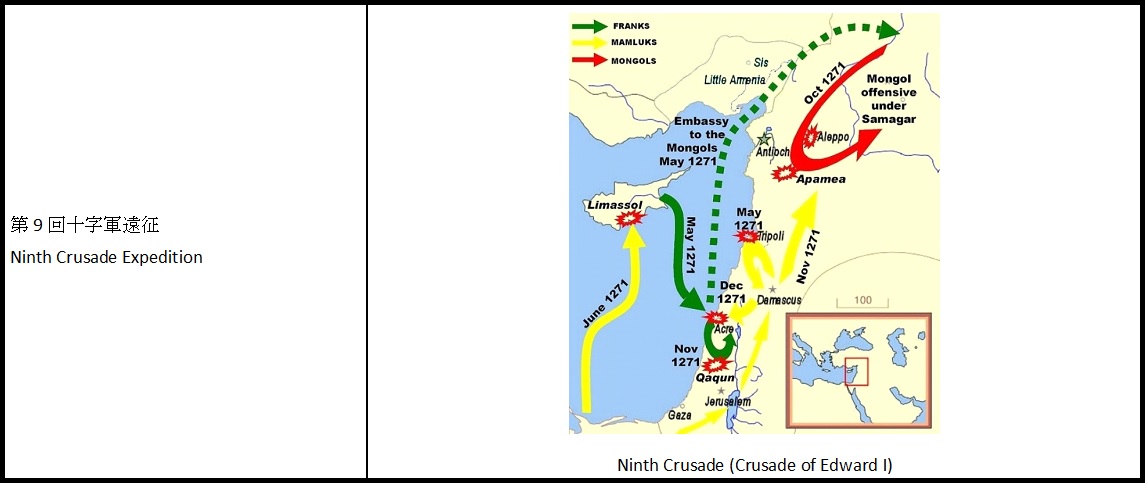
| 第9回十字軍遠征(戴冠前のエドワード1世が主導) | 1271 ~ 1272 | イスラーム教徒(バイバルスとの休戦に不満) | シチリア、アッカー(聖地奪回には殆ど何もできなかった) |
Crusader Expeditions that invaded the Islamic Empire
List of Crusade Expeditions against Islamic Empire
| Crusader Name | Duration | Expedition Targets | Main expedition sites |
| First Crusade Expedition | 1096 ~ 1099 | Muslims | Anatolia, Syria |
| (Noble Crusade) | (The lords of the Islamic world were destroyed without any counter-measures or effective resistance | Jerusalem | |
| Establishment of the Crusader states such as the Kingdom of Jerusalem, the Count of Edessa, the Count of Tripoli, and the Principality of Antioch. | |||
| Peasant Crusade | 1096 | Muslims | Northwest Anatolia |
| (a part of First Expedition) | (Easily repulsed by the Seljuks of Rum) | ||
| Jews | |||
| Rhineland Massacre | Rhineland (Western Germany along the Rhine) | ||
| Crusade of 1101 | 1101 | Muslims | Anatolia (few have made it to the Holy Land) |
| (Large-scale Holy Land Expedition) | (Destroyed and fled by the counterattack of the Islamic Alliance forces) | ||
| Second Crusade Expedition | 1145 ~ 1149 | Muslims | Anatolia, Levanto (Jerusalem, Damascus, etc.) |
| (Triggered by the occupation of the principality of Edessa by Zengid dynasty (1127~1250)) | (Defeated and withdrawn by counterattack by Islamic allied forces) | ||
| Third Crusade Expedition | 1189 ~ 1192 | Muslims | Levanto (Jerusalem, Acker, Ar-Suf, Jaffa) |
| (Salahuddin recaptured the Crusader states and holy sites) | (An armistice was signed, and some coastal ports were placed under the control of the Kingdom of Jerusalem and the holy sites were placed under Islamic rule.) | ||
| German Crusade | 1197 | Muslims | Levant (Sidon, Beirut, etc.) |
| (Emperor’s Crusade) | (Founded by Holy Roman Emperor Heinrich VI) | Captured Sidon, Beirut, etc., but withdrew due to the death of Heinrich VI. | |
| (a part of 3rd Expedition) | |||
| Fifth Crusade Expedition (Return of Damietta and 8-year armistice) | 1217 ~ 1221 | Muslims | Acker (done almost nothing) |
| Kamil (الكاملl) (the fourth Ayyubid sultan of Egypt) | Egypt (Capture of Damietta) | ||
| Sixth Crusade Expedition (led by the excommunicated Frederick II) | 1228 ~ 1229 | Muslims Kamil (الكاملl) | Acker (armistice in return for the protection of Kamil and the Ayyubids) |
| (the fourth Ayyubid sultan of Egypt) | |||
| Small crusades (dissatisfied with the armistice of Frederick II) | 1239 ~ 1241 | Muslims Kamil (الكاملl) | Acker (Treaty of Territorial Enlargement of the Kingdom of Jerusalem taking advantage of internal strife of the enemy) |
| (the fourth Ayyubid sultan of Egypt) | |||
| Seventh Crusade Expedition (led by King Louis IX of France, defeated, abandoned occupied territories, paid a huge ransom) | 1248 ~ 1254 | Muslims | Egypt (Damietta and Mansoura), Syria, Jerusalem (after his release, Louis IX went to the Kingdom of Jerusalem to reinforce his defenses) |
| (Ayyubid Salih dies, Shajar al-= Durru, founded Mamluk Sultanate) | |||
| Ninth Crusade Expedition (led by Edward I before his coronation) | 1271 ~ 1272 | Muslims (dissatisfied with the truce with Baibars) | Acker, Sicily (could do little to retake the Holy Land) |
イスラーム帝国に侵攻した十字軍遠征関連地図
Map related to the Crusader Expedition that invaded the Islamic Empire
第1回十字軍(貴族十字軍)遠征 First Crusade Expedition (Noble Crusade)
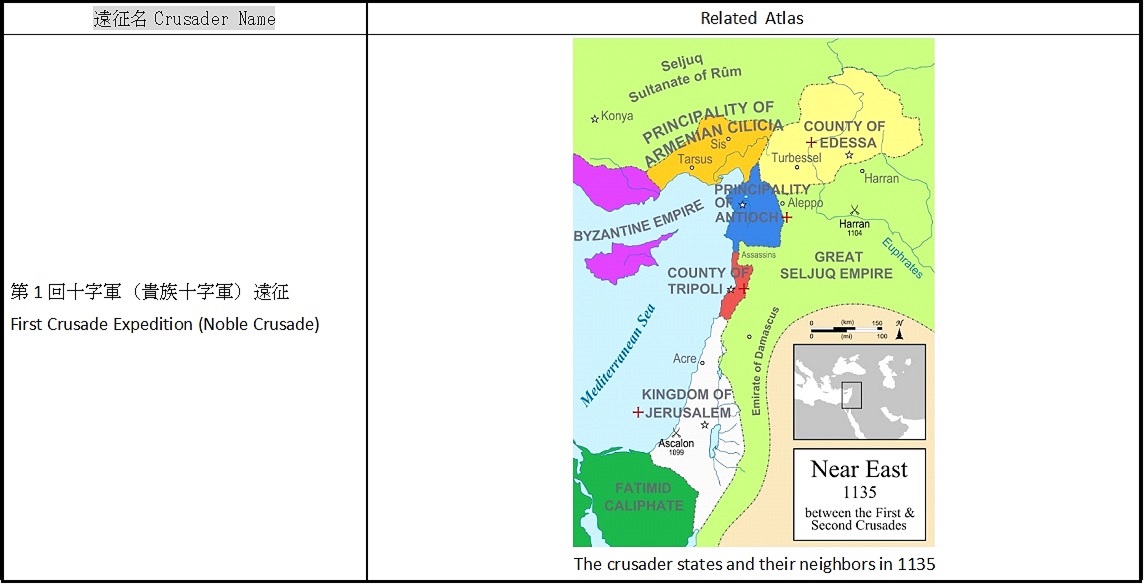
1st Crusade: https://en.wikipedia.org/wiki/Timeline_of_the_Principality_of_Antioch#/media/File:Map_Crusader_states_1135-en.svg
第2回十字軍遠征 Second Crusade Expedition
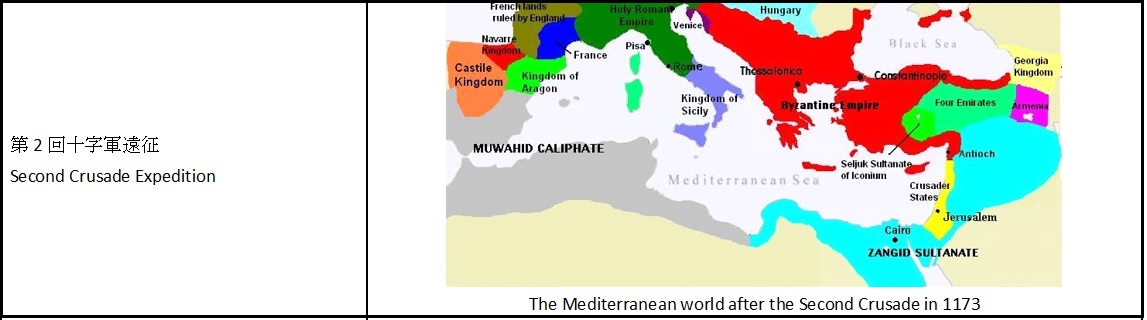
2nd Crusade: https://en.wikipedia.org/wiki/Second_Crusade#/media/File:Byzantium1173.JPG
第3回十字軍遠征 Third Crusade Expedition
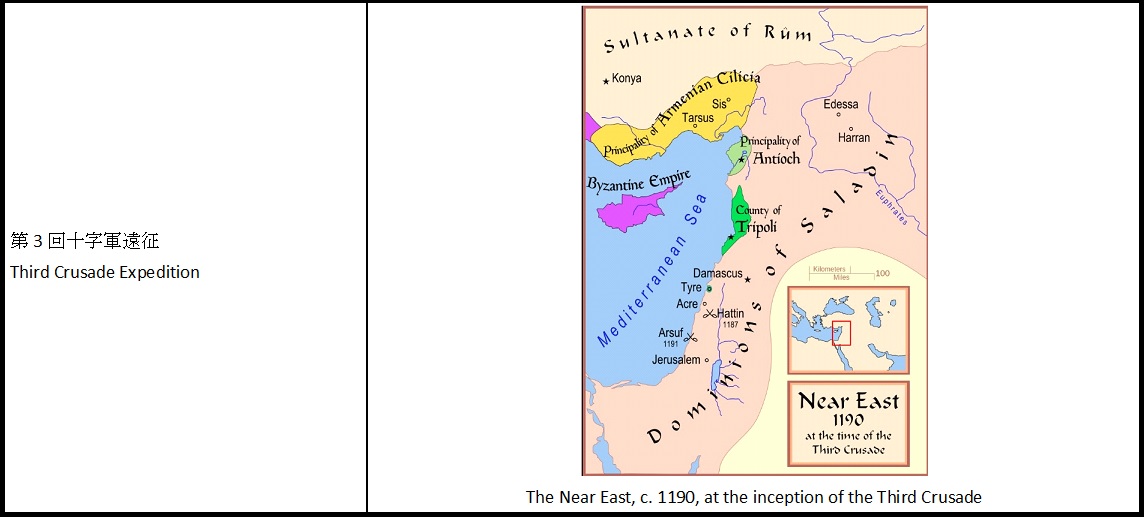
3rd Crusade: https://en.wikipedia.org/wiki/Third_Crusade#/media/File:Map_Crusader_states_1190-en.svg
第5回十字軍遠征 Fifth Crusade Expedition
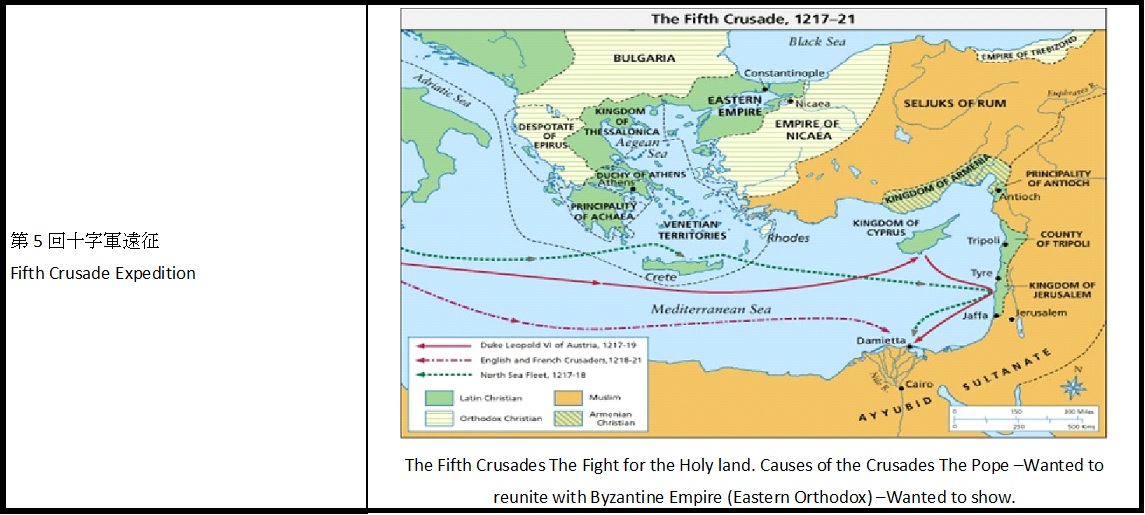
5th Crusade: https://slideplayer.com/slide/7611632/
第6回十字軍遠征 Sixth Crusade Expedition
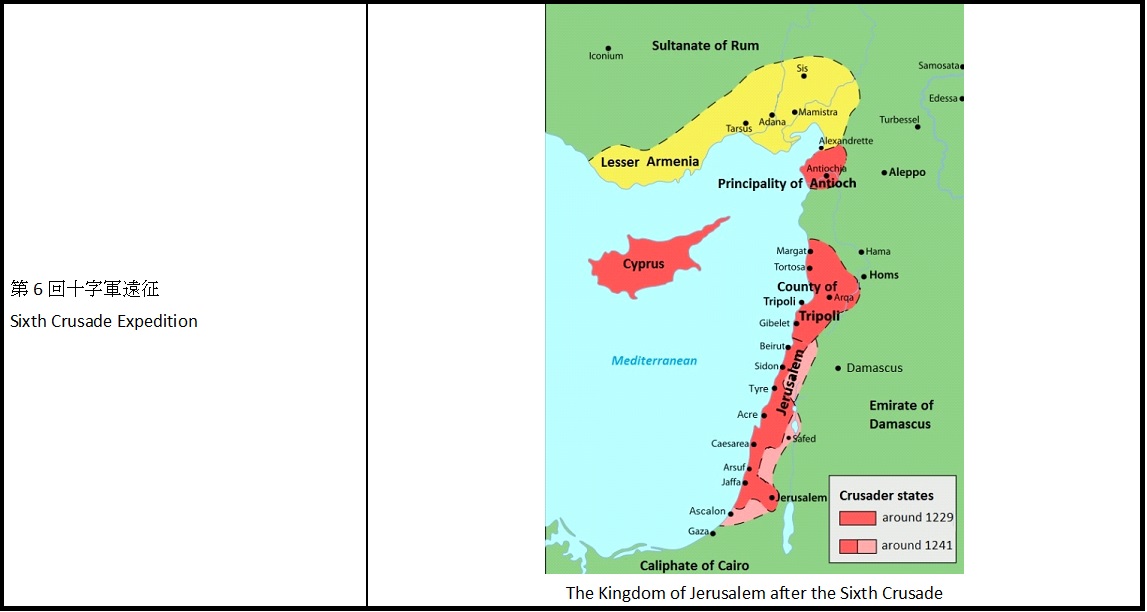
6th Crusade: https://en.wikipedia.org/wiki/Sixth_Crusade#/media/File:Map_Crusader_states_1240-eng.png
第7回十字軍遠征 Seventh Crusade Expedition
7th Crusade: https://en.wikipedia.org/wiki/Seventh_Crusade#/media/File:Septi%C3%A8me_croisade-en.svg
第9回十字軍遠征 Ninth Crusade Expedition
9th Crusade: https://en.wikipedia.org/wiki/Lord_Edward%27s_crusade#/media/File:EdwardICrusadeMap.jpg
十字軍遠征に立ち向かったイスラーム帝国の指導者達
Islamic Leaders Against the Crusade Expeditions
ザンギー
Zengi
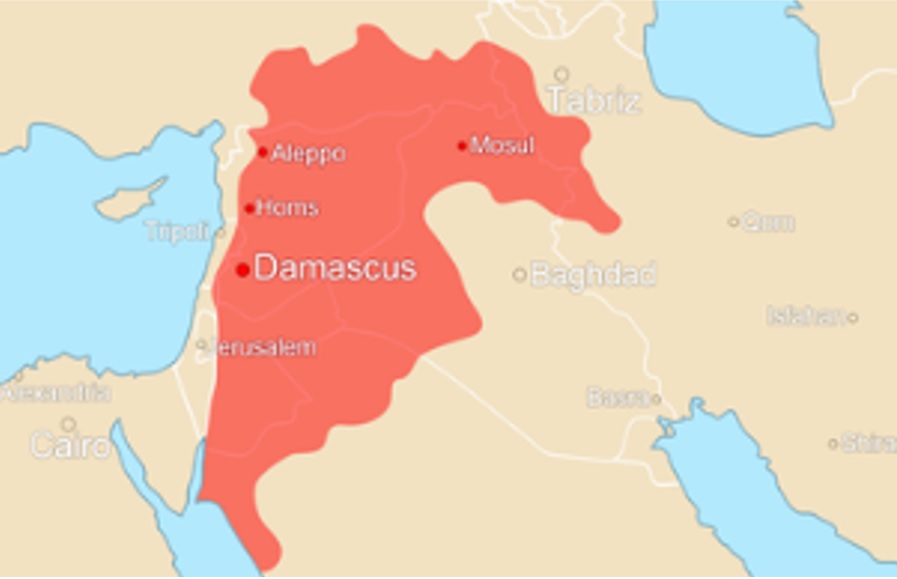
イマードゥッディーン・ザンギー(Imad al-Din Zengi) (c. 1085~1146) (عماد الدین زنكي)は、トルコのチュルク(突厥)系オグズ族 (Oghuz Turkic origin)出身です。父親の代からセルジューク朝(Seljuk dynasty)に仕え、1127 年にモスル(Mosul)のセルジューク朝(Seljuk dynasty)の太守(atabeg)になりました。この年が、ザンギー朝(Zengid dynasty) (1127~1250) (الدولة الزنكية)の創設とされています。
Imad al-Din Zengi (c.1085~1146) (عماد الد ین زنكي) is a Turkic Oghuz from the Turkic origin. He served Seljuk Dynasty from his father’s generation and became an Atabeg of Seljuk Dynasty of Mosul in 1127. This year marked the founding of Zengid Dynasty (1127~1250) (الدولة الزنكية).
ザンギー(Zengi)は、すぐに北シリアとイラクの主要なチュルク系有力者になりました。1128 年には、同じくオグズ族系トゥルクマーン(Oghuz Turkic origin)のセルジューク朝系アタベク政権アルトゥク朝(Artuqid Dynasty) (1102~1409)との争いからアレッポ(Aleppo)を奪いました。1144 年の「エデッサ包囲戦(Siege of Edessa)」の後には十字軍(Crusaders)からエデッサ郡(County of Edessa)を占領しました。この功績により、ザンギーは、イスラム世界の英雄となりました。その2 年後の 1146 年にザンギーは、奴隷に暗殺されました。それにもかかわらず、ザンギ―朝は、その後の1169 年にエジプトの支配権を掌握しました。
Zangi soon became a major Turkic strongman in the northern Syria and Iraq. In 1128, Zangi robbed Aleppo in a conflict with the Seljuk Atabek government of the Artuqid Dynasty (1102~1409). Artuqid Dynasty was also a Turkic Oghuz from the Turkic origin. After the Siege of Edessa in 1144, the Crusaders transferred the County of Edessa to Zangi, who occupied it afterwards. For this achievement, Zanghi became a hero of the Islamic world. Two years later, in 1146, he was assassinated by slaves. Nevertheless, Zanguids seized control of Egypt in 1169.
The Zengid state in Mid. 12th century
https://en.wikipedia.org/wiki/Zengid_dynasty
ヌールッディーン
Nur ad-Din
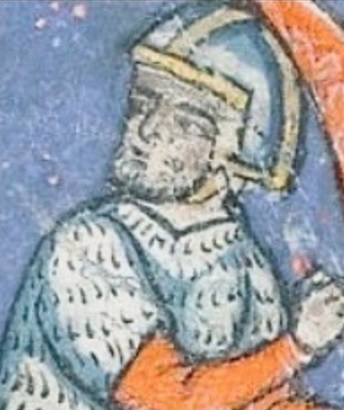
ヌールッディーン・マフムード(Nur al-Din Maḥmud Zengi) (1118~1174) (نور الدين محمود زنگي)は、ザンギー朝の第2代君主(2nd Emir) (r. 1146~1174)です。
Nur al-Din Maḥmud Zengi (1118~1174) (ور الدين زنكي) was the second monarch of Zangi Dynasty (2nd Emir) (r. 1146~1174).
1146年、父のサンギー(Zengi)が暗殺された後、その所領を兄サイフッディーン(Saif ad-Din Ghazi I) (died 1149))と分割し、西半分のシリアを得て、アレッポ(Aleppo)の太守(atabeg)となりました。ヌールッディーンは、イスラーム勢力の結集を計り、アルトゥク朝(Artuqid Dynasty) 系諸政権やブーリー朝(Burid Dynasty)と同盟を結びました。
After the assassination of his father Zengi in 1146, he divided his possessions with his brother Saif ad-Din Ghazi I (died 1149). He obtained the western half of Syria, and became the Atabeg of Aleppo. Nur al-Din tried to mobilize Islamic forces and formed an alliance with Artuqid Dynasty Regimes and Burid Dynasty.
アルトゥク朝(Artuqid Dynasty) (1102~1409) (الدولة الأرتقية):セルジューク帝国(Seljuk Empire) (1037~1194)のトルクメン・ベイリク(Turkmen Beylik)でオグズ・トルコ(Oghuz Turks) (トルクメン(Turkmen))のドジャー族(Döger (Deogers))出身のアルトゥーク・ベイ(Artuk Bey) (r.1085–1091)が創設した王朝(1102~1409)です。主として11~13世紀にかけて、アナトリア東部やシリヤ北部とイラク北部を支配していました。
Artuqid Dynasty (الدولة الأرتقية) : Artuk Bey (r.1085–1091) had been a Turkmen Beylik of Seljuk Empire (1037-1194). He was from Döger (Deogers) of the Oghuz Turks (Turkmen). He founded one dynasty (1102~1409) which ruled the eastern Anatolia, northern Syria, and northern Iraq, mainly from the 11th to 13th centuries.
ブーリー朝(Burid Dynasty) (1104~1154) (بوريون):12世紀初頭にダマスカスを支配したテュルク系のアタベク政権(atabeg)。
Burid Dynasty (1104~1154) (بوريون): Turkic Atabeg regime that ruled Damascus in the early 12th century.
こうして、ヌールッディーンは、アンティオキア公国(Principality of Antioch) (1098~1268年)や所領奪回を目指すエデッサ伯(County of Edessa) (1098~1144)を始めとする十字軍と戦いました。
Thus, Nur al-Din fought the Crusaders, including Principality of Antioch (1098-1268) and Count of Edessa (1098-1144), who sought to recapture his possessions.
1148年に第二回十字軍遠征(Second Crusade Expedition)が襲来しました。第二回十字軍は、エルサレム王国(Kingdom of Jerusalem) (1099~1187 & 1192~1291)と親しかったダマスカスを攻め、ヌールッディーンとダマスカスを接近させてしまいました。この為に、第二回十字軍遠征が成果を挙げず撤退しました。
In 1148 the Second Crusade Expedition invaded. The Second Crusade attacked Damascus, which had been a friendly relation with Kingdom of Jerusalem (1099-1187 & 1192-1291), bringing Nur al-Din and Damascus closer together. Because of this, the Second Crusade was withdrawn without success.
「イナブの戦い(Battle of Inab) (1149)」でも勝利したヌールッディーンは、アンティオキア公国の所領の大部分を奪い、1154年にはダマスカスも確保して、シリアの大部分を支配下に治めました。
Nur al-Din, who also won the Battle of Inab (1149), seized most of the possessions of Principality of Antioch, and in 1154 also secured Damascus and ruled over the most of Syria
Nureddin, Sultan of Damascus
http://prodigi.bl.uk/IllImages/BLCD%5Cmid/c131/c1317-02a.jpg
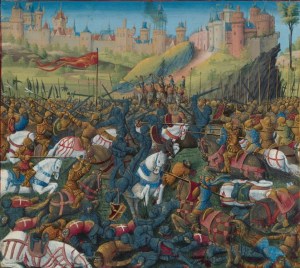
Battle Of Inab (also named Ard al-Hatim)
https://upload.wikimedia.org/wikipedia/commons/thumb/c/cb/BattleOfInab.jpg/1024px-BattleOfInab.jpg
サラディーン
Saladin
ユスフ・イブン・アイユーブ(Yusuf ibn Ayyub) (c. 1137~1193) (صلاح الدين الأيوبي)は、一般にサラディーンという通称(epithet)で知られています。イラク北部のティクリート(Tikrit) (تكريت)に住むアルメニアのクルド人一族の出身でアイユーブ朝(Ayyubid dynasty) (1171~1260/1341) (الدولة الأيوبية)の創設者でした。
Yusuf ibn Ayyub (c. 1137~1193) (صلاح الدين الأيوبي) is commonly known by the epithet of Saladin. Originally from an Armenian Kurdish family living in Tikrit (تكريت) in the northern Iraq, he was the founder of Ayyubid dynasty (1171~1260/1341) (الدولة الأيوبية).
若い頃にセルジューク朝(Seljuq)系のザンギー朝(Zengid dynasty)第2代君主ヌールッディーン(Nur ad-Din)に仕え、ヌールッディーンの3回に渡る「エジプト遠征(1164, 1167 & 1169)」に参加しました。1169年上官であった叔父シール・クーフ(Shirkuh)が没すると、その軍権を引継ぎました。さらにヌールッディーンの指示でファーティマ朝(Fatimid Caliphate) (909~1171) (الدولة الفاطمية)を助成するために、その宰相にも就任してエジプト全土を掌握しました。
As a young man, he served Nur ad-Din, the second Zangid dynasty monarch of the Seljuq descent, and participated in Nur ad-Din’s three expeditions to Egypt (1164, 1167 & 1169). When his uncle Shirkuh died in 1169, he took over Shirkuh’s military power. In addition, under Nur ad-Din’s instructions, he became the vizier of Fatimid Caliphate (909~1171) (الدولة الفاطمية) to subsidize it, and took control of all of Egypt.
カリフ・アーディド(al-`Adid) (1160~1171)が世継ぎを儲けぬまま病没したことによりファーティマ朝は滅亡したので、同年にアイユーブ朝(Ayyoubid Dynasty)を創設しました。1174年ヌールッディーンがダマスクス(Damascus)で没するとサラディーンはシリア方面へ領土を拡大し、諸軍を整備して王朝の軍事力を高めました。そして、その軍事力をもってエルサレム王国(Kingdom of Jerusalem)を攻撃し、1187年7月に「ハッティーンの戦い(Battle of Hattin)」で十字軍の主力部隊を壊滅させたのち、エルサレム(Jerusalem)を同年10月までに奪還することに成功しました。
Caliph Adid (al-‘Adid) (1160~ 1171) died of illness without making an heir, and Fatimid dynasty was destroyed, so he founded Ayyoubid Dynasty in the same year. After Nur ad-Din died in Damascus in 1174, Saladin expanded his territory towards Syria, building armies and increasing the dynasty’s military power. He used his military might to attack the Kingdom of Jerusalem, destroying the main force of the Crusaders at the Battle of Hattin in July 1187, and succeeding in recapturing Jerusalem by October of the same year.
しかし、1189年にヨーロッパ諸国がエルサレム奪還のためにイギリスの獅子心王(Richard the Lionheart, or Cœur de Lion)・リチャード1世(Richard I, 1157 – 1199)を総司令官とした第3回十字軍(Third Crusade, 1189 – 1192)を編成して、侵攻してくることになりました。さすがのサラディーンも一時、アッコン(Acre)を奪われるという窮地にまで追い詰められました。しかし、サラディーンは敵の猛攻に耐え、1192年、十字軍と休戦条約を結ぶことに成功しました。これにより、エルサレム(Jerusalem)をはじめとする広大な領土が、アイユーブ朝の領土として確定するとともに、十字軍も往時の勢いを失うこととなりました。サラディーンも翌年、ダマスカス(Damascus)にて病死しました。
However, in 1189, the European powers appointed Richard I (1157-1199) (England Richard the Lionheart, or Cœur de Lion), as the commander-in-chief of the Third Crusade (1189 – 1192). The Third Crusade was formed to retake Jerusalem and it came to invade Islam Empire. As expected, Saladine was also cornered to the point of being robbed of Acre for a while. However, Saladin withstood the onslaught of the enemy and, in 1192, succeeded in signing a truce with the Crusaders. As a result, Jerusalem and other vast territories were confirmed as Ayyubid territories, and the Crusades lost their former momentum. Saladin died of illness in Damascus the following year.
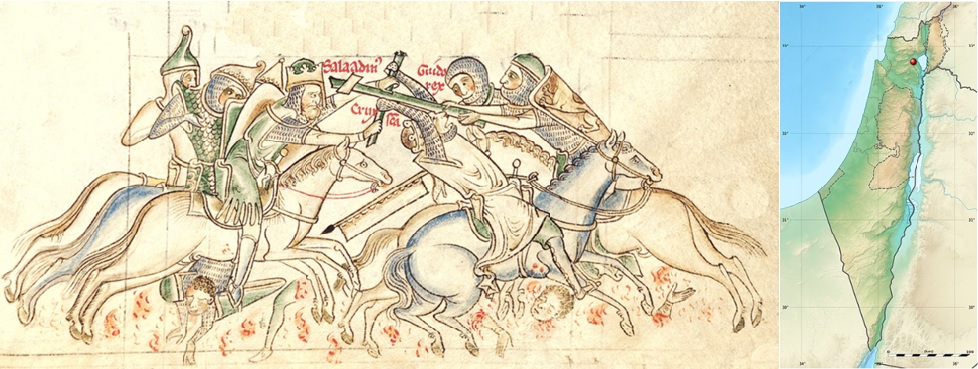
Battle of Hattin
The Battle of Hattin, from a 13th-century manuscript of the Chronica Majora.
https://en.wikipedia.org/wiki/Battle_of_Hattin
アル=カーミル
Al-Kamil
アル=カーミル(Al-Kamil) (الكامل)は、尊称で、本名はナースィルッディーン・ムハンマド (Nasir al-Din Muḥammad bin Abu Bakr bin Ayyub) (1180~ 1238) (ناصر الدين محمد بن أبو بكر بن أيوب)は、アイユーブ朝の第5代スルターン(Ayyubid 5th Sultan) (r.1218~1238)です。父がスルターンの在位にあった間は、副王(naib)つまりスルターンの「代理人」)として父を補佐してエジプト統治に務めました。1218年、父が第5回十字軍(Fifth Crusade) (1217~1221)と交戦中に心臓発作で死去したため、後を継いでスルターンとして即位しました。
Al-Kamil (الكامل) is an honorific and his real name is Nasir al-Din Muḥammad bin Abu Bakr bin Ayyub (1180 ~1238) (ناصر الدين محمد بن أبو بكر بن أيوب). Al-Kamil was the 5th Sultan (r.1218~1238) of Ayyubid dynasty. During his father’s reign as Sultan, he assisted his father in governing Egypt as a viceroy (naib), or “agent” of the Sultan. In 1218, his father died of a heart attack during the warfare against the Fifth Crusade Expedition (1217~1221), then he succeeded him as the Sultan.
父の死により、第5回十字軍(Fifth Crusade Expedition)によってダミエッタ(Damietta)を占領されるなど、アイユーブ朝は、一時は危機に陥入りました。しかし、総力を挙げて反攻に転じ、十字軍を破りました。その後も、アル=カーミルの即位に不満を持つ一族やアレッポとダマスカスの総督に反乱を起こされて、再び苦境に追い込まれました。その最中に1228年には神聖ローマ皇帝フリードリヒ2世(Frederick II, Holy Roman Emperor)が第六回十字軍遠征(Sixth Crusade Expedition) (1228~1229)を率いて侵攻を始めました。
With the death of his father, Ayyubid dynasty fell into crisis for a time, including the capture of Damietta by the Fifth Crusade Expedition. However, with all their might, they turned to counter-attack and defeated the Crusaders. After that, Al-Kamil was put in a difficult situation again by rebellion by the family dissatisfied with his accession to the throne and by the governors of Aleppo and Damascus. In the midst of this, in 1228, Frederick II (the Holy Roman Emperor) led the Sixth Crusade Expedition (1228~1229), and began the invasion.
アル=カーミルには十字軍を迎撃する余裕など無く、一方、フリードリヒ2世もローマ教皇や教皇派諸侯との争いに集中したいと思っていました。2人は、知識人としての交流(自然科学についての論議も行われた)を書簡によって続けるうち、互いが戦う事を望まない事を知りました。アル=カーミルは、「10年間の休戦」および「十字軍側への聖地エルサレム返還」に同意し、全軍を内紛の収拾に向けました。この為、帝国の内紛は、収拾しましたが、エルサレムを放棄した事で多くのイスラーム教徒からの不満を招き、バグダードのモスクではアル=カーミルを糾弾する集会が開かれたと言われています。エルサレムに和平が訪れてから9年後の1238年にアル=カーミルは亡くなりました。フリードリヒ2世との交流はアル=カーミルが亡くなるまで続いた様です。
Al-Kamil could not afford to intercept the Crusaders, while Frederick II wanted to focus on the conflict with the Pope and the Papal princes. As the two continued their intellectual exchanges (including discussions on the natural sciences) through letters, they learned that they did not want to fight each other. Al-Kamil agreed to the “10-year truce” and the “Return of the holy city of Jerusalem to the Crusaders” and directed his entire army to settle the internal strife. For this reason, the internal strife in Empire was settled, but the abandonment of Jerusalem caused dissatisfaction from many Muslims, and it is said that a rally was held at a mosque in Baghdad to denounce Al-Kamil. Al-Kamil died in 1238, nine years after the peace came to Jerusalem. His association with Frederick II seems to have continued until Al-Kamil’s death.
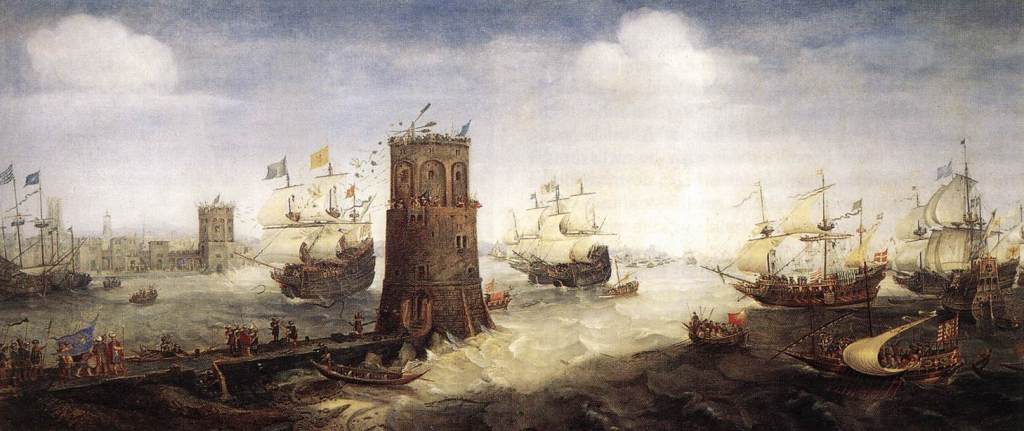
The siege of Damietta (1217~1221)
https://upload.wikimedia.org/wikipedia/commons/0/02/Capturing_Damiate.jpg
サーリフ
As-Salih
アル=マリク・アッ=サーリフ(Al-Malik as-Salih Najm al-Din Ayyub) (1205 ~1249) (الملك الصالح نجم الدين أيوب)は、アイユーブ朝第7代スルターン(Ayyubid 7th Sultan) (r.1240~1249)であり、父親は、第5代スルターン(Ayyubid 5th Sultan)アル=カーミル(Al-Kamil)です。一般的にはアル=マリク・アッ=サーリフは、サーリフ(Salih)として知られています。
Al-Malik as-Salih Najm al-Din Ayyub (1205 ~1249) (الملك الصالح نجم الدين أيوب) was the 7th Ayyubid Sultan (r.1240~ 1249) and his father was the 5th Ayyubid Sultan Al-Kamil. Al-Malik as-Salih Najm al-Din Ayyub is commonly known as Salih.
サーリフは、父親が締結した休戦協定を守っていました。しかし、十字軍内の内訌で皇帝派に対して現地十字軍国家の封建領主(Baron)たちが優位に立ち自治権を行使し始めました。それを機にサーリフは、神聖ローマ皇帝(Holy Roman Emperor)の支配下にない地域に対して攻撃を開始しました。サーリフは、マムルークの武将バイバルス(Rukn Al-Din Baybars Al-Salihi)に指示してホラズム勢と連合させました。その連合軍に十字軍国家を攻撃させました。また、その連合軍にサーリフの先年来の敵アル=サーリフ・イスマーイール(Al-Salih Ismail) (r. 1237–1245) (الصالح إسماعيل) のダマスカスに対する攻撃を指示しました。
Salih was keeping the armistice signed by his father. However, within the Crusades, the feudal lords (Barons) of the local crusader states gained the upper hand over the imperial faction and began to exercise their autonomy. Salih then launched an offensive against areas not under the control of Holy Roman Emperor.
Salih instructed the Mamluk warlord Rukn Al-Din Baybars Al-Salihi to allied with the Khorezm forces. That Allied force attacked the Crusader states. He also directed the allied forces to attack Damascus, Salih’s long-time enemy, Al-Salih Ismail (r. 1237–1245) (الصالح إسماعيل).
エジプト=ホラズム連合(Egypt Ayyubid Alley)と、ダマスカス=十字軍連合(Damascus Ayyubid-Crusaders Ally)との戦いは、「ラ・フォルビーの戦い(Battle of La Forbie)」と呼ばれ、ガザ(Gaza)近郊のラ・フォルビー(La Forbie)で行われました。そして、ダマスカス=十字軍連合(Damascus Ayyubid-Crusaders Ally)の大敗という結果に終わりました。この戦いの後、エジプト・アイユーブ朝軍(Egypt Ayyubid Army)はシリア各地を転戦し、領地の拡大に努め、十字軍国家は弱体化しました。
The Egypt-Khorezm Ally and Damascus-Crusaders Ally fought at the Battle of La Forbie. La Forbie locates near Gaza. And it ended in a major defeat for Damascus Ayyubid-Crusaders Ally. After this battle, the Egyptian Ayyubid Army moved around Syria to expand its territory and weaken the Crusader state
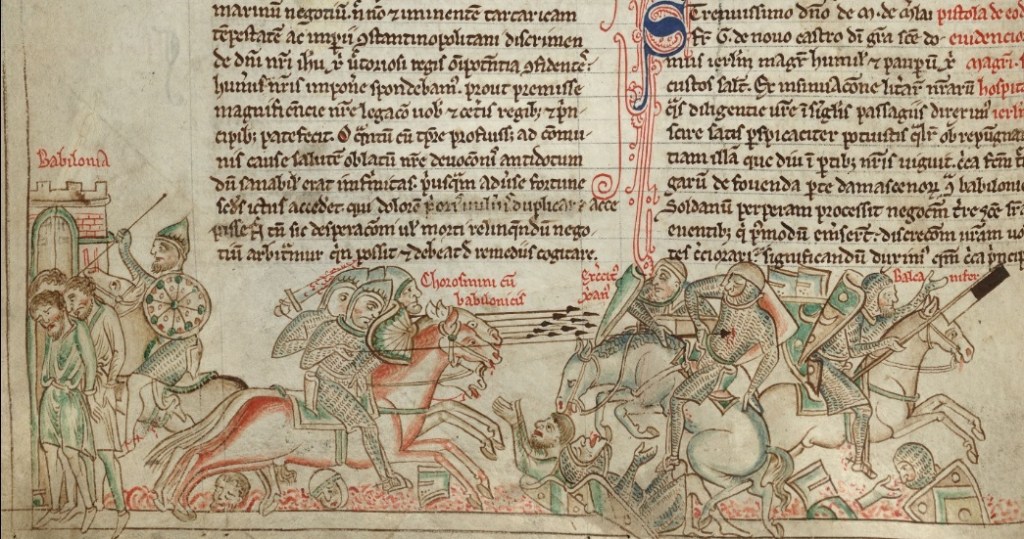
Battle of La Forbie, from Chronica Majora by Matthew Paris
https://en.wikipedia.org/wiki/Battle_of_La_Forbie
ホラズム勢(Khwarazmian forces):1219 年から1221年にかけての「モンゴルのホラズム・シャー朝征服(Mongol invasion of the Khwarazmian Empire)」によって西走した「ホラズム勢・シャー朝(Khwarazmian dynasty) (1190–1220) (خاندان انوشتکین)」の残党。
Khwarazmian forces: They were the remnants of Khwarazmian dynasty (1190–1220) (خاندان انوشتکین), and escaped to the westward after the Mongol invasion of Khwarazmian Empire in 1219–1221.
エジプト=ホラズム連合(Egypt Ayyubid Alley):ホラズムの傭兵で補強されたアイユーブ朝のスルタン・アズ・サーリフ・アイユーブのエジプト軍。
Egypt Ayyubid- Khwarazmian Ally: The Egyptian army of the Ayyubid Sultan as-Salih Ayyub, reinforced with the Khwarezmian mercenarie.
ダマスカス=十字軍連合(Damascus Ayyubid-Crusaders Ally):エルサレム王国を中心に十字軍による騎士修道会やアイユーブ朝から離反したダマスカス、ホムス、カラク等の都市による連合軍。
Damascus Ayyubid-Crusaders Ally: The allied armies drawn from Kingdom of Jerusalem, the crusading orders, the breakaway Ayyubids of Damascus, Homs, and Kerak.
なお、この戦後処理において、サーリフはホラズム勢に対して地中海岸の一地域をあてがいました。しかしながら、ホラズム勢は、これに不満を持ち、ダマスカスに駐留していたエジプト・アイユーブ朝軍(Egypt Ayyubid Army)に襲いかかりました。1246年5月、この度はアイユーブ家連合(Ayyubids Alley)がホラズム勢(Khwarazmian forces)を叩き、以降ホラズム勢の目立った活動は見られなくなりました。
In this post-war process, Salih assigned an area of the Mediterranean coast to the Khorezm forces. However, the Khorezm forces were dissatisfied with this and attacked the Egyptian Ayyubid Army stationed in Damascus. In May 1246, the Ayyubids Ally defeated the Khwarazmian forces, and there has been no significant activity of the Khorezm forces since then.
シャジャル・アル=ドゥッル
Shajar al-Durru
1248年、フランス王ルイ9世(Louis IX of France) (r. 1226~1270)が指揮する第七回十字軍遠征(Seventh Crusade Expedition) (1248~1254)は、エジプトを攻撃すべくフランスを発ちました。キプロス(Cyprus)を経由した後、1249年6月、エジプトの港市ダミエッタ(Damietta)を占領しました。サーリフは、既に重病状態でした。ダミエッタ占領を受けて父の例に習い、サーリフもルイ(Louis IX)に対してダミエッタ放棄の見返りとしてエルサレムを含むシリア領の割譲を申し出ました。しかし、ルイ(Louis IX)がこの申し出を蹴ったため、サーリフは、重病の身にもかかわらずマンスーラ(Mansurah)に向かいました。しかし、サーリフは、「マンスーラ攻防戦(Battle of Mansurah) (1250)」が勃発する直前に病死してしまいました。
In 1248, the Seventh Crusade Expedition (1248~1254), led by King Louis IX of France (r. 1226~1270), left France to attack Egypt. After passing through Cyprus, in June 1249, the Crusaders captured the Egyptian port city of Damietta. Salih had already been seriously ill. In the wake of the capture of Damietta, Salih offered Louis IX the cession of Syrian territory, including Jerusalem, in return for the abandonment of Damietta, following his father’s example. Louis IX kicked the offer, therefore Salih went to Mansurah despite being seriously ill. Salih died of illness shortly before the Battle of Mansurah (1250) broke out.
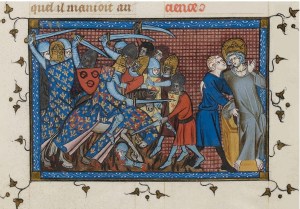
Battle of Al Mansurah. BnF, Ms.Fr. 5716.
https://en.wikipedia.org/wiki/Battle_of_Mansurah_(1250)
この後、シャジャル・アル=ドゥッル(Shajar al-Durr)は、サーリフの死を隠し通しました、シャジャル・アル=ドゥッルは、夫が生きているかのように装って、エジプト・アイユーブ朝軍(Egypt Ayyubid Army)の指揮をとり続けました。このことで、バフリー・マムルーク(Bahri Mamluk)は、動揺することなく、活躍し、十字軍を撃退して、マンスーラ攻防戦(Battle of Mansurah)に勝利しました。
After this, Shajar al=Durr concealed Salih’s death, while Shajar al=Durr continued to command the Egyptian Ayyubid Army, pretending that her husband was alive. This allowed that Bahri Mamluk acted unfazed, repulsed the Crusaders and won the Battle of Mansurah.
「真珠の木」を意味する名のシャジャル・アル=ドゥッル(شجر الدر)は、もとはバグダードのアッバース朝のカリフの後宮(ハレム(harem) (حريم))で働いていたテュルク系奴隷であったと言われています。後にアイユーブ朝第7代スルターン(Ayyubid 7th Sultan) (r.1240~1249)サーリフに贈られました。サーリフの寵愛を受けたシャジャル・アル=ドゥッル(Shajar al-Durr)は、サーリフの息子ハリール(Khalil)(夭折)を生んで、サーリフの正夫人となりました。マンスーラ攻防戦(Battle of Mansurah)の勝利で、シャジャル・アル=ドゥッル(Shajar al-Durr)は、マムルーク(Mamluk) (مملوك)軍団バフリーヤ(Bahri Mamluk)の絶大な支持を得ました。
Shajar al=Dur (شجر الدر), meaning “pearl tree”, had originally worked for the court of Abbasid Caliphate in Baghdad (harem) (حريم). It is said that she was a Turkic slave. She was later given to Ayyubid 7th Sultan (r.1240~1249) Salih. Shajar al=Durr, who received Salih’s favor, gave birth to Salih’s son Khalil and became Salih’s formal wife.
In the victory of the Battle of Mansurah, Shajar al=Durr won the trust relationship with Mamluk (مملوك) legion Bahri Mamluk and gained their tremendous support.
その支持を後ろ盾に、シャジャル・アル=ドゥッル(Shajar al-Durr)は、後継者が絶えたアイユーブ朝(Ayyubid Dynasty) (1174~1250)の代わりに、1250 年 5 月 2 日にエジプトのスルターナ(Sultana)なりました。それが、マムルーク朝(Mamluk Sultanate) (1250 – 1517)の創設でした。シャジャル・アル=ドゥッル(Shajar al-Durr)は、捕虜としているルイ9世(Louis IX of France)ら十字軍の将兵の身代金の受け取り、釈放などの戦後処理を滞りなく済ませました。
With their support, Shajar al=Durr became the Sultana of Egypt on May 2, 1250, because any successor of Ayyubid dynasty (1174~1250) had ceased to exist. That was the founding of Mamluk Sultanate (1250~1517). Shajar al=Durr successfully completed the post-war process, including receiving ransom and releasing the captured Crusader officers and soldiers, including Louis IX of France.
そして、僅か三ヶ月で、マムルーク(奴隷軍人)(Mamluk)出身で、筆頭将軍であったイッズ・アッディーン・アイバック(Izz al-Din Aybak)と結婚し、スルターン(Sultan)の位を譲りました。これは、スルターナ(Sultana)に対して、地方君主、将軍達、アッバース朝(Abbasid Caliphate)等の反対が多かったためと思われます。
Only in three months, she married with Izz al-Din Aybak, a Mamluk native and chief general, and made him to succeed the Sultan after her. This may be due to the large opposition to the Sultana by local monarchs, generals, and Abbasid Caliphate.
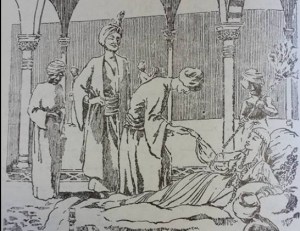
Shajar al-Durr
https://en.wikipedia.org/wiki/Shajar_al-Durr
バイバルス
Sultan Baybars
バイバルス(Sultan Baybars)は、トルコ系のキプチャック族(Kipchak Turk)です。「モンゴルに囚われ、奴隷として売られてきたが、馬術に秀でていたので奴隷兵部隊(Mamluk)に編入された。」と言われています。
It is said that “Sultan Baybars was a Kipchak Turk of the Turkish descent. He was imprisoned by the Mongols and sold as a slave, but because of his mastery in horsemanship, he was incorporated into the slave army (Mamluk).”
マンスーラの戦い(Battle of El Mansurah)(1250年2月8日から11日)で、実戦を指揮したのが、スルターン護衛隊長のバイバルス(Sultan Baybars)でした。軍団長不在のバフリー・マムルーク軍(Bahri Mamluk)の指揮を取り、奮戦しました。そのお陰でマンスーラの戦い(Battle of El Mansurah)において、ルイ九世(King Louis IX) (1226~1270)の率いる第七次十字軍(7th Crusaders) (1248~1254)に壊滅的な打撃を与え、ルイ九世を捕虜とする等、大勝利をおさめました。
During the Battle of El Mansurah (8~11 February 1250), Sultan Baybars, the captain of the Sultan’s guard, took command of the battle. He led the Bahri Mamluk army because its commander was absent, and fought hard together with them. Then, they won a great victory in the Battle of El Mansurah, inflicting a devastating blow on the 7th Crusaders (1248-1254) led by King Louis IX (1226~1270) and taking King Louis IX to prisoner.
バイバルス(Sultan Baybars) (1233-1277) (al-Malik al-Zahir Rukn al Din Baybars al Bunduqdari) (الملك الظاهر ركن الدين بيبرس البندقداري)は、後にマムルーク朝第5代目スルターン(r. 1260~1277)となりました。バイバルス(Sultan Baybars)は、モンゴル(Mongol)に滅ぼされたアッバース朝(Abbasid Caliphate) (750~1258)のカリフを受け入れました。それによって、バイバルス(Sultan Baybars)は、求心力を高め、マムルーク朝(Mamluk)の繁栄の基礎を作りました。
Sultan Baybars (1233-1277) (al-Malik al-Zahir Rukn al Din Baybars al Bunduqdari) (الملك الظاهر ركن الدين بيبرس البندقداري) later became the fifth Sultan of Mamluk Sultanate (r.1260~1277). Sultan Baybars accepted a caliph of Abbasid Caliphate (750~1258), which had already been destroyed by the Mongols. Thereby, Sultan Baybars increased the centripetal force and laid the foundation for the prosperity of Mamluk Empire.
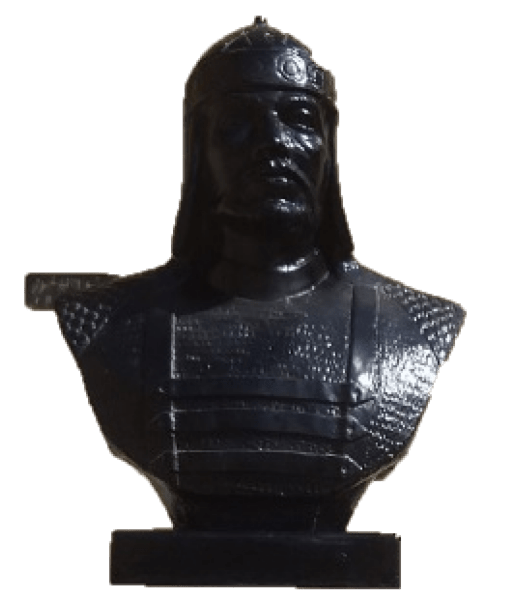
Bronze bust of Sultan Baibars
Egyptian National Military Museum
バイバルス(Sultan Baybars)は、1268年にはアンティオキア(Antioch)を陥落させてアンティオキア公国(Principality of Antioch) (1098~1268)を完全に滅亡させました。このときバイバルス(Sultan Baybars)は、アンティオキア住民の全てを殺害、または奴隷にし、都市を完全に破壊しました。1271 年 3 月 30 日、バイバルス(Sultan Baybars)はシャステル・ブラン(Chastel Blanc)を含むこの地域の小さな城を占領した後、クラック・デ ・シュヴァリエ(Krak des Chevaliers)を包囲し、守備隊は降伏させました。
Sultan Baybars completely destroyed the Principality of Antioch (1098~1268) by capturing Antioch in 1268. At that time, Sultan Baybars killed or enslaved all of the inhabitants of Antioch and completely destroyed the city. On 30 March 1271, Sultan Baybars captured the small castles in the area, including the Chastel Blanc, and besieged the Krak des Chevaliers, forcing the garrison to surrender.
アンティオキアの陥落は、短期遠征に終わったイギリスのエドワード王子(Lord Edward)が率いる第 9 回十字軍遠征(Ninth Crusade Expedition) (1271~1272)につながりました。エドワード王子(Lord Edward)は、1271 年 5 月にアッコ(Acre)に到着し、バイバルス(Sultan Baybars)に対してモンゴルと同盟を結ぼうとしていました。バイバルス(Sultan Baybars)はトリポリに注意を向けましたが、1271 年 5 月にエドワード王子(Lord Edward)に停戦を呼びかけるために包囲を中断しました。そして、バイバルス(Sultan Baybars)は、トリポリとバイバルス(Sultan Baybars)から領土を獲得することができなかったエドワードとの停戦を宣言しました。
The fall of Antioch led to the Ninth Crusade Expedition (1271~1272) led by Prince Edward of England, but it ended in a short expedition. Lord Edward arrived at Acre in May 1271 and attempted to ally with the Mongols against Sultan Baybars. Sultan Baybars turned his attention to Tripoli, but in May 1271 broke off the siege to call for a truce with Lord Edward. And Sultan Baybars declared a truce with Edward who was unable to gain territory from neither Tripoli nor Sultan Baybars.
「バイバルス(Sultan Baybars)がエドワードを毒で暗殺させようとした」との説も有力です。エドワード王子(Lord Edward)はその試みを生き延び、1272年に帰国し、エドワード1世(Edward I of England) (r.1272~1307)に戴冠しています。
Another popular theory is that Sultan Baybars tried to assassinate Edward with poison. Lord Edward survived the attempt and returned home in 1272, where he was crowned as Edward I of England (r.1272~1307).
 Desert peninsula