32 Saudi Arabia after its founding


目次(Index)

ナジュドと属領のスルターン
Sultan of Najd and its Dependencies
父とクウェイトに逃れていたイブン・サウード(Ibn Saud) (1876~1953) (ابن سعود)は、1902年1月15日に僅かな手勢で、リヤード(Riyadh) (رياض)を急襲してラシード家(House of Rasid) (آل رشيد)から奪還し、1903年までにはカスィーム(Qasim) (قصيم)を除く、ナジュド(Najd) (نجد)中央部の大半を掌中に収めました。1913年にはイブン・サウードはオスマン帝国守備隊を奇襲してハサー(Ahsa) (أحساء)地方を占拠しました。
Ibn Saud (1876~1953) (ابن سعود), who had fled to Kuwait with his father, stormed Masmak Fortress (قصر المصمك) with a small squad on January 15, 1902. and recaptured Riyadh (ريام) from the House of Rasid (آل رشيد). By 1903, Ibn Saud had controlled the most of central Najd (نجد), except the Qasim (قصيم).
In 1913 Ibn Saud made a surprise attack to the Ottoman garrison and captured the Ahsa (Hasa) (أحساء) province.
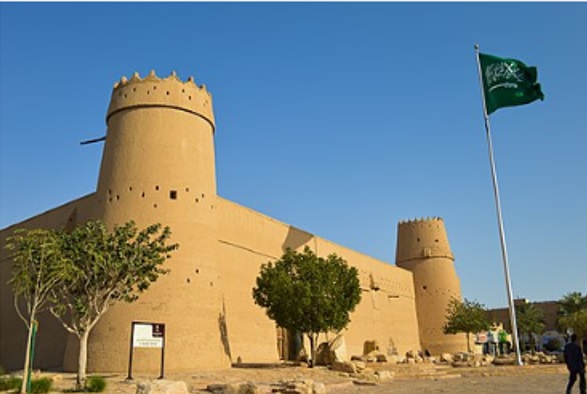
Masmak Fort (قصر المصمك)
1921年に宿敵ラシード族の本拠であるハーイル(Hayil) (حائل)を攻略、第12代首長ムハンマド(Muhammad bin Talal Al Rashid) (r.1920~1921) (محمد بن طلال الرشيد)を降伏させ、英国了解の下にシャンマル山塊(Jabal Shammar) (جبل شمر)を領有して「ナジュドと属領のスルターン(Sultan of Najd and its Dependencies) (سلطان النجد وملحقاتها)」を名乗りました。1922年にはジャウフ(Jawf) (جوف)、ハイバル(Khaybar) (خيبر)、タイマー(Tayma) (تيماء)、涸れ谷スィルハーン(Wadi’l-Sirhan) (وادي السرحان)及びナフード沙漠(An Nafud Al Kabir) (النفود الكبير)を獲得し、ナジュド沙漠(Najd) (نجد)全体の支配を確立しました。
In 1921, he conquered the Hayil, the stronghold of his old enemy Rashid tribe, and forced Muhammad bin Talal Al Rashid (محمد بن طلال الرشيد), the 12th Amir (r.1920~1921), to surrender. With the consent of the British government, he took possession of the Jabal Shammar (جبل شمر) and called himself the “Sultan over Najd and its dependencies (سلطان النجد وملحقاتها) “. In 1922, Ibn Saud had obtained the Jawf (جوف), Khaybar (خيبر), Tayma (تيماء), Wadi’l-Sirhan (وادي السرحان) and An Nafud Al Kabir (النفود الكبير). And then he declared his dominion over the entire Najd Desert (نجد).
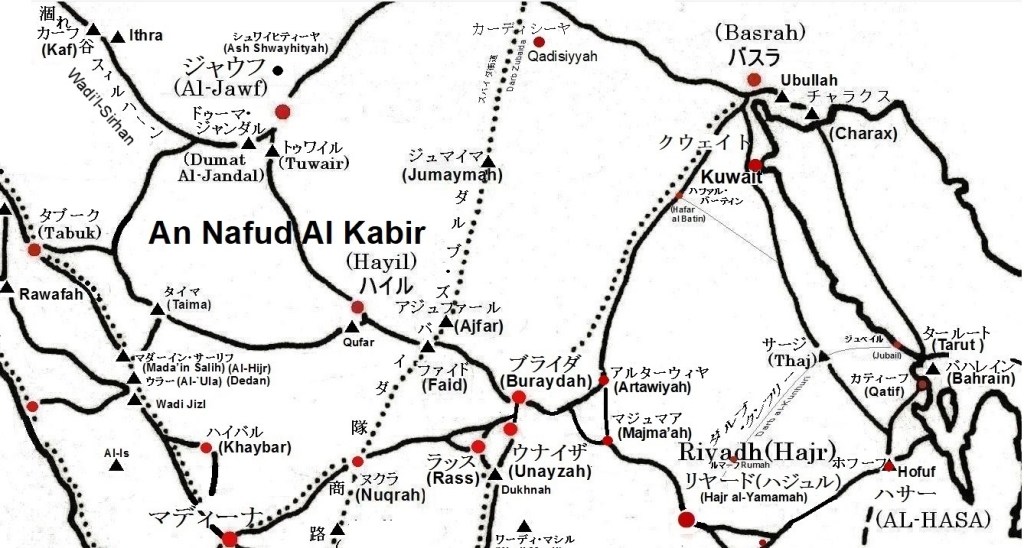
Najd and its dependencies
「ヒジャーズの王」を戴冠し、二重王位獲得
Granted Dual Throne as crowned King of Hejaz
一方、1916年6月にハーシム家(Hashemite) (هاشميون)に主導されたアラブ諸部族は、メッカ等の中東各地でオスマン帝国に対する「アラブの反乱(Arab Revolt) (1916~1918) (الثورة العربية)」と呼ばれる解放運動の一斉蜂起を開始しました。
On the other hand, in June 1916, the various Arab tribes led by the Hashemite (هاشميون) launched a mass uprising of the liberation movement against the Ottoman Empire in Mecca and other parts of the Middle East. It was called “the Arab Revolt (1916~1918) (الثورة العربية)”.
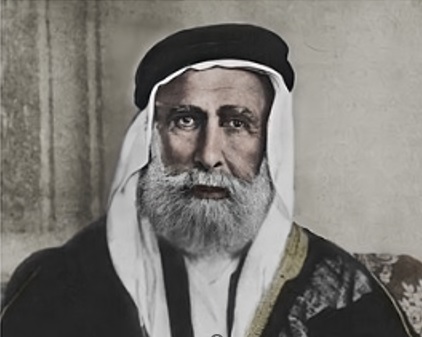
Hussein bin Ali (r.1916~1924) (الحسين بن علي الهاشمي)
1917年にメッカ太守(Sharif of Mecca) (r.1908~1916) (شريف مكة)でシャリーフ・フサイン(Hussein bin Ali) (1854~1931) (حسين ابن علي)は、ヒジャーズ王(King of Hejaz) (1916~1924) (ملك الحجاز)と全アラブの王(King of all Arabs) (ملك العرب)を宣言してイブン・サウードと対峙しました。シャリーフ・フサインが1924年にカリフ宣言(Caliphate Declaration) (إعلان الخلافة)すると、イブン・サウードは、イフワーン遠征部隊(Ikhwan Expeditionary Force) (قوة مشاة الإخوان)をターイフ(Taif) (طائف)に派遣、次いでジェッダ(Jeddah) (جدة)に迫り、1925年12月に降伏させました。イブン・サウードは、1926年1月に「ヒジャーズの王(King of the Hejaz) (ملك الحجاز)」を戴冠し、1927年5月には「ナジュドと属領のスルターン(Sultan of the Hejaz and of Nejd and Its Dependencies) (سلطان الحجاز ونجد وملحقاتها)」との二重王位がジェッダ条約(The 1927 Treaty of Jeddah) (معاهدة جدة 1927)によって英国に認められました。
In 1917 the Sharif of Mecca (r.1908~1916) (شريف مكة), Hussein bin Ali (1854~1931) (حسين ابن علي), proclaimed himself the King of Hejaz ( 1916~1924) (ملك الحجاز) cum the King of all Arabs (ملك العرب), and then he confronted Ibn Saud.
After Sharif Husayn’s Caliphate Declaration (إعلان الخلافة) in 1924, Ibn Saud sent the Ikhwan Expeditionary Force (قوة مشاة الإخوان) to Taif (طائف) and then Jeddah ( جدة ) and forced Jeddah to surrender in December 1925.
Ibn Saud was crowned “King of the Hejaz” (ملك الحجاز) in January 1926. Then, the dual throne of “Sultan of the Hejaz and the Najd and its dependencies) (سلطان الحجاز ونجد وملحقاتها)” was granted by the British government in the 1927 Treaty of Jeddah (معاهدة جدة 1927).
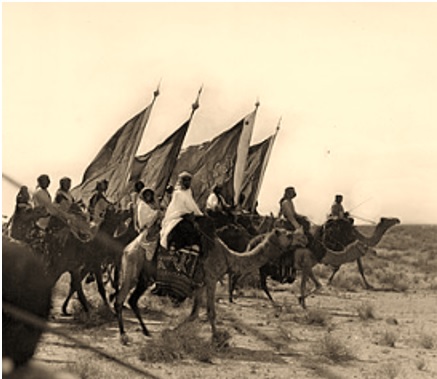
Ikhwan on the move
19世紀末にアルターウィヤ(Artawiyah) (أرطاوية)で始まったイフワーン運動(Ikhwan movement) (حركة الإخوان)は、部族の枠をこえた宗教・軍事上の同胞組織となり、イブン・サウードのアラビア半島統一の主力部隊でしたが、1920年代後期から公然と造反したのでイブン・サウードは、1930年代初めには弾圧して解散させました。
The Ikhwan movement (حركة الإخوان), which began in the late 19th century in the Artawiyah (أرطاوية), became a religious and military brotherhood organization that transcended tribal boundaries, and was Ibn Saud’s main force for the unification of the Arabian Peninsula. However, since the late 1920s it had openly rebelled and Ibn Saud cracked down and disbanded it in the early 1930s.
アシールとティハーマのサウジアラビア王国編入
Incorporate Asir and Tihama to Saudi Arabia
国境を争っていたイエメンと後述の「1934年条約(Treaty of Taif) (معاهدة الطائف 1934)」が締結され、ナジュラーン(Najran) (نجران)を含みイブン・アイド(Hasan Ali Ibn Aid) (r.1917~1919) (حسن علي ابن عيد)よって支配されていたアシール(Asir) (عسير)およびイドリーシー一族が支配していたティハーマ(Tihama) (تهامة)は、サウジアラビア王国に編入されました。これでイエメンとの国境紛争は、一応終了しましたが、実際には、その後も国境問題は継続し、解決したのは21世紀に入った最近の事です。
The “Treaty of Taif” (معاهدة الطائف 1934) was concluded with Yemen, who had been fighting over the border. Thus, the Asir (عسير kl) including the Najran (نجران) and Tihama (تهامة) were incorporated into the Kingdom of Saudi Arabia. Until then, the Asir (عسير kl) including the Najran was controlled by Hasan Ali Ibn Aid (r.1917~1919) (حسن علي ابن عيد) and Tihama was ruled by the Idrisi clan (الإدريسي). With this, the border dispute with Yemen came to an end, but in fact, the border issue continued even after that, and it was only recently in the 21st century that it was resolved.
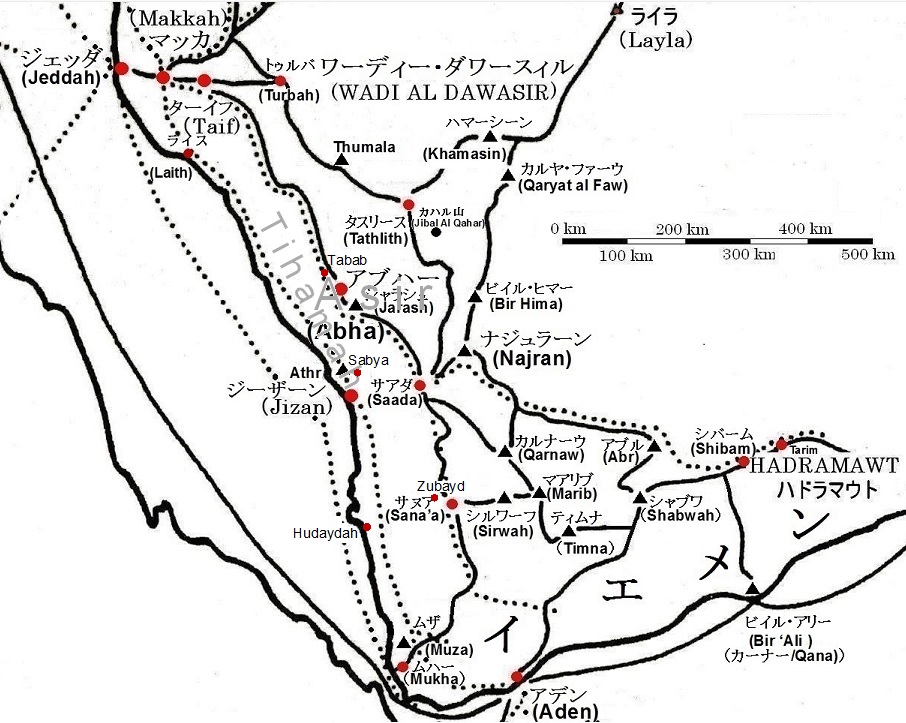
Asir – Tihama
イブン・アイドのアシール支配
Muhammad ibn ‘Awn’s control over Asir
1817 /1818年、シャリーフ(Sharif) (شريف) ムハッマド・イブン・アウン (Muhammad ibn ‘Awn) (محمد ابن عون)は、軍隊をアシール(Asir) (عسير)へと進め、占領し、征服してオスマン帝国総督(Wali) (والي)ムハッマド・アリー・パシャ(Muhammad Ali Pasha) (1769~1849) (محمد علي باشا)の支配下に置きました。
In 1817/1818, Sharif (شريف) Muhammad ibn ‘Awn (محمد ابن عون) advanced his army to Asir (عسير), captured and conquered there. Then he placed Asir under the rule of Muhammad Ali Pasha (1769~1849) (محمد علي باشا), Governor-General (Wali) (والي) of Ottoman Empire.
しかしながら、サイード・イブン・ムスラト・アル=ムフィーディ(Sa’eed ibn Muslat al-Mufeedi) (سعيد بن مسلة المفيدي)に率いられたアシール(Asir) (عسير)の住人は、1822/1823年にタバブ(Tabab) (طبب)のシャリーフ(Sharif)ムハッマド・イブン・アウン (Muhammad ibn ‘Awn) の要塞を襲い、彼を殺し、要塞の守備隊長のハッザ・イブン・アウン(Hazza ibn ‘Awn) (هزاع بن عون)を放逐しました。
In 1822/1823 the inhabitants of Asir (عسير) were led by Sa’eed ibn Muslat al-Mufeedi (سعيد بن مسلة المفيد), and they Rebelled against Sharif Muhammad ibn ‘Awn. They stormed his fortress at Tabab (طبب), killed him, and exiled Hazza ibn ‘Awn (هزاع بن عون), the garrison captain of the fortress.
サウド・イブン・ムサエド(Sa’ud ibn Musaed) (سعود بن مساعد)が力を持ち、アシールの首長にはバヌー・ムフィード族 (Banu Mufeed) (بنو مفيد)が任命されました。最も卓越した首長は、アリー・イブン・ミサル・アル=ムフィーディ(‘Ali ibn Mihthal al-Mufeedi) (علي بن مهثال المفيدي)でした。彼は、没する1833/1834年までイスラームを支持し、最大の保護と配慮をもって尽くしました。
Sa’ud ibn Musaed (سعود بن مساعد) was in power, and the Banu Mufeed (بنو مفيد) was appointed Amir of Asir. The most prominent Amir was ‘Ali ibn Mihthal al-Mufeedi (علي بن مهثال المفيدي). He upheld Islam until his death in 1833/1834, rendering it with the utmost protection and care.
その後は、アイド ・イブン・マリ(‘Ayid ibn Mar’i) (عيد بن مرعي)が引継ぎ、北は、バスルハマル(Baslhamar) (بصلحمر)族の区域から南は、ズバイド(Zubayd) (زبيد)、西は、ガムハー(Qamhah) (قمـحـة)海岸、東は、タスリース(Tathlith) (تثليث)まで首長国の領域を広げました。オスマン帝国(Ottoman Empire) (1299~1923) (لدولة العثمانية)が47年間の支配を終えて引き上げた1820/1821年までオスマン帝国に帰属していました。
It was then taken over by ‘Ayid ibn Mar’i (عيد بن مرعي). He extended the territory of this Emirate until Baslhamar (بصلحمر) territory to the north, Zubayd (Zubayd) to the south, the coast of Qamhah to the west, and Tasrith to the east. However, Asir had belonged to the Ottoman Empire until 1820/1821, that was the year when Ottoman Empire (1299~1923) (لدولة العثمانية) withdrew after 47 years of Asir rule.
その後、フサイン・イブン・アリー・イブン・アイド(Husayn ibn ‘Ali ibn ‘Ayid) (حسن علي ابن عيد)が支配権を握りましたが、ムハンマド・イブン・アリー・イドリーシー(Muhammad ibn Ali al-Idrisi) (r.1906 ~1920) (محمد بن علي الإدريسي)との戦いは、1919 1920年にアブドゥルアズィーズ・ビン・アブドゥルラフマーン・ビン・ファイサル・アール・サウード王 (King Abdulaziz bin Abdul Rahman Al Saud) (1932~1953) (الملك عبدالعزيز بن عبد الرحمن آل سعود)が軍隊を組織し、アブドゥルアズィーズ・イブン・ムサイド(‘Abd al-‘Aziz ibn Musa’id) (عبد العزيز بن مساعد)の指揮の下にアシールに派遣し、この地域を占領するまで続きました。
Husayn ibn ‘Ali ibn ‘Ayid (r.1917~1919) (حسن علي ابن عيد) then assumed control. However, the war soon began with Muhammad ibn Ali al-Idrisi (r.1906 ~1920) (محمد بن علي الإدريسي). It continued until Saudi force occupied the area in 1919/1920. This force was formed by King Abdulaziz bin Abdul Rahman Al Saud (1932~1953) (الملك عبد العزيز بن عبد الرحمن آل سعود), and was sent to Asir under the command of ‘Abd al-‘Aziz ibn Musa’id (عبد العزيز بن مساعد).
イブン・アイド(Ibn Aid)の軍隊は、1922 /1923年にアシール再び戻って来ましたが、ファイサル・イブン・アブドゥルアズィーズ首長(Amir Faisal ibn ‘Abd al-‘Aziz) (1906~1975) (أمير فيصل بن عبد العزيز)の軍隊がアブハに侵攻、無血入城して征圧しました。ファイサル(Faisal)は、この地域の治安を強化し、首長を任命しました。この時からアシールはサウジアラビア王国(Kingdom of Saudi Arabia) (المملكة العربية السعودية)の中の独立した行政体として残って来ています。
Ibn Aid’s army returned again to Asir in 1922/1923, but Amir Faisal ibn ‘Abd al-‘Aziz (1906~1975) (أمير فيصل بن عبد العزيز)’s army invaded Abha, entered it bloodlessly and conquered Asir. Faisal strengthened security in the region and appointed a chieftain for each county. Since then, Asir has remained an independent administrative body within the Kingdom of Saudi Arabia (المملكة العربية السعودية).
バヌー・ムフィード (Banu Mufeed) (بنو مفيد):アシール族同盟(Asir Alliance) (تحالف عسير)の一部族。
Banu Mufeed (بنو مفيد): A member of Asir Alliance (تحالف عسير).
バスルハマル族(Baslhamar) (بصلحمر):アシール山脈在住部族(Tribes in Sarawat Mountains) (القبائل في جبال السروات)の一部族
Baslhamar (بصلحمر): One of Tribes living in Sarawat Mountains (القبائل في جبال السروات).
イドリーシー族のティハーマ支配
Tihama Rule of Idrisi Tribe
預言者ムハッマド(Prophet Muhammad) (الرسول محمد)の血を引くアラウィー(Alawi) (علوي)の一人イドリーシー(Idris ibn Abdallah) (r.788~791) (إدريس بن عبد الله)がマグリブ(Maghreb) (مغرب)のベルベル人(Berbers) (بربر)に受け入れられ、開いたシーア派(Shia Islam) (شيعة)王朝がイドリーシー朝(Idrisid Dynasty) (789~985) (الدولة الإدريسية)です。その末裔が率いたティハーマ(Tihama) (تهامة)に住む部族がイドリーシー族(Idrisi Tribe) (قبيلة الإدريسي)と呼ばれていました。
Idris ibn Abdallah (r.788~791) (إدريس بن عبد الله) is one of Alawi (علوي), the descendants of the Prophet Muhammad (الرسول محمد). He was accepted by the Berbers (بربر) of the Maghreb (مغرب) and founded the Shia Islam (شيعة) dynasty. That dynasty was the Idrisid Dynasty (789~985) (الدولة الإدريسية). The tribe living in Tihama (تهامة) led by its descendants was called the Idrisi Tribe (قبيلة الإدريسي).
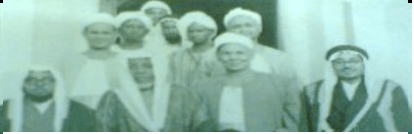
Idrisi Tribe
サブヤ(Sabya) (صبيا)に行政府を構えたムハッマド・イブン・アリ・アル=イドリーシー(Muhammad ibn Ali al-Idrisi) (r.1906~1920) (محمد بن علي الإدريسي)は、オスマン帝国(Ottoman Empire) (الدولة العثمانية)がアシールから撤退した後、ティハーマ中心にアシールを支配し、サブヤ・イドリーシー首長国(Idrisid Emirate of Sabya) (إمارة صبيا الإدريسية)とも呼ばれるイドリーシー首長国(Emirate of Al-Idrisi) (1906~1934) (إمارة الإدريسي)を樹立していました。
Muhammad ibn Ali al-Idrisi (r.1906~1920) (محمد بن علي الإدريسي) had an executive branch in Sabya (صبيا). After the Ottoman Empire (الدولة العثمانية) withdrew from Asir, he ruled Asir centered on Tihama and established the Emirate (مارة). That emirate was the Emirate of Al-Idrisi (1906~1934) (إمارة الإدريسي), also called the Idrisid Emirate of Sabya (إم صبيارة الإدريسية).
1920年にイブン・サウド(Ibn Saud) (بن سعود)がアシール(Asir) (عسير)および遠くフダイダー(Hudaydah) (حديدة)までのティハマー(Tihamah) (تهامة) をイドリーシー首長国の名目支配の儘で保護領の主都となるアブハー(Abha) (أبها)を占領しました。
In 1920 Ibn Saud (بن سعود) made Asir (عسير) and Tihamah (تهامة) as far as Hudaydah (حديدة) a protectorate under the nominal rule of the Emirate of Idrisi. He then captured Abha (أبها), the capital of the protectorate
1922年にムハッマド・アル=イドリーシー(Mohammad al-Idrisi) (محمد الإدريسي)が没するとその息子と兄弟に率いられた分族間の内戦が続きました。この内戦は、1934年のタイフ条約(Treaty of Taif) (معاهدة الطائف)で、アシール(Asir)およびティハマー(Tihamah)がサウディアラビア王国(the Kingdom of Saudi Arabia)に編入されて決着しました。
After the death of Mohammad al-Idrisi (محمد الإدريسي) in 1922, a civil war ensued among the tribes led by his sons and brothers. The civil war ended with the 1934 Treaty of Taif (معاهدة الطائف), which incorporated Asir and Tihamah into Kingdom of Saudi Arabia (المملكة العربية السعودية).
サウジアラビア王国建国と石油発見
Founding Saudi Arabia and Oil Discovery
1932年9月23日にイブン・サウード(Ibn Saud) (ابن سعود)は、ナジュドおよびヒジャーズ二重王国(Kingdom of Hejaz and Nejd) (1926~1932) (مملكة الحجاز ونجد)をサウード家のアラビア(Arab Kingdom of House of Saud) (المملكة العربية لآل سعود)と名付け、国王に成る事を宣言し、ここにサウジアラビア王国(Kingdom of Saudi Arabia) (المملكة العربية السعودية).が建国されました。
On September 23, 1932, Ibn Saud (ابن سعود) rename the Double Kingdom of Hejaz and Nejd (1926~1932) (مملكة الحجاز ونجد) to the Arab Kingdom of House of Saud (المملكة العربية لآل سعود). and he declared himself to be its king. Thus, the Kingdom of Saudi Arabia (المملكة العربية السعودية) was founded here.

Ibn Saud, 1932
新王国は、限られた農業と巡礼収入に頼るもっとも貧しい国の1つでしたが、1938年にハサー地方(Ahsa region) (منطقة الأحساء)で莫大な埋蔵量の原油が発見され、1941年に大規模な油田開発が米国経営のARAMCO(Arabian-American Oil Company)の下で開始されました。原油は、経済的繁栄および傑出した国際的政治影響力をもたらしました。
The New Kingdom was one of the poorest nations relying on limited farming and pilgrim income, but in 1938 huge reserves of crude oil were discovered in the Ahsa region (منطقة الأحساء), and in 1941 A large-scale oil field development was started under the American management of ARAMCO (Arabian-American Oil Company). Crude oil had brought economic prosperity and outstanding international political influence.
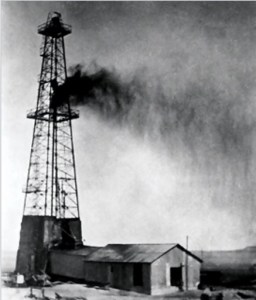
Damman No.7, Struck Oil, 1938 03 03
二度の石油ショックと世界最大の原油生産国有化
Twice Oil Shocks and Nationalization of World’s Largest Oil Production
1953年に父王の死によってサウード(Saud bin Abdulaziz Al Saud) (r.1953~1964) (سعود بن عبد العزيز آل سعود)が国王に即位し、王家内部の激しい敵対関係の後に腹違いの弟のファイサル(Faisal bin Abdulaziz Al Saud) (r.1964~1975) (فيصل بن عبد العزيز آل سعود)によって1964年に追放されました。
1973年に第四次中東戦争(the Fourth Arab–Israeli War or the October War) (حرب أكتوبر)で西洋諸国がイスラエルを支援した事に対して石油禁輸をファイサルが指導し、原油価格は4倍に値上がりしました(第一次石油ショック(the 1973 oil crisis or first oil crisis) (حظر النفط 1973))。1975年にファイサルは、暗殺され、腹違いの弟ハーリド(Khalid bin Abdulaziz Al Saud) (r.1975~1982) (خالد بن عبد العزيز آل سعود)によって後継されました。1976年までにサウジアラビアは世界最大の原油生産国となりました
In 1953, following the death of his father, Saud bin Abdulaziz Al Saud (r.1953~1964) (سعود بن عبد العزيز آل سعود) became the king, and after the bitter internal rivalries, his half-brother Faisal bin Abdulaziz Al Saud (r.1964~1975) (فيصل بن عبد العزيز آل سعود) exiled him in 1964 and Faisal enthroned as the third king.
In 1973, Faisal led an oil embargo in response to the western Aid to Israel in the Fourth Arab–Israeli War (the October War (حرب أكتوبر)), and then the crude oil price had risen to quadruple. This was the 1973 oil crisis (the first oil crisis (حظر النفط 1973)). In 1975 Faisal was assassinated and succeeded by his half-brother Khalid bin Abdulaziz Al Saud (r.1975-1982). By 1976 Saudi Arabia became to the world’s largest oil producer.
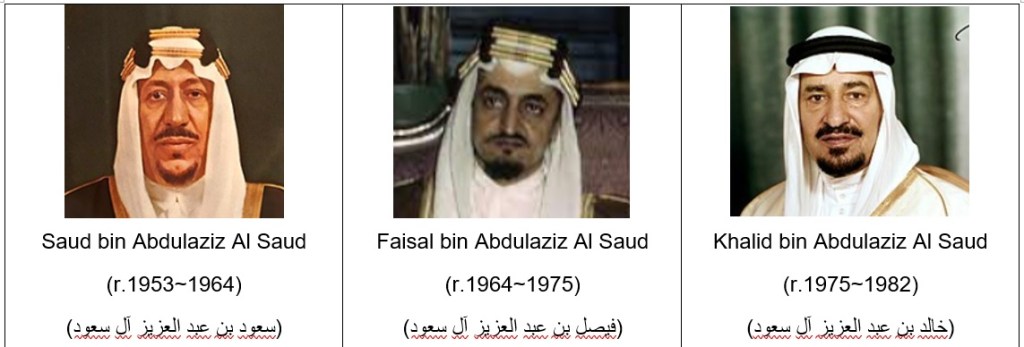
Saud-Faisal-Khalid
1979年にはサウジ政府が重大な関心を持ち、外交と内政に長い間影響を与えた「イランのイスラーム革命(the Iranian Revolution or Islamic Revolution) (1979) (الثورة الإسلامية في إيران)」と「メッカの大モスクの占拠(Grand Mosque Seizure) (1979) (حادثة الحرم المكي 1979)」が起きました。それらが第二次石油ショック(the 1979 Oil Shock or Second Oil Crisis)
(1979 أزمة الطاقة)と云われる原油高騰の契機となり、産油国は、勢力を増しました。1980年にサウジアラビアは、アラムコの米国持ち分を100%に買い足し、サウジ産原油支配力を自らの掌中に収めました。(the founding of the Saudi Arabian Oil Group (Saudi Aramco) (أرامكو السعودية)).
In 1979, the Islamic Revolution of Iran (1979) (الثورة الإسلامية في إيران) and the Grand Mosque Seizure) (1979) (حادثة الحرم المكي 1979) were of great concern to the Saudi government. And the both incidents had a long-lasting impact on either the foreign affairs or domestic affairs of the Saudi government. They also triggered a sharp rise in crude oil prices, and increased the power of the oil-producing countries. This was the 1979 Oil Shock (1979 أزمة الطاقة) which was also called as the Second Oil Crisis.
In 1980, Saudi Arabia acquired a 100% US stake in Aramco, giving it control over Saudi oil. This was the founding of the Saudi Arabian Oil Group (Saudi Aramco) (أرامكو السعودية)).
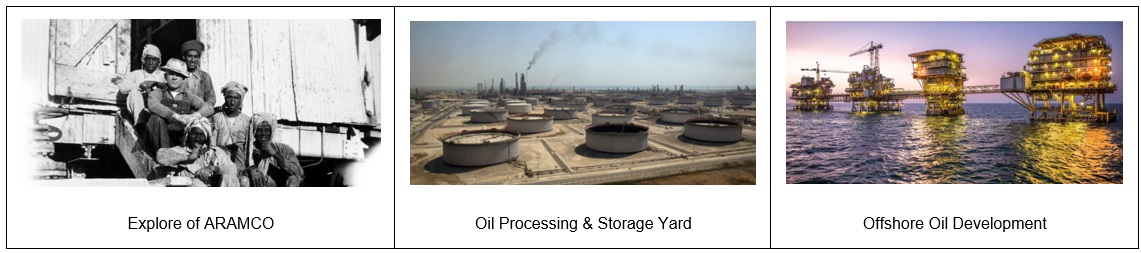
ARAMCO Operation Sites
原理主義者の台頭、2 度の湾岸戦争、増加するイスラム テロリズム
Rising Fundamentalists, Twice Gulf Wars, Increasing Islamic Terrorism
1982年6月にハーリド国王は、心臓麻痺で亡くなりました。異母弟ファハド(Fahd bin Abdulaziz Al Saud) (r.1982~2005) (فهد بن عبد العزيز آل سعود)が後継者と成り、原理主義者(Islamic Fundamentalists) (الأصوليون الإسلاميون)の圧力に応えて1986年、自分の名に「2聖モスクの守護者(Custodian of the Two Holy Mosques) (خادم الحرمين الشريفين)」と付け加えました。
King Khalid died of a heart attack in June 1982. His half-brother Fahd bin Abdulaziz Al Saud (r.1982~2005) (فهد بن عبد العزيز آل سعود) became his successor, and in 1986, in response to pressure from the Islamic Fundamentalists (الأصوليون الإسلاميون), He added to his name “Custodian of the Two Holy Mosques” (خادم الحرمين الشريفين).
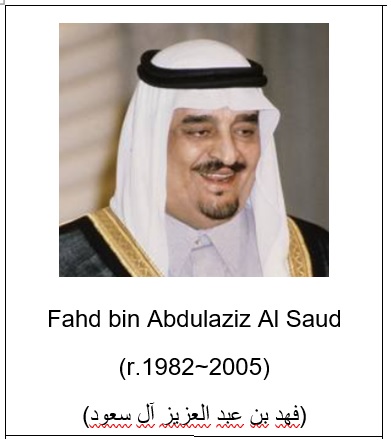
Fahd
石油歳入が生み出す莫大な富は、サウジ社会に巨大な衝撃を伴う影響力を持ち始めました。莫大な富が文化的ではなく技術的に急速な近代化、都市化、教育改革や新たなメディアの創設を導きました。この事と増大する多くの外国人労働者が伝統的なサウジの規範や価値観を大きく変化させました
The enormous wealth generated by oil revenues has begun to have a huge impact on the Saudi society. Great wealth has led to the rapid modernization, urbanization, educational reforms and the creation of new media, technologically rather than culturally. Addition to those, the growing number of foreign workers had significantly changed the traditional Saudi norms and values.
サウジアラビアは、1980年代のイラン・イラク戦争(第一次湾岸戦争)(Iran–Iraq War) (1980-1988) (حرب الخليج الأولى)ではサッダーム・フセイン(Saddam Hussein) (r. 1979~2003) (صدام حسين)を支援する為に250億ドルを費やしましたが、1990年8月の「イラクのクウェイト侵攻(Iraqi invasion of Kuwait) (August 1990) (الغزو العراقي للكويت)」を強く非難し、イラクへの爆撃およびクウェイト解放を助ける為の陸上侵攻に参加しました(「湾岸戦争(第二次湾岸戦争)(Gulf War) (Operation Desert Shield and Operation Desert Storm) (1990~1991) (حرب الخليج الثانية)」)。
Saudi Arabia spent $ 25 billion to assist Saddam Hussein (r. 1979-2003) (صدام حسين) during the Iran–Iraq War (1980-1988) (حرب الخليج الأولى) in the 1980s. Contrary to this, Saudi Arabia strongly condemned “Iraqi invasion of Kuwait (August 1990)” (الغزو العراقي للكويت), and joined to bomb Iraq and helped the liberate Kuwait. (“Gulf War (Operation Desert Shield and Operation Desert Storm) (1990~1991) (حرب الخليج الثانية)”).
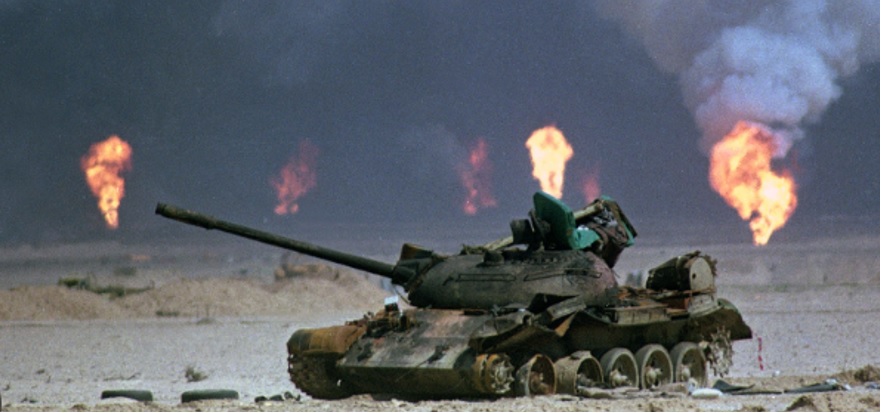
Operation Desert Shield and Operation Desert Storm
サウジアラビアの西洋との接近は、イスラーム・テロリスト(Islamic Terrorist) (ارهابي اسلامي)の増大および西洋諸国でのイスラーム・テロ攻撃(Islamic terrorist Attack) (هجوم ارهابي اسلامي)を招く原因でもありました。この為、1992年3月に支配者の義務と責任を強調した「基本法(the Basic Law of Saudi Arabia) (النظام الأساسي للحكم) 」を施行し、1993年12月に諮問評議会(Consultative Assembly of Saudi Arabia) (مجلس الشورى السعودي)が発足しました。
Saudi Arabia’s proximity to the occidental countries had also contributed to the rise of (Islamic Terrorism) (إرهاب منسوب للمسلمين) as well as Islamic Terrorist Attacks (هجوم ارهابي اسلامي) in the westerns. For this reason, the Basic Law of Saudi Arabia (النظام الأساسي للحكم) came into force in March 1992, emphasizing the duties and responsibilities of rulers. Based on this, the Consultative Assembly of Saudi Arabia (مجلس الشورى السعودي) was established in December 1993.
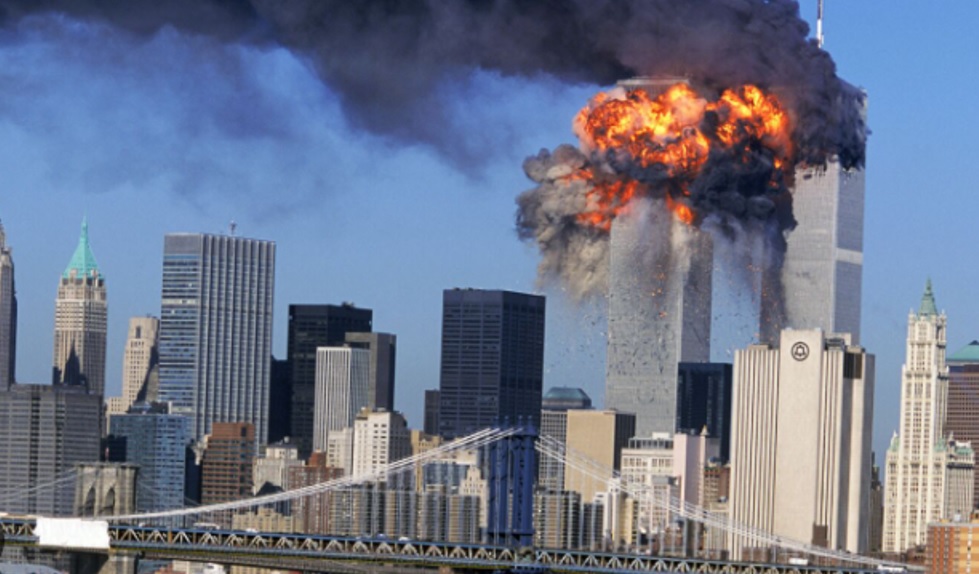
World Trade Center attacked on 2001.09.11
石油歳入の依存脱却のための自由化・近代化と経済改革
Liberalization, modernization and economic reforms for de-dependence on oil revenues
2005年に異母弟アブドゥッラー(Abdullah bin Abdulaziz Al Saud) (r.2005~2015) (عبد الله بن عبد العزيز آل سعود)が故ファハド(Fahd)を後継し、当座は最低限の改革と抗議を抑え込む政策を継続しました。アブドゥッラー国王(King Abdullah) (الملك عبدالله)は、石油歳入への依存を減らす為に制限付きの自由化、外国投資促進および私有化等の多くの経済改革を導入し、2009年2月には司法、武装部隊および様々な省庁を近代化する為の一連の政府機構の改変を発表しました。これ等には司法組織およびムタワ(宗教警察)(Islamic religious police) (مطوعين)幹部の穏健な個人による交代およびサウジ最初の女性副大臣の任命も含まれていました。
In 2005, his half-brother Abdullah bin Abdulaziz Al Saud (r.2005~2015) (عبد الله بن عبد العزيز آل سعود) succeeded the late Fahd, for the time being a policy of minimal reforms and suppression of protests continued. Then, King Abdullah (الملك عبدالله) introduced a number of economic reforms to reduce dependence on oil revenues, including limited liberalization, promotion of foreign investment and privatization, and in February 2009, the Judiciary , announced a series of changes to government structures to modernize armed forces and various ministries. These included the replacement of the Judiciary and Islamic religious police (Mutaween (مطوعين)) leadership by moderate individuals and also the appointment of Saudi Arabia’s first female deputy minister.
ムタワ(مطوعين):勧善懲悪委員会(the Committee for the Promotion of Virtue and the Prevention of Vice) (هيئة الأمر بالمعروف والنهي عن المنكر)で、実質的にサウジアラビアの宗教警察です。
Mutaween (مطوعين): the Committee for the Promotion of Virtue and the Prevention of Vice (هيئة الأمر بالمعروف والنهي عن المنكر), effectively the religious police of Saudi Arabia.
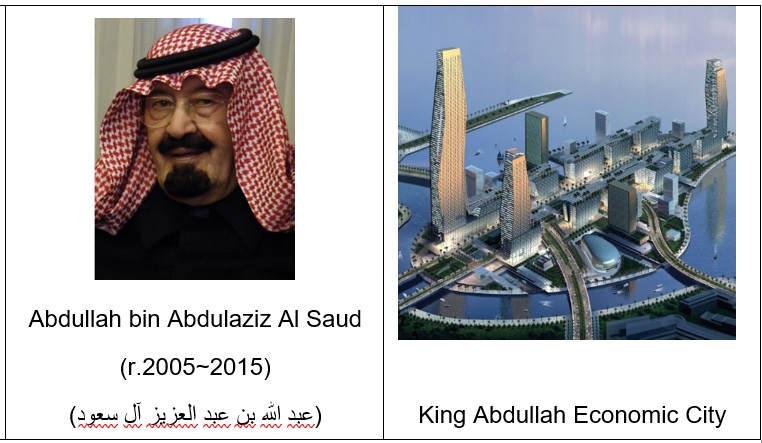
King Abdullah & Economic City
2011年以来、自国の「アラブの春(Arab Spring) (الربيع العربي)」抵抗運動に応えて、アブドゥッラー国王は360億ドルに上る一連の国民に対する給付を発表し、続いて新たな治安業務への6万人雇用に加えて670億ドルの50万棟の新築住宅が含まれる930億ドルのパッケージを発表し、国民の不満を和らげようとしていました。2015年の地方自治体選挙に女性が参加、立候補する事、さらに諮問評議会もメンバーに女性を任命することも認めました。
Since 2011, in response to his country’s Arab Spring (الربيعالعربي) resistance movement, King Abdullah has announced a series of public benefits amounting to $36 billion. He then sought to assuage public discontent by announcing a $93 billion package that included 60,000 new security jobs, plus half a million new homes worth $67 billion. It also allowed for women to participate and stand in the 2015 local government elections and also for women to be appointed as members of the Consultative Assembly (مجلس الشورى السعودي).
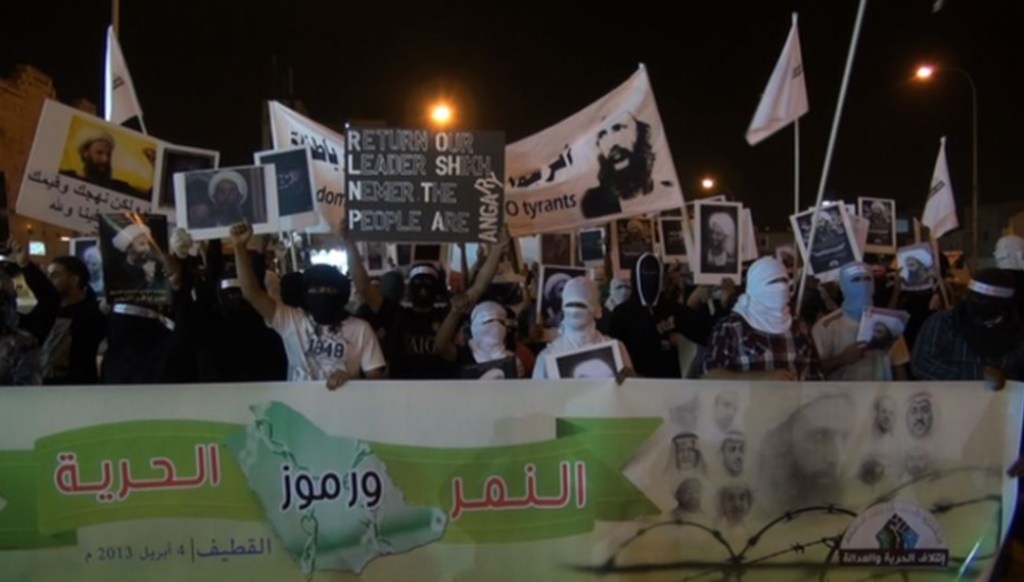
Saudi Arabia hidden uprising published on 2014.05.30
サルマーン国王即位とビジョン2030
King Salman Enthronement and Vision 2030
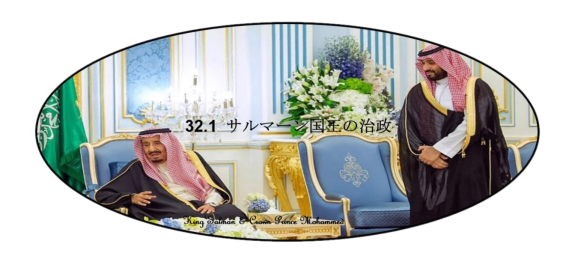
アブドゥッラー国王が2015年1月23日死去すると、故ファハド同腹の異母弟サルマーン殿下(Salman bin Abdulaziz Al Saud) (1935~present) (سلمان بن عبد العزيز آل سعود)が同日付で第7代サウジアラビア国王(7th King of Saudi Arabia) (r. 2015~present) (السابع ملك المملكة العربية السعودية)に即位しました。
King Abdullah passed away on January 23, 2015. His half-brother Salman bin Abdulaziz Al Saud (1935~present) (سلمان بن عبد العزيز آل سعود) became the 7th King of Saudi Arabia on the same date. 7th King of Saudi Arabia) (r. 2015~present) (السابع ملك المملكة العربية السعودية).
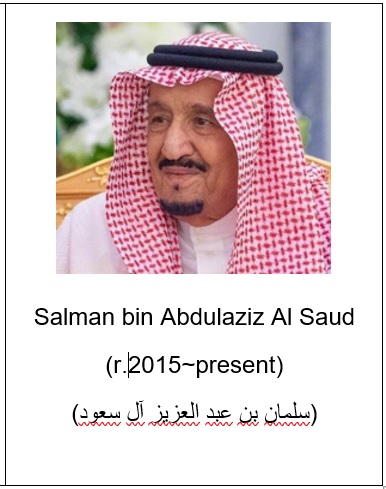
Salman
政策継承を声明して皇太子に異母弟ムクリン殿下(Muqrin bin Abdulaziz) (1945~present) (مقرن بن عبد العزيز آل سعود)、副皇太子には第三世代初のナーイフ殿下(Muhammad bin Nayef) (1959~present) (محمد بن نايف آل سعود)を任命しました。又、国王自身の息子で1985年生まれのムハンマド殿下(Mohammed bin Salman) (محمد بن سلمان آل سعود を国防大臣に任命しました。
Declaring the succession of the policy, Prince Muqrin bin Abdulaziz (1945~present) was appointed as Crown Prince, and Muhammad bin Nayef (1959~present) was appointed as Deputy Crown Prince (محمد بن نايف آل سعود). His Highness Naif was the first member of the third generation of the House of Saud (آل سعود) to be named heir to the throne. It also appointed His Highness Mohammed bin Salman (محمد بن سلمان آل سعود), a son of King Salman, born in 1985, as Defense Minister.
3ヵ月後の4月29日に皇太子を解任、ナーイフ殿下に皇太子を継承させ、ムハンマド殿下(Mohammed bin Salman)を副皇太子兼国防大臣に任命しました。翌2016年、4月25日にムハンマド殿下提案のサウジアラビア新国造り「ビジョン2030 (Saudi Vision 2030) (رؤية السعودية 2030)(イスラームに基づき、石油依存体質から脱却し,包括的発展を実現するための成長戦略)」を承認、その為の公的投資基金を確保する為にアラムコ株式の5%売却準備に着手し ました。
Three months later, on April 29, King Salman dismissed the crown prince, appointing Prince Nayef as New Crown Prince and appointing Prince Mohammed bin Salman as Deputy Crown Prince cum Minister of Defense. On April 25, 2016, the Reconstruction Plan of Saudi Arabia proposed by Deputy Crown Prince Mohammed was approved. This proposal is named “Vision 2030 (Saudi Vision 2030) (رؤية السعودية 2030)” and is a growth strategy plan based on Islam to break away from dependence on oil and realize comprehensive development. It was ordered the preparations to begin to sell a 5% stake in Aramco to secure public investment funds for its implementation.

Saudi Aramco IPO broke record on 2019.12.11
 Desert peninsula