38 Bahrain since Modern Time


目次(Index)
Bahrain Territory
バハレインとイスラーム教
Bahrain and Islam
16世紀初頭まで、バハレイン(Bahrain) (بحرين)という名前は、アラビア湾岸に沿ってバスラ(Basra) (بصرة)からホルムズ海峡(Strait of Hormu) (مضيق هرمز)まで広がるバハレインのより広い歴史的地域を指していました。この地域のアラブ人住民は、アラブ族アブドゥル・カイス族(‘Abd al-Qays) (عبد القيس)の子孫でした。
Until the early 16th century, the name Bahrain (بحرين) referred to the wider historical region of Bahrain stretching from Basrah (بصرة) to Strait of Hormuz (مضيق هرمز) along Arabian Gulf coast. Arab inhabitants of this region were descendants of Arab tribe Abd al-Qais (عبد القيس).
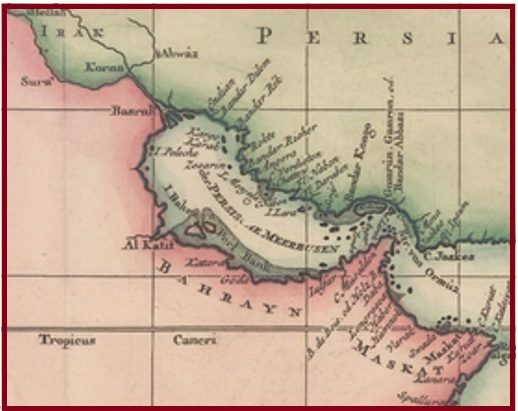
Historical region of Bahrain on a 1745 Bellin map
アブドゥル・カイス族(‘Abd al-Qays) (عبد القيس):ラビーア・アドナーン部族Rabi’ah Adnan Arab (ربيعة عدنان عرب)の支族
Abd al-Qays (عبد القيس): A branch of Rabi’ah Adnan Arab (ربيعة عدنان عرب)
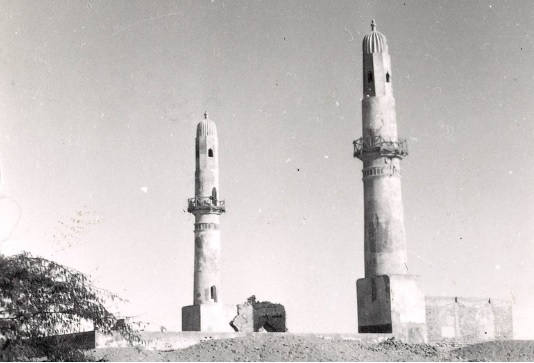
Khamis Mosque in 1956
バハレインは629年(ヒジュラ(Hijra) (هجرة)の7年目)にイスラーム教を受け入れました。預言者ムハンマド(Prophet Muhammad) (c.570~632) (الرسول محمد)は、彼の代表の一人であるアル=アラ`ア・アル=ハドラミー(Al-Ala’a Al-Hadhrami) (d.635/636 or 641/642) (العلاء الحضرمي)を通じてバハレインを統治しました。預言者の有名な仲間であるウマル・イブン・アル=ハッターブ(Umar ibn al-Khattab) (r. 634~644) (عمر بن الخطاب)の時代、アブ・フライラ(Abu Hurayrah) (c.603~681) (أبو هريرة)は、バハレインの知事でした。ウマル・イブン・アル=ハッターブはまた、ウスマーン・ビン・アビー・アル=アース(Uthman bin Abi Al As) (d.671 or 675) (عثمان بن أبي العاص)をこの地域の知事に任命した。692年に設立されたアル=カミース?/モスク(Al Khamis Mosque) (مسجد الخميس)は、ウマイヤ朝(Umayyad Dynasty) (661~750) (الخلافة الأموية)のカリフ・ウマル・イブン・アブドアルアジーズ(Caliph Umar ibn Abd al-Aziz) (r.717~720) (عمر بن عبد العزيز)の時代にバハレインで建てられた最も初期のモスクの1つでした。イスラーム教以前は、バハレインはネストリウス派キリスト教の中心地でした。
Bahrain embraced Islam in 629 (the seventh year of hijra); Prophet Mohammed (c.570~632) (الرسول محمد) ruled Bahrain through one of his representatives, Al-Ala’a Al-Hadhrami (d.635/636 or 641/642) (العلاء الحضرمي). During the time of Umar ibn al-Khattab (r.634~644) (عمر بن الخطاب) the famous companion of Prophet, Abu Hurayrah (c.603~681) (أبو هريرة), was the governor of Bahrain. Umar ibn al-Khattab also appointed Uthman bin Abi Al Aas (r.636~650) (عثمان بن أبي العاص) as governor of the area. Al Khamis Mosque (مسجد الخميس), founded in 692, was one of the earliest mosques built in Bahrain, in the era of Umayyad Dynasty (661~750) (الخلافة الأموية) Caliph Umar ibn Abd al-Aziz (r.717~720) (عمر بن عبد العزيز). Prior to Islam, Bahrain was a centre of Nestorian Christianity.
バグダッド(Baghdad) (بغداد)が750年にカリフの首都であり、イスラム文明の中心地として浮上した後、バハレインは、特に中国と南アジアからの外国製品に対する都市の需要の増加から大きな恩恵を受けました。
After Baghdad (بغداد) emerged as the capital of Caliph in 750 and the main centre of Islamic civilization, Bahrain greatly benefited from the city’s increased demand for foreign goods especially from China and South Asia.
中世のアラブ族支配
Medieval Arab domination
節索引(Section Index)
カルマティア共和国
Qarmatian Republic
900年頃、アブー・サイード・ハサン・イブン・アル=ジャンナービー(Abu Sa’id al-Hasan al-Jannabi) (845/855~913/91) (بو سعيد حسن بن بهرام الجنابي)は、クーファ(كوفة) (バグダッドの南170km)で始まったイスマーイール派(Ismailism) (الإسماعيليون)による反乱であるカルマティア革命(Qarmatian revolution) (899~1077) (ثورة القرامطة)を主導しました。アル=ジャンナービーは、当時のバハレインの首都であるハジル(حجر)の街と、彼が共和国の首都にしたアハサー(al-Hasa) (حسا),を引き継ぎました。国家を支配すると、彼はユートピア社会を創造しようとしました。
Around the year 900, Abu Sa’id al-Hasan al-Jannabi (845/855~913/91) (بو سعيد حسن بن بهرام الجنابي) led Qarmatian revolution (899~1077) (ثورة القرامطة), a rebellion by Ismailism (الإسماعيليون) originating in Kufa (كوفة) (170km south of Baghdad). Al-Jannabi took over the city of Hajr (حجر), Bahrain’s capital at that time, and al-Hasa (حسا), which he made the capital of his republic. Once in control of the state he sought to create a utopian society.
カルマティア人の目標(Qarmatians’ goal)は、理性と平等に基づいた社会を構築することでした。コミュニティ内のすべての財産は、すべてのイニシエートに均等に分配されました。カルマティア人は秘儀的なな社会として組織されましたが、秘密結社として組織されませんでした。彼らの活動は公にされ、公然と広められました。
Qarmatians’ goal was to build a society based on reason and equality. All property within the community was distributed evenly among all initiates. Qarmatians were organized as an esoteric society but not as a secret one. Their activities were public and openly propagated.
バハレイン(Bahrain) (بحرين)を乗っ取る前でさえ、カルマティア人は、一部の学者がクーファで「テロの世紀」と呼んでいるものを扇動していました。バハレインから彼らはアラビアを横断する巡礼者のルートに沿って襲撃を開始しました。906年に彼らはメッカから戻ってきた巡礼者のキャラバンを待ち伏せし、20,000人の巡礼者を虐殺しました。アブー・ターヒル・アル=ジャナービー(Abu Tahir al-Jannabi) (r.923~944) (أبو طاهر الجنابي)の下で、彼らは923年にバグダッドを占領し、930年にメッカ(Mecca) (مكة)を略奪しました。イスラーム教の最も神聖な場所への攻撃で、カルマティア人はハッジ巡礼者の死体でザムザムの井戸(Well of Zamzam) (بئر زمزم)を冒涜し、メッカからアハサ ―にブラックストーン(Black Stone) (الحجر الأسود)を運びました。
Even before taking over Bahrain (بحرين), Qarmatians had instigated what some scholars have termed a ‘century of terrorism’ in Kufa. From Bahrain they launched raids along the pilgrim routes crossing Arabia. In 906 they ambushed the pilgrim caravan returning from Mecca (مكة) and massacred 20,000 pilgrims. Under Abu Tahir al-Jannabi (r.923~944) (أبو طاهر الجنابي) they came close to capturing Baghdad in 923, and sacked Mecca in 930. In the assault on Islam’s holiest sites, Qarmatians desecrated Well of Zamzam (بئر زمزم) with corpses of Hajj pilgrims, and took Black Stone (الحجر الأسود) from Mecca (مكة) to al-Hasa.
メッカの略奪は、928年に土星と木星の合をめぐってカルマティア人(およびペルシャ)の間で千年紀(千年紀)の興奮に続きました。バハレインは、シャリーア法を廃止したイスファハンから、カルマティア人の待望の救世主であるカルマティア・マハディー・カリフ(Qarmatian Mahdi-Caliph) (القرامطة المهدي-الخليفة)の首都になりました。新しいマハディはまた、メッカからの祈りの方向であるキブラ(Qibla) (قبلة)を火の方向、特にゾロアスター教の慣習(Zoroastrian practice) (ممارسة الزرادشتية)に変えました。
Sack of Mecca followed millenarian (millenarian) excitement among Qarmatians (and in Persia) over the conjunction of Saturn and Jupiter in 928. Bahrain became the capital of Qarmatian Mahdi-Caliph (القرامطة المهدي-الخليفة), who is the long-awaited savior of Qarmatians, from Isfahan who abolished Sharia law (قانون الشريعة). The new Mahdi also changed Qibla (قبلة), which is the direction of prayer from Mecca to that of fire, a specifically Zoroastrian practice (ممارسة الزرادشتية).
10世紀のほとんどの間、カルマティア人はアラビア湾と中東で最も強力な勢力であり、オマーンの海岸を支配していました。
For much of the 10th century Qarmatians were the most powerful force in Arabian Gulf and Middle East, controlling the coast of Oman.
カルマティア国は、バハレインとアハサーとカティーフ(Qatif) ()قطيفの両方に広大な果物と穀物の農園を持っていました。1051年にアハサーを訪れたナーシリ・クスルー(Nasiri Khusru) (1004~1070) (ناصر خسرو)は、これらの地所は約3万人のエチオピア人奴隷によって耕作されたと語った。彼は、「アハサーの人々は税金を免除されていた」と述べています。貧しい人や借金のある人は、業務を整理するまでローンを組むことができます。
Qarmatian state had vast fruit and grain estates both on Bahrain and in Hasa and Qatif (قطيف). Nasiri Khusru (1004~1070) (ناصر خسرو), who visited Hasa in 1051, recounted that these estates were cultivated by some thirty thousand Ethiopian slaves. He mentions that the people of Hasa were exempt from taxes. Those impoverished or in debt could obtain a loan until they put their affairs in order.
カルマティア人は、976年にアッバース朝(Abbasid Caliphate) (750~1258) (الدولة العباسية),によって戦いで敗北させられ、功利主義社会を構築するために内向きに目を向けることを奨励しました。1058年頃、アブドゥル・カイス族(‘Abd al-Qays) (عبد القيس)の2人のシーア派メンバー、アブー・アル=バフルル・アル=アワーム(Abu al-Bahlul al-Awwam) (أبو البهلول العوام)とアブー・アル=ワリード・ムスリム(Abu’l-Walid Muslim) (أبو الوليد مسلم),が率いるバハレイン島での反乱は、カルマティアの権力の衰退を引き起こし、最終的にはアブドゥル・カイス族に属するアラブ王朝であるウユーニー朝(Uyunids) (1076~ 1253) (العيونيون),の権力への優勢を引き起こしました。
Qarmatians were defeated in battle in 976 by Abbasid Caliphate (750~1258) (الدولة العباسية), which encouraged them to look inward to build their utilitarian society. Around 1058, a revolt on the island of Bahrain led by two Shi’a members of Abd al-Qays tribe, Abu al-Bahlul al-Awwam (أبو البهلول العوام) and Abu’l-Walid Muslim (أبو الوليد مسلم), precipitated the waning of Qarmatian power and eventually the ascendancy to power of Uyunids (1076~ 1253) (العيونيون), an Arab dynasty belonging to Abdul Qays tribe.
ウユーニー朝
Uyunid dynasty
1076年から1077年にかけて、シャイク(Shaykh) (الشيخ) アブドゥッラー・イブン・アリー・アル=ウユーニー(Abdullah bin Ali Al Uyuni) (عبد الله بن علي العيوني)は、大セルジューク帝国(Great Seljuq Empire) (1037~1194) (الدولة السلجوقية)の軍事支援を受けて、バハレインとアハサーのカルマティア人から国を占領し、ウユーニー朝(Uyunid dynasty) (الأسرة العيونية)を設立しました。ウユーニー朝は、11世紀から13世紀までの163年間バハレインを統治しました。彼らの宗派の帰属には、「シーア派あるいはスンニ派である」との論争がされています。彼らはアブドゥル・カイス族(‘Abd al-Qays) (عبد القيس)の残党でした。アハサー州はウユーニー首長国(Uyunid Emirate)の最初の首都でした。その後、アブドゥッラー(Abdullah) (عبد الله)の息子であるアルファドル(Al-Fadhl) (الفضل)は、首都をカティーフに移し、次にアワール(Awal) (أوال) (バハレインの古代の名前)に移します。彼の治世に、州はクウェートにまで及びました。
In 1076–1077, Shaykh (الشيخ) Abdullah bin Ali Al Uyuni (عبد الله بن علي العيوني) seized the country from Qarmatians in Bahrain and Al-Hasa with the military assistance of Great Seljuq Empire (1037~1194) (الدولة السلجوقية) and founded Uyunid dynasty. Uyunid dynasty, ruled Bahrain for 163 years, from the 11th to the 13th centuries. Their sect is disputed that some sources mention they were Shia, others Sunni. They were the remnants of Bani Abdul Qays tribe. The state of Al-Hasa was the first capital of Uyunid Emirate. Then Al-Fadhl (الفضل), son of Abdullah, transfers his capital to Qatif, then to Awal (أوال) (an ancient name of Bahrain). In his reign, the state extended to Kuwait.
1253年、ウユーニー家内の紛争により、バヌー・ウカイル(Banu Uqayl) (بنو عقيل)のベドウィン(Bedouin) (بدوي) ウスフールUsfurids (آل عصفور)はウスフール朝(Usfurids dynasty) (1253~1320) (الدولة العصفورية)を樹立し、ウユーニー王朝を破壊する機会を得ました。それによってバハレインの島々を含む東アラビアの支配権を獲得しました。
In 1253 C. Conflicts inside Uyunid family gave the chance to Bedouin (بدوي) Usfurids (آل عصفور) of Banu Uqayl (بنو عقيل) to establish Usfurids dynasty (1253~1320) (الدولة العصفورية) and destroy Uyunid dynasty. Thereby gaining control over eastern Arabia, including the islands of Bahrain.
バヌー・ウカイル族(Banu Uqayl) (نو عقيل):バヌー ‘アーミル族同盟(Banu ‘Amir Confederation) (اتحاد بنو أمير)傘下バヌー・カアブ族(Banu Ka’b or Banu Kaab) (بنو كعب)の一門。
Banu Uqayl (نو عقيل): A branch of Banu Kaab (بنو كعب), who belongs to Banu ‘Amir Confederation) (اتحاد بنو أمير).
なお、部族同盟の名には、下記のバヌー・ウカイル族(Banu Uqayl) (نو عقيل)の名前が使われています。
In addition, the name of the following Banu Uqayl (نو عقيل) is used as the name of this tribal confederation.
バヌー・ウカイル族(Banu Uqayl) (بنو عقيل) :ムダル・アドナーン部族(Mudar Adnan Arab) (مضر عدنان عرب)のカイス族(Kais) (قيس)のハワージン族(Hawazin) (هوازن)のアーミル族(‘Amir) (عامرية)のバヌー・カアブ族(Banu Kaab) (بنو كعب)一門の支族。
Banu Uqayl (بنو عقيل) : a branch of Banu Kaab (بنو كعب), who belongs to ‘Amir (عامرية), who belongs to Hawazin (هوازن), who belongs to Kais (قيس), who belongs to Mudar Adnan Arab (مضر عدنان عرب).
ウスフーリー朝
Usfurid dybasty
1253年、創設者のウスフール・イブン・ラーシド(Usfur ibn Rashid) (r.1253~1258) (عصفور بن راشد)にちなんで名付けられたバヌー・ウカイル族(Banu Uqayl) (بنو عقيل)のバハレインの王朝ウスフーリー朝(Usfurids) (1253~1320) (الدولة العصفورية)は、バハレインの島々を含む東アラビアの支配権を獲得しました。中世後期は慢性的に不安定な時期であり、地元の紛争により、カイス(Qais) (قیس) (Kish Island (جزيرة كيش))、キシュム(Qishm Island) (قشم جزيرة)、ホルムズ(Hormuz) (جزيرة هرمز)に拠点を置くさまざまなペルシャを拠点とするアラブ王国がバーレーンの問題に関与することができました。1330年、島々はホルムズ王国(Kingdom of Hormuz) (11th century~1622) (مملكة هرمز)の支配者の従属国となりました。そのホルムズ王国も1515年から1622年までポルトガルの属国でした。
In 1253, Bahrani dynasty of Usfurids (1253~1320) (الدولة العصفورية) of Banu Uqayl – named after its founder, Usfur ibn Rashid (r.1253~1258) (عصفور بن راشد) – gained control over eastern Arabia, including the islands of Bahrain. The late Middle Ages were a time of chronic instability with local disputes allowing various Persian-based Arab Kingdoms based in Qais (قیس) (Kish Island (جزيرة كيش)), Qishm (قشم جزيرة) and Hormuz (جزيرة هرمز) to involve themselves in Bahrain’s affairs. In 1330, the islands became tributary to the rulers of Kingdom of Hormuz (11th century~1622) (مملكة هرمز). Kingdom of Hormuz was also a vassal state of Portugal from 1515 to 1622.
カティーフ(Qatif) (قطيف)を訪れた北アフリカの旅行者イブン・バットゥータ(Ibn Battuta) (1304~1368/1369) (ابن بطوطة)は、真珠産業のおかげでこの地域の莫大な富を得ていると指摘していました。
North African traveller Ibn Battuta (1304~1368/1369) (ابن بطوطة) visiting Qatif (قطيف) around noted the great wealth of the area thanks to the pearling industry.
ジャブリー朝
Jabrids Emirate
15世紀半ば、ザーミル・イブン・ジャビル(Zamil ibn Jabir) (r.1417~1463) (زامل بن حسين بن جبر)が率いるバヌー・ウカイル(Banu Uqayl)の別の支族がバハレインの支配権を奪い、ベドウィン(Bedouin) (بدوي)ジャブリー族(Jabrids) (جبريون)の王朝を設立しました。アハサーに拠点を置くジャブリー首長国(Jabrids Emirate) (1417~1524) (الإمارة الجبرية)は、アラビア東部の大部分を支配し、スンニー派マーリキー学派の儀式(Sunni Maliki rite) (طقوس المالكي السني),に従いました。この儀式は首長国内で積極的に宣伝されました。
In the mid-15th century, another branch of Banu Uqayl, led by Zamil ibn Jabir (r.1417~1463) (زامل بن حسين بن جبر), wrested control of Bahrain, founding the dynasty of Bedouin (بدوي) Jabrids (جبريون). Based in al-Ahsa, Jabrids Emirate (1417~1524) (الإمارة الجبرية) ruled most of eastern Arabia and followed Sunni Maliki rite (طقوس المالكي السني), which they actively promoted within their emirate.
ポルトガルおよび近隣からの侵略統治
Invasive rule from Portugal or neighbors
節索引(Section Index)
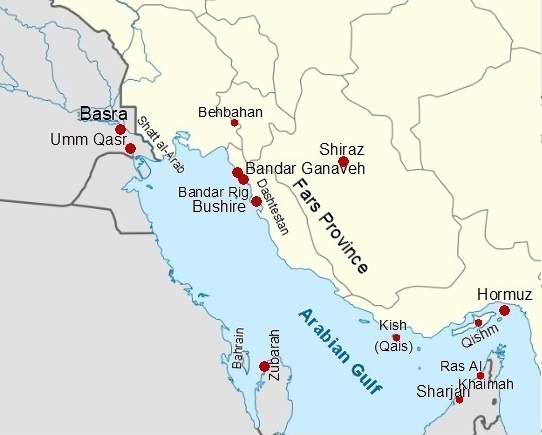
Arabian Gulf Map
真珠と交易路で潤うアラビア湾
Arabian Gulf enriched with pearls and trade
海の王子または海のライオンとして知られるアラブの航海士、アハマド・イブン・マージッド(Ahmad Bin Majid) (c.1432~c.1500) (أحمد بن ماجد)は、ラアス・アル=ハイマ(Ras Al Khaimah) (رأس الخيمة)で生まれました。彼はポルトガル人がこの地域に到着する前の1489年にバハレインを訪れ、国について「アワル(Awal) (أوال)(バハレインの昔の名前)には360の村があり、淡水は多くの場所で見つけることができます。バハレイン周辺には真珠漁業があり、多くの島々に真珠養殖場があり、この事業には、1,000隻程度の舟が関わっています。」と説明しています。
Arab navigator, Ahmad Bin Majid (c.1432~c.1500) (أحمد بن ماجد), known as Prince of Sea or Lion of Sea, was born in Ras Al Khaimah (رأس الخيمة). He visited Bahrain in 1489 prior to Portuguese’ arrival in the region and gave an account of the country: “In Awal (أوال) (Bahrain) there are 360 villages and fresh water can be found in a number of places. Around Bahrain are pearl fisheries and a number of islands all of which have pearl fisheries and connected with this trade are 1,000 ships”
16世紀初頭のポルトガルのインド洋への拡大は、ポルトガル人(Portuguese Empire) (1415~1999)がアラビア湾の海岸でオスマン帝国(Ottoman Empire) (1299~1923) (الدولة العثمانية)と戦ったヴァスコ・ダ・ガマ(Vasco da Gama) (c.1460s ~1524)の探検航海に続きました。アラビア湾岸の儲かる交易路に引き込まれたポルトガル人は、バハレイン(Bahrain)に目を向ける前に、戦略的なホルムズ(Hormuz)地域の支配を求めました。
Portuguese expansion into Indian Ocean in the early 16th century followed Vasco da Gama’s voyages of exploration in which Portuguese (Portuguese Empire) (1415~1999) battled Ottoman Empire (1299~1923) (الدولة العثمانية) up the coast of Arabian Gulf. Portuguese, drawn in by the lucrative trade routes of Gulf, sought control of the strategic Hormuz region before setting its sights on Bahrain.
ホルムズ王国属国化とアハサーの統合
Hormuz vassalization and Al Hasa integration
ポルトガルのホルムズ王国属国化
Hormuz vassalized by Portugal
ポルトガルの船は1485年に初めてアラビア湾に入りました。また、バハレインを最初に訪れたポルトガル人旅行者は、有名なドゥアルテ・バルボーサDuarte Barbosa (c.1480~1521) (دوارتي باربوسا)でした。
Portuguese ships first entered Gulf in 1485, the first reputed Portuguese traveller to visit Bahrain was Duarte Barbosa (c.1480~1521) (دوارتي باربوسا).
ポルトガルは、1507年にホルムズ王国(Kingdom of Hormuz)をポルトガルの属国としました。その後、ホルムズのバハレインの政治的支配は、バハレイン島がジャブリー首長国(Jabrids Emirate)に陥落した為に、失われました。アントニオ・コレイア(António Correia) (c.1487~1566) (أنطونيو كوريا)が率いるポルトガルとホルムズの合同軍は、バハレン(Bahrain)を占領し、西暦1520年にカティーフ(Qatif)を略奪し、ホルムズ(Hormuz)への朝貢を拒否していたジャブリー支配者(the Jabri ruler)のムグリン(Muqrin ibn Zamil) (مقرن بن زامل)を1521年に殺害しました。
After making Kingdom of Hormuz a Portuguese vassal state in 1507, Bahrain’s political control of Hormuz was lost because Bahrain fell to Jabrids Emirate. A combined Portuguese-Hormuz army led by António Correia captured Bahrain, sacked Qatif in 1520 AD, and killed Jabri ruler Muqrin ibn Zamil (مقرن بن زامل) in 1521, who had refused to pay tribute to Hormuz.
アハサーのオスマン帝国バスラ州へ統合
Al Hasa integrated by Ottoman Basra
ジャブリー首長国(Jabrids Emirate)は、末期的に弱まり、西暦1524年にバスラ(Basra)支配者のムンタフィク族同盟(Al-Muntafiq Confederation) (تحالف قبائل المنتفق)のラシッド・イブン・ムガミス(Rashid ibn Mughamis) (راشد بن مغامس)の餌食と成りました。
Jabrids Emirate eventually weakened and fell prey to Basra ruler Rashid ibn Mughamis (راشد بن مغامس) of Al-Muntafiq Confederation (تحالف قبائل المنتفق) in 1524 AD. In 1536, during the Ottoman–Safavid War (1532-1555), Bedouin Al-Muntafiq Confederation ruler of Basra,
オスマン・サファヴィー朝戦争(Ottoman–Safavid War) (1532~1555)最中の1536年にバスラ(Basra)のベドウィン族ムンタフィク族同盟(Al-Muntafiq Confederation)支配者ラシード・イブン・ムガーミス(Rashid ibn Mughamis)は、オスマン帝国のスレイマン大帝(Suleiman the Magnificent) (r.1520~1566) (سلطان سليمان اول) を宗主国(suzerain)として認め、バスラ総督(Governor of Basra)として承認されました。こうして、アハサ―(Al Hasa)は、オスマン帝国バスラ州(Ottoman vilayets of Basra) の一部に組み込まれました。
Rashid ibn Mughamis, ruler of Bedouin Al-Muntafiq Confederation of Basra in 1536 during Ottoman–Safavid War (1532-1555) recognized Suleiman the Magnificent (r.1520~1566) (سلطان سليمان اول) of Ottoman Empire as its suzerain and was approved as Governor of Basra. Al Hasa thus became part of the Ottoman vilayets of Basra.
ポルトガルの間接支配とその終焉
Portuguese indirect domination and its end
一方、ポルトガル人は後に、ポルトガルの駐屯地の基地として機能することになっていたQal’atal-Bahrain (قلعة البحرين)要塞を再建することによって島の支配を強化しました
On the other hand, Portuguese later consolidated their position of the island by reconstructing Qal’at al-Bahrain (قلعة البحرين) fortress, which was to serve as the base for Portuguese garrison.
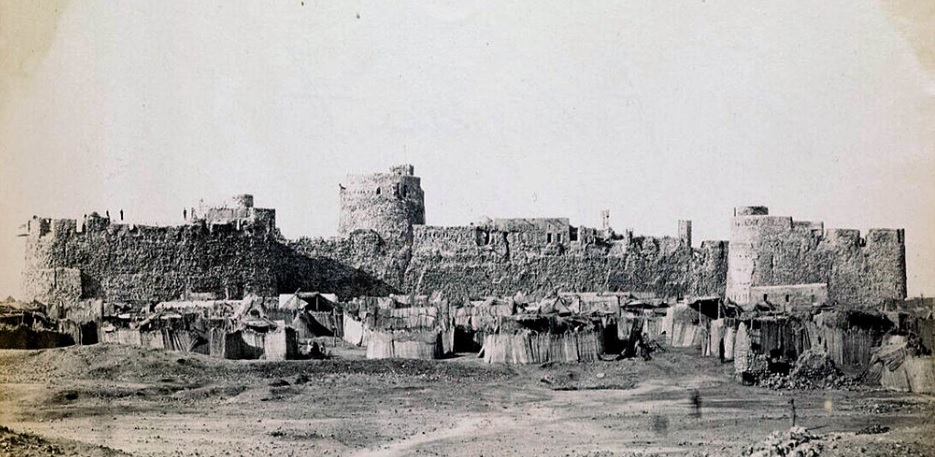
Portuguese Fort (Qal’at al-Bahrain) in 1870
ポルトガル人は、いくつかの反乱と抗議にもかかわらず、80年間、ホルムズ王国を通じて住民を間接的に統治することで島を支配したと考えられています。1529年の反乱では、島を制圧するために派遣された400人のポルトガル軍の配備が見られました。それでも、1534年の叛乱は一時的な独立をもたらしました程の規模でした。
Portuguese is believed to have ruled the island by indirectly governing its inhabitants through Kingdom of Hormuz for 80 years, despite several rebellions and protests. The 1529 rebellion saw the deployment of 400 Portuguese troops sent to overwhelm the island. Even so, the rebellion of 1534 was large enough to bring about temporary independence.
1559年にオスマン帝国のラーサ・エヤレット(Ottoman Lahsa Eyalet) (إيالة الأحساء)の知事(the governor) (والي)ムスタファ・パシャ(Mustafa Pasha) (مصطفى باشا)が島を占領しようとして撃退されたの短い期間を除いて、ポルトガル人は、ルクン・アル=ディーン(Rukn ed-Din) (ركن الدين)の有名な蜂起で バハレイン砦(Bahrain Fort)の支配を奪われた1602年に島から追い出されるまでバハレインを支配し続けました。
Except for a brief period in 1559 when the governor (والي) Mustafa Pasha (مصطفى باشا) of Ottoman Lahsa Eyalet (إيالة الأحساء) tried to occupy the islands but were repelled. Portuguese remained in control until they were driven out of the island in 1602, when a popular uprising led by Rukn ed-Din (ركن الدين) took control of Bahrain Fort.
この蜂起は、島で最も裕福なトレーダーの処刑という知事の命令によって引き起こされました。バハレインを奪還しようとするポルトガルの試みは、サファヴィー朝(Safavid dynasty) (1501~1736) (الدولة الصفوية)からの援助のために阻止されました。
The uprising was sparked by the governor’s order of the execution of the island’s richest traders. Portuguese attempts to retake Bahrain were thwarted due to aid from Safavid dynasty (1501~1736) (الدولة الصفوية).
蜂起はポルトガルとライバルのヨーロッパの大国との間の地域紛争と一致しました。結果として生じた権力の空白は、ペルシャの駐屯部隊をバハレイン砦に配備し、サファヴィー朝(Safavid Empire) (1501–1736) (الدولة الصفوية)に包摂したサファヴィー朝の5番目のシャー(the fifth shah) (r.1588 ~1629)シャーアッバース1世(Shah Abbas I) (عباس الأول الصفوي)によってほぼ即座に埋められました。
The uprising coincided with regional disputes between Portuguese and rival European powers. The power vacuum that resulted was almost immediately filled by the fifth shah of Safavid Empire (1501–1736) (الدولة الصفوية) , Shah Abbas I (r.1588 ~1629) (عباس الأول الصفوي), who deployed a Persian garrison to Bahrain Fort and subsumed it within Safavid Empire.
サファヴィー朝の覇権と聖職者の強化
Safavid hegemony and strengthening clerics
ペルシャのサファヴィー朝(Persian Safavid rule) (1602~1717) (الحكم الصفوي الفارسي),の支配下で、バハレインはイラン南西部のベーフバハーン(Behbahan) (بهبهان)を中心とするクフギル(Kuhgilu) (現在のベフバハーン(Behbahan)市)のベグラルベギ(Beglarbegi) (司令官)の行政管轄下に置かれました。実際、サファヴィー朝(Safavids)は、バハレインを遠くから統治し、力ではなく、イデオロギーと地元の対立の操作を通じて島を支配しようとしました。
Under Persian Safavid rule (1602~1717) (الحكم الصفوي الفارسي), Bahrain fell under the administrative jurisdiction of Beglarbegi (commander) of Kuhgilu (present Behbahan city) centered at Behbahan (بهبهان) in south western Iran. In fact, Safavids ruled Bahrain from a distance, seeking to control the islands not by force, but through ideology and the manipulation of local rivalries.
サファヴィー朝の支配は、シーア派ウラマー(Shia Ulama) (العلماء الشيعة) (シーア派神学的エリート)の間で知的開花の時期であり、バハレインの神学校はシェイク・ユスフ・アル・バハラニなどの理論家を輩出しました。サファヴィー朝は聖職者を使って彼らの支配を支持し、イマミのシーア派(Imami Shi’ism) (الشيعي الإمامي)をしっかりと植え付けることによって、貿易ルートと真珠取引の中心性を備えたバハレインの島々を確保できることを望んでいました。
Safavid rule was a period of intellectual flowering among Shia Ulama (العلماء الشيعة) (Shia theological elite), with Bahrain’s seminaries producing such theorists as Shaykh (شيخ) Yusuf Al Bahrani (1695~1772) (يوسف البحراني). Safavid’s used the clergy to support their rule, hoping that by firmly implanting Imami Shi’ism (الشيعي الإمامي) they could secure the islands of Bahrain, with their centrality to trade routes and pearl trading.
注: 十二シーア派(Twelver Shiites) (الشيعة الاثني عشرية) は、イマーミ・シーア派(Imami Shi’ism) (الشيعي الإمامي) としても知られ、シーア派イスラーム教(Shia Islam) (الشيعة) の最大の宗派です。
Note: Twelver Shiites (الشيعة الاثني عشرية), also known as Imami Shi’ism (الشيعي الإمامي), is the largest branch of Shia Islam (الشيعة).
しかし、サファヴィー朝の戦略は多くの点で成功しすぎていました。宗教階級の権力と影響力は、彼らが大きな自治権を持っていたことを意味し、バハレインの神学的活力を推進したのは、サファヴィー朝と聖職者の間のその後の緊張でした。この繁栄の一部は、バハレインの聖職者が保守的なアクバーリー・十二シーア派(Akhbari Twelver Shi’ism) (الشيعة الأخباریون)に固執したことから生まれましたが、サファヴィー朝はより国家中心のウスーリー・十二シーア派(Usulis Twelver Shi’ism) (الشيعة الاصولیون)を奨励しました。
However, Safavids’ strategy was in many ways too successful. The power and influence of the religious class meant that they had a great deal of autonomy, and it was the subsequent tension between Safavid dynasty and the clergy that drove Bahrain’s theological vitality. Part of this flourishing was borne of Bahraini clerics’ adherence to conservative Akhbari Twelver Shi’ism (الشيعة الأخباریون), while Safavids encouraged more state-centric.
ペルシャのサファヴィー朝がバハレインのシーア派ウラマーを統治しようとする試みは、しばしば逆効果であり、儲かる真珠貿易に対する聖職者の支配に異議を唱えた地元の土地所有バハレインのライバルに対して聖職者を強化することになりました。聖職者と地主の対立は、上級のシーア派ウラマーが通常土地所有階級の息子であったことを考えると、通常、非常に限られたパラメーター内に封じ込められました。
Attempts by Persians Safavid dynasty to reign in Bahraini Shia Ulama were often counterproductive, and ended up strengthening the clerics against their local land-owning Bahraini rivals who challenged the clerics’ control over the lucrative pearl trade. Cleric-landowner conflict was usually contained within very limited parameters given that the senior Shia Ulama were usually the sons of the land-owning class.
サファヴィー朝崩壊後の不安定さ
Instability after Safavid fall
オマーンの侵略とその後の荒廃
Oman’s Invasion and subsequent devastation
18世紀初頭のペルシャのサファヴィー朝へのアフガニスタンの侵略は、サファヴィー朝のほぼ崩壊をもたらしました。結果として生じた権力の空白の中で、オマーンは1717年にバハレインに侵攻し、100年以上のペルシャの覇権を終わらせました。オマーンの侵略は政情不安の時期を開始し、外部の支配者の急速な連続が権力を握り、その結果、破壊されました。
An Afghan invasion of Persian Safavid dynasty at the beginning of the 18th century resulted in the near collapse of Safavid dynasty. In the resultant power vacuum, Oman invaded Bahrain in 1717, ending over a hundred years of Persian hegemony. Omani invasion began a period of political instability and a quick succession of outside rulers took power with consequent destruction.
神学者のシャイク・ユースフ・アル=バハラーニー(Shaykh Yusuf Al Bahrani) (1695/6~1772) (الشیخ یوسف البحراني)による現代の説明によると、ペルシャ人とそのベドウィンの同盟国がハワーリジュ派・オマーンからバハレインを取り戻そうとして失敗したため、島の多くは焼失しました。
According to a contemporary account by theologian, Shaykh Yusuf Al Bahrani (1695/6~1772) (الشیخ یوسف البحراني)), in an unsuccessful attempt by Persians and their Bedouin allies to take back Bahrain from Kharijite (لخوارج) Omanis, much of the island was burnt to the ground.
ハワーリジュ派(Kharijite) (لخوارج) :第一次フィトナ時代(First Fitna period) (656–661)にイスラーム教の多数派から分離しました。ハワーリジュ派(Kharijite)は、後のスンナ派のもシーア派にも属さず、ハワーリジュ(出ていった者・離反した者)と呼ばれる一派です。直接的には657 年のシフィンの戦いでの仲裁交渉の受け入れに、裁きは神のみに属する」と主張して反抗した者達が始まりでした。
Kharijite (لخوارج): they separated from the majority of Islam during the First Fitna period (656–661). Kharijite sect does belong neither to the later Sunnis nor Shia sects, and is a sect called Kharijite (those who left or defected). They began directly with those who rebelled against the acceptance of arbitration negotiations at the Battle of Siffin in 657. They were arguing that judgment belongs only to God.
フワラ族実権掌握
Huwala’s power seizure
バハレインは最終的にオマーン人によってペルシャ人に売却されましたが、サファヴィー朝の弱さにより、フワラ族(Huwala) (الهولة)が支配権を掌握しました。
Bahrain was eventually sold back to Persians by Omanis, but the weakness of Safavid empire saw Huw24ala (هولة) tribes seize control.
フワラ(Huwala) (الهولة): 彼らは総称して バニー・フワラ(Bani Huwala )とも呼ばれます。 フワラは通常、アラビア半島出身のイラン系アラブ人を指すのに使用されます。 彼らは最初に 13 世紀から 14 世紀にイラクとアラビア半島から移住し、主にアラブ起源の先住民族と混ざりました。彼らは、スンニ派イスラーム教徒です。
Huwala (الهولة): They also collectively referred to as Bani Huwala. Huwala are usually used to refer to Iranian Arabs who originate from Arabian Peninsula. They initially migrating in the 13th and 14th century from Iraq and Arabia Peninsula and intermixed mainly with Arab origin indigenous population. They follows Sunni Islam.
ブシェールのアラブ人による占領
Occupation by Arabs of Bushire
1730年、ペルシャの新しいシャー(New Shah)、アフシャール朝(Afsharid dynasty) (1736~1796) (الدولة الأفشارية)のナーディル・シャー・アフシャール(Nader Shah Afshar) (r.1736~1747) (نادر شاه الأفشاري)は、バハレインでペルシャの主権を再主張しようとしました。
In 1730, the new Shah of Persia, Nader Shah Afshar (r.1736~1747) (نادر شاه الأفشاري) of Afsharid dynasty (1736~1796) (الدولة الأفشارية), sought to re-assert Persian sovereignty in Bahrain.
彼は、アラビア湾のペルシャ海軍の提督であるラティフ・カーン(Latif Khan) (d.1737) (محمد لطيف خان),に、イラン南西部のブーシェフル(Bushehr) (بوشهر)に侵略艦隊を準備するように命じました。
He ordered Latif Khan (d.1737) (محمد لطيف خان), the admiral of Persian navy in Arabian Gulf, to prepare an invasion fleet in Bushehr (بوشهر) in south western Iran.
当時のバハレインの支配者は、土着のシーア派部族バハールナ(Baharna) (بحارنة) 出身で、支配者シャイク(Shaykh) (الشيخ)の称号を持つジュバイル(Jubayr) (جبير)でした。ペルシャ人は、ジュバイル(Jubayr)がメッカ巡礼で不在だった1736年3月または4月上旬にバハレイン島に侵入しました。
The ruler of Bahrain at that time was Jubayr (جبير), from the indigenous Shiite tribe Baharna (بحارنة), who held the title of ruler Shaykh (الشيخ). Persians invaded Bahrain in March or early April 1736, when Jubayr was away on his pilgrimage to Mecca.
侵略者は、島を中央支配下に戻し、島を足掛かりとしてアラビア湾でオマーンに挑戦しました。ジュバイル(Jubayr)は、メッカ巡礼から戻ると、イギリスとオランダに助けを求め、最終的に1736年末までにバハレインをアフシャール朝(Afsharid dynasty)から奪還しました。
The invaders returned the island to central control and used it as a foothold to challenge Oman in Arabian Gulf. After returning from his pilgrimage to Mecca, Jubayr turned to British and Dutch for help, eventually recapturing Bahrain from Afsharid dynasty of Persia until end 1736.
1753年、バハレインは、ブシャール(Arabs of Bushire) (بوشهر)(アブ・シャフル(Abu Shahr) (ابو شهر)を拠点とするアル・マドゥクール家(House of Al Madhkur) (آل مذكور)のアラブ人によって占領され、ペルシャの名の下にバハレインを統治し、ザンド王朝(Zand dynasty) (1751~1794) (دودمان زندیان)のカリム・カーン・ザンド(Karim Khan Zand) (r.1751~1779) (کریم خان زند)に忠誠を誓いました。ガージャール朝時代(Qajar dynasty ) (1789~1925) (الدولة القاجارية)には、バハレインに対するペルシャの支配は衰退しました。
In 1753, Bahrain was occupied by Arabs of Bushire (بوشهر) (Abu Shahr) (ابو شهر)-based House of Al Madhkur (آل مذكور), who ruled Bahrain in the name of Persia and paid allegiance to Karim Khan Zand (r.1751~1779) (کریم خان زند) of Zand dynasty (1751~1794) (دودمان زندیان). During Qajar dynasty (الدولة القاجارية) era (1789~1925), Persian control over Bahrain waned.
ガージャール朝 (Qajar dynasty) (القاجاريون):この王朝は、トルクマン(تركمان)のガージャール部族連合(اتحاد قبيلة القاجار)によるイスラーム王朝(Islamic dynasty) (1796~1925) (السلالة الإسلامية)です。 その首都はテヘラン(Tehran)でした。 サファヴィー朝崩壊(Safavid dynasty fall)およびアフシャール朝崩壊(Afsharid dynasty fall)後にイランを統一し、急速に変化する対立の時代に終止符を打ちました。 しかし、ガージャール時代(Qajar period) (فترة القاجار)は内外の混乱に悩まされ、イランの暗黒時代と言われています。
Qajar dynasty (القاجاريون): It was an Islamic dynasty (1796~1925) (السلالة الإسلامية) by Qajar Tribal Union (اتحاد قبيلة القاجار) of Turkuman (تركمان). Its capital was Tehran. It united Iran after Safavid dynasty fall and after Afsharid dynasty fall and put an end to an era of fast-changing rivalries. However, Qajar period (فترة القاجار) was plagued by internal and external troubles, and is said to be Iran’s dark age.
ドイツの地理学者Carsten Niebuhr(1733~1815)は、1763年にバハレインの360の町や村が戦争と経済的困窮によってわずか60に減少したことを発見しました。 ペルシア(イラン)の影響は、アクバーリー派(Akhbari)とウスーリー派(Usulis)の間のイデオロギー的権力闘争がバハレインのウスーリー派(Usulis)の勝利で最高潮に達した18世紀の終わりにペルシャの支配は、さらに損なわれました。
The years of almost constant warfare and instability in the period led to a demographic collapse – German geographer Carsten Niebuhr (1733~1815) found in 1763 that Bahrain’s 360 towns and villages had, through warfare and economic distress, been reduced to only 60. The influence of Persia (Iran) was further undermined at the end of the 18th century when the ideological power struggle between Akhbari-Usuli strands culminated in victory for Usulis in Bahrain.
カリーファ家侵攻とイギリス保護領化
Khalifa Invasion and British Protectorate
節索引(Section Index)
| フワラ族とバニー・ウトバ族の戦争 | War between Huwara and Utova |
| カリーファ家のバハレイン侵攻 | Khalifa’s invasion of Bahrain |
| イギリスとの条約 | Treaties with Britain |
| 卓越した貿易の中心地 | Pre-eminent trading centre |
| 20世紀初頭の改革 | Early 20th century reforms |
フワラ族とバニー・ウトバ族の戦争
War between Huwara and Utova
1782年、バハレイン(Bahrain)とブーシェフル(Bushehr) (بوشهر)の支配者であるシャイク・ナスル・アル=マドゥクール(Shaykh Nasr Al-Madhkur) (الشيخ نصر آل مذكور)の軍隊と、カタールのカタール(Qatar)に在るズバーラ(Zubarah) (زبارة)を拠点とするバニー・ウトバ(Bani Utbah) (بني عتبة)の間で戦争が勃発しましたが、ペルシャ人がズバーラ(Zubarah)基地を脅威と見なした後、1777年以来敵対行為が発生しました。現代のカタールにあるズバーラ(Zubarah)の繁栄は、当時の2つの主要国、ペルシャとオマーンの注目を集め、おそらくシャイク・ナスル(Shaykh Nasr)の野心に同情していました。同時に、バハレインはその海域で見つかった豊富な真珠のために大きな潜在的な富を提供しました。
In 1782, war broke out between the army of Shaykh Nasr Al-Madhkur (الشيخ نصر آل مذكور), the ruler of Bahrain and Bushehr and Zubarah (زبارة) of Qatar-based Bani Utbah (بني عتبة), though hostilities arose since 1777 after Persians saw Zubarah base as a threat. The prosperity of Zubarah, which is in modern Qatar, had brought it to the attention of the two main powers at the time, Persia and Oman, which were presumably sympathetic to Shaykh Nasr’s ambitions. At the same time, Bahrain offered great potential wealth because of the extensive pearls found in its waters.
バニー・ウトバ族(Bani Utbah) (بني عتبة):ムダル・アドナーン部族(Mudar Adnan Arab) (مضر عدنان عرب) バニー・スライム・ビン・マンスール族(Bani Sulaim bin Mansoor) (بني سليم بن منصور)のカファーフ一門(Khafaf) (خفاف)の分かれです。
Bani Utbah (بني عتبة): A Branch of Khafaf (خفاف) clan of Bani Sulaim bin Mansoor(بني سليم بن منصور) belonging to Mudar Adnan Arab (مضر عدنان عرب)
シャイク・ナスル・アル=マドゥクール(Shaykh Nasr Al-Madhkur) (الشيخ نصر آل مذكور):彼は、ザンド王朝(Zand dynasty) (1751~1794) (دودمان زندیان)のカリム・カーン・ザンド(Karim Khan Zand) (r.1751~1779) (کریم خان زند)配下のフワラ(الهولة)氏族出身の18世紀アラブ総督でした。当時の記述で、ブーシェフルとバーレーンの「独立国家」として説明されてもいました。
Shaykh Nasr Al-Madhkur (الشيخ نصر آل مذكور):He was a 18th-century Arab governor from a Huwala (الهولة) clan under Karim Khan Zand (r.1751~1779) (کریم خان زند) of Zand dynasty (1751~1794) (دودمان زندیان) . His territory was described by a contemporary account as an “independent state” in Bushehr and Bahrain.
シャイク・ナスル(Shaykh Nasr)は、バンダル・リーグ(Bandar Rig) (بندر ريق)、バンダル・ガナヴェ(Bandar Ganaveh) (بندر غناوة)、ダシュテスターン(Dashtestan) (دشتستان)の支配者の援助を求め、 甥のムハンマド(Mohammed) (محمد)が指揮する2,000人の兵士の軍隊を集めました。ペルシャ人はズバーラ(Zubarah)の砦への攻撃を開始しましたが、アル=カリーファ族(Al Khalifa) (الخليفة)の擁護者からの激しい抵抗に苦しみ、クウェートのバニー・ウトバ軍(Bani Utbah men) (رجال بني عتبة)からの差し迫った海軍の援軍に直面した後、包囲を破ることを余儀なくされました。
Nasr enlisted the aid of the rulers of Bandar Rig (بندر ريق), Bandar Ganaveh (بندر غناوة) and Dashtestan (دشتستان) and amassed an army of 2,000 soldiers to be commanded by his nephew, Mohammed (محمد). Persians launched an assault of Zubarah’s fort but were forced to break the siege after suffering stiff resistance from Al Khalifa (آل خليفة) defenders and facing imminent naval reinforcements from Bani Utbah men in Kuwait.
カリーファ家のバハレイン侵攻
Khalifa’s invasion of Bahrain
攻撃への報復として、バニー・ウトバ族(Bani Utbah)は、1783年にバハレイン島への侵攻を開始しました。クウェートからの海軍増援は、シャイク・ナスル・アル・マドゥクールからバハレインの彼の代表へのペルシャ人が戦いに負けたと述べたメッセージを傍受した。これを知ると、艦隊は進路を変えてバハレインに侵攻し、バハレインの砦と周辺のペルシャ駐屯地を占領しました。
In retaliation to the assault, Bani Utbah launched an invasion of Bahrain Island in 1783. Incoming naval reinforcements from Kuwait intercepted a message from Shaykh Nasr Al-Madhkur to his representative in Bahrain stating that Persians had lost the battle. Upon learning this, the fleet switched course and invaded Bahrain, capturing Bahrain fort and surrounding Persian garrison.
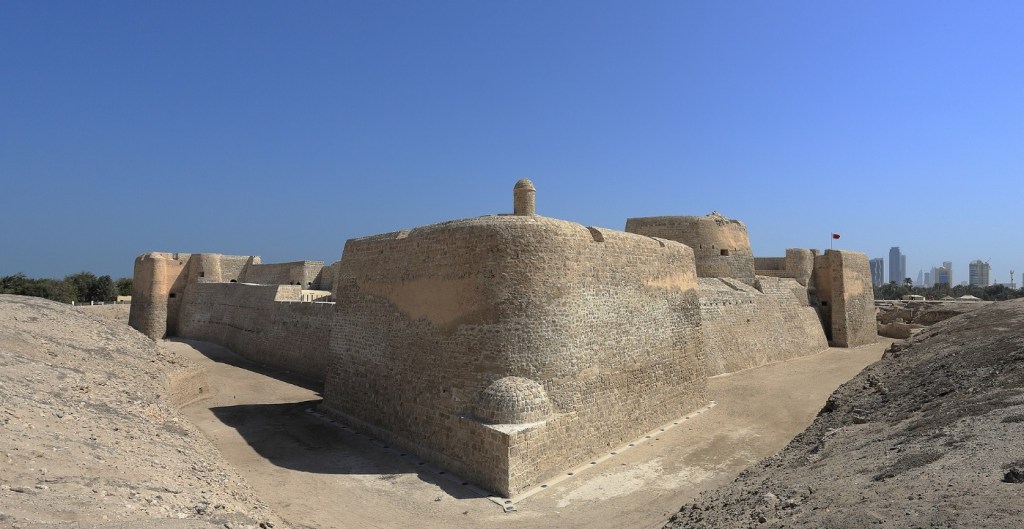
バハレイン砦(Bahrain Fort) (カラット・アル=バハレイン(Qalʿat al-Bahrain))
バニー・ウトバ族(Bani Utbah)とアラビア内陸部の部族の大規模な連合により、バハレインの侵攻は1783年7月28日に完了しました。 クウェート人(Kuwaitis)がバハレインに侵攻したのは、ズバーラ(Zubarah)よりもバハレインに近かったためで、ペルシャ人に戦術的な敗北をもたらし、後にバニー・ウトバ族(Bani Utbah)に所有権を引き渡すことになりました。 クウェート人(Kuwaitis)侵攻は、1783年にアフマド・イブン・ムハンマド・イブン・カリーファ(Ahmed ibn Muhammad ibn Khalifa) (r. 1783~1795) (أحمد بن محمد بن خليفة)が主導し、マナーマ(Manama) (منامة)郊外での戦いでシャイク・ナスル・アル=マドゥクール(Shaykh Nasr Al-Madhkur) (الشيخ نصر آل مذكور)を打ち負かし、町を略奪しました。
With a large coalition of tribesmen from Bani Utbah and interior Arabia, Invasion of Bahrain was completed on 28 July 1783. Kuwaitis invaded Bahrain because they were closer to it than to Zubarah and as such, would deliver a tactical defeat to Persians and would later handover possession to Bani Utbah. Kuwaity invasion was led by Ahmed ibn Muhammad ibn Khalifa (r. 1783~1795) (أحمد بن محمد بن خليفة) in 1783 and that he defeated Shaykh Nasr Al-Madhkur in battle on the outskirts of Manama (منامة) and plundered the town.
アフマド・イブン・ムハンマド・イブン・カリーファハ(Ahmed ibn Muhammad ibn Khalifa)は、バハレインを征服したために一般にアフマド・アルー=ファーテフ(Ahmed al-Fateh) (الشيخ أحمد الفاتح) (征服者アフマド)と呼ばれています。アフマド・アルー=ファーテフ(Ahmed al-Fateh)は、バハレインとズバーラ(Zubarah)を統治し、1796年に亡くなるまで、夏には前者を、冬には後者を訪れました。
Ahmed ibn Muhammad ibn Khalifa is commonly referred to as Ahmed al-Fateh (الشيخ أحمد الفاتح) (Ahmed the Conqueror) because he conquered Bahrain. Ahmed al-Fateh ruled Bahrain and Zubarah, visiting the former in the summer and the latter in the winter, until his death in 1796.
1797年、バニー・ウトバ族(Bani Utbah)の権力を獲得してから14年後、アール・カリーファ家(Al Khalifa) (ال خليفة)は、バハレインに移り、東海岸のジャウ(Jaww) (جو),に定住し、後に内陸北部のリファ(Riffa )(رفاع)に移りました。彼らはもともとクウェート出身で、1766年にそこを去りました。アール・サバーハ家(House of Sabah) (آل صباح)の伝統は、彼らの家族の祖先とアル・カリーファ家(Al Khalifa)の祖先が、バスラのキャラバンを襲い、シャット・アルアラブ水路(Shatt al-Arab) (شط العرب)の舟を海賊していた初期の基地であるイラクのウンム・カスル(Umm Qasr) (أم قصر)の町からトルコ人によってコール・ズバイル(Khor Zubair )(خور الزبير)に追放された後、クウェートに来たことに関連しています。 アル・カリーファ家(Al Khalifa)の最初の支配者は、シャイク・アフマド・アルー=ファーテフ(Ahmed al-Fateh) (الشيخ أحمد الفاتح)でした。
In 1797, fourteen years later after gaining the power of Bani Utbah, Al Khalifa family moved to Bahrain and settled at Jaww (جو) in the eastern coast, later moving to Riffa (رفاع) in the northern interior. They were originally from Kuwait having left in 1766. House of Sabah (آل صباح) traditions relates that the ancestors of their family and those of House of Khalifa (آل خليفة) came to Kuwait after their expulsion from Iraqi Umm Qasr (أم قصر) town upon Khor Zubair (خور الزبير) by Turks, an earlier base from which they preyed on the caravans of Basra (بصرة) and pirated ships in Shatt al-Arab (شط العرب) waterway. The first ruler of Al Khalifa was Shaikh Ahmed al-Fateh (الشيخ أحمد الفاتح).
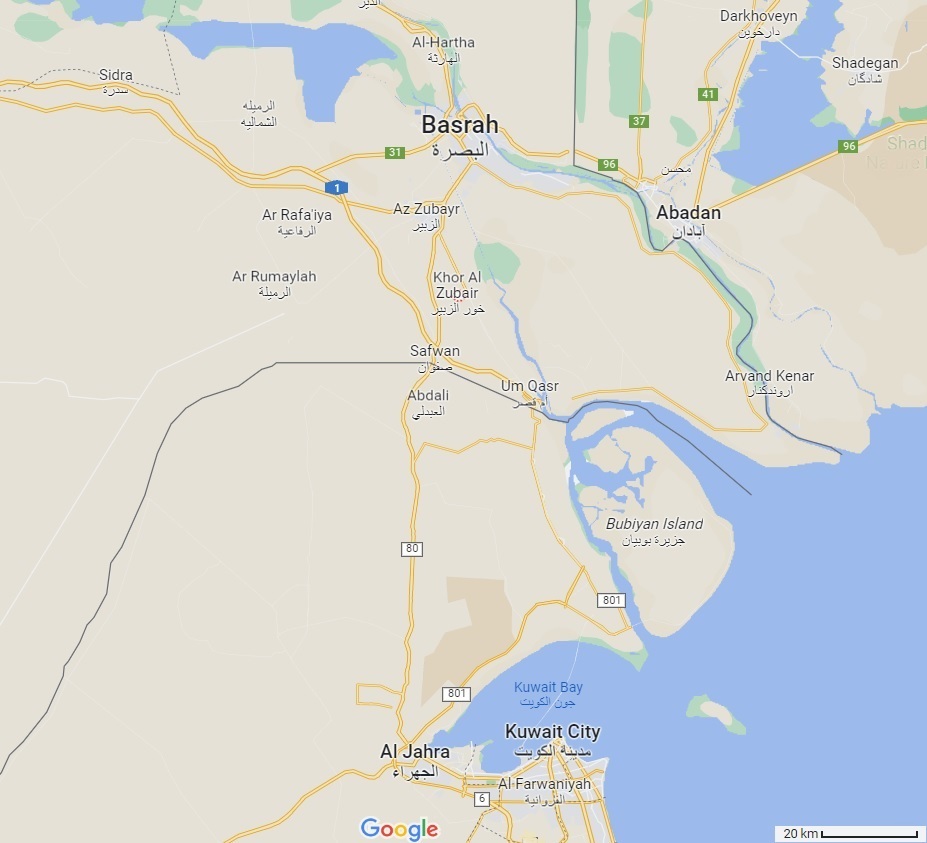
クウェイトおよびイラク南部(Kuwait and Southern Iraq)
ペルシャは1783年と1785年にバハレイン島を再征服しようとして、失敗しました。1783年の遠征は、ブーシェフル(Bushehr)を離れることのなかったペルシャとカワシム(Persian-Qawasim)の合同侵攻軍でした。ブーシェフル(Bushehr) (بوشهر)、バンダル・リーグ(Bandar Rig) (بندر ريق)、シラーズ(Shiraz) (شیراز)の部隊で構成される1785年の侵略艦隊は、シーラーズの支配者であるザンド王朝(Zand dynasty) (1751~1794) (دودمان زندیان)のアリ・ムラド・カーン(Ali Murad Khan) (r.1781~1785) (علی مراد خان زند)の死後、中止されました。
Persian attempts to reconquer the island in 1783 and in 1785 failed; the 1783 expedition was a joint Persian-Qawasim invasion force that never left Bushehr. The 1785 invasion fleet, composed of forces from Bushehr (بوشهر), Bandar Rig (بندر ريق) and Shiraz (شیراز) was called off after the death of the ruler of Shiraz, Ali Murad Khan (r.1781~1785) (علی مراد خان زند) of Zand dynasty (1751~1794) (دودمان زندیان) .
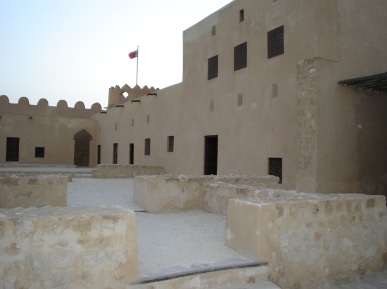
リファ砦の内部(Inside Riffa Fort)
カワーシム王朝(Qassimi dynasty) (القواسم)は、1722年に設立され、シャルジャ(Sharjah) (إمارة الشارقة)とラアス・アル=ハイマ(Ras Al Khaimah) (إمارة رأس الخيمة)を統治しています。
Al Qassimi dynasty (القواسم) was founded in 1722 and ruled Sharjah ((إمارة الشارقة)) and Ras Al Khaimah (إمارة رأس الخيمة).
カワーシム族(Qawasim) (القواسم):
シャルジャ(Sharjah) (الشارقة)とラス・アル=ハイマ(Ras Al Khaimah) (رأس الخيمة)を統治しています。イスラーム教の預言者ムハンマドの子孫であると主張し、湾岸地域のムワッヒドゥーン(Muwahhidun) (الموحدون)の教義を強く擁護して「スンニー派部族連合(a confederation of Sunni tribes)」となりました。ディルイーヤ(Dir’iyah) (الدرعية)のワッハーブ派首長国(the Wahhabi Emirate) (إمارة الدرعية)すなわち 第一次サウード公国(the First Saudi State) (الدولة السعودية الأولى) とは、緊密な同盟国になり、アラビア湾のディルイーヤ(Dir’iyah)の海上利益を保護するためのワッハーブ派(Wahhabi) (وهابية)の私掠船(Privateers) (قرصنة تفويضية)として行動し、ラアス・アル=ハイマ(Ras Al Khaimah) (رأس الخيمة)を始め、ペルシャ側のゲシュム(Qeshm) (قشم)、バンダル・アッバース(Bandar Abbas) (بندر عباس) およびレンゲ(Lingeh) (لنجة)に基地を持つ、海事大国(a maritime power)となりました。この為に、アラビア湾沿いの海軍支配をめぐって、ディルイーヤ首長国のライバルで、イギリスと同盟関係にあるオマーン帝国(the Omani Empire) (الإمبراطورية العمانية)との強い競争に直面、戦いになりました。その結果、大英帝国(the British Empire)がカワーシム族(Qawasimを「海賊(pirates)」として、1809年と1819年に2つの主要な軍事作戦に踏み切りました。これにより、アラビア湾の南岸は「海賊海岸(the Pirate Coast)」として特定されました。
Qawasim (القواسم):
Qawasim (القواسم) has been governing Sharjah (إمارة الشارقة) and also Ras Al Khaimah (إمارة رأس الخيمة). Claiming to be descendants of the Islamic prophet Muhammad and strongly defending the doctrine of Muwahhidun (الموحدون) in Gulf region, it became “a confederation of Sunni tribes.” It became one of the close allies with the Wahhabi Emirate (إمارة الدرعية) i.e. First Saudi State(1727~1818) (الدولة السعودية الأولى) in Dir’iyah (الدرعية). To protect the maritime interests of Emirate of Dir’iyah (1727~1818) (إمارة الدرعية) in Arabian Gulf, it acted as Privateers of Wahhabi (وهابية) and became a maritime power with its bases not only in Ras Al Khaimah (إمارة رأس الخيمة) on Arabian Side but also in Qesh (قشم), Bandar Abbas (بندر عباس) and Lingeh (لنجة) on Persian Side. For this reason, it faced a strong competition with Omani Empire (الإمبراطورية العمانية), who was one of allies of British Empire, for the naval dominance along Arabian Gulf. As a result, British Empire regarded Qawasim as”pirates” and embarked on two major military campaigns in 1809 and 1819. Afterwards, the southern shore of Arabian Gulf was identified as “Pirate Coast.”
内部の困難のために、ペルシャ人は別の侵略を試みることができませんでした。 1799年、バハレインは、バハレインが未払いの税金を支払っていないという口実でバハレイン島に侵入したとき、オマーンのスルターンであるサイード・ビン・スルターン・アル=ブサイディ(Saïd bin Sultan al-Busaidi) (r.1804~1856) (سعيد بن سلطان البوسعيدي)の拡張主義政策の脅威にさらされました。 バニー・ウトバ族(Bani Utbah)は、バハレインがペルシャの朝貢国になることを条件に、オマーン人を追放するためにブシャール(Bushire)の援助を求めました。1800年、サイード・ビン・スルターン・アル=ブサイディ(Saïd bin Sultan al-Busaidi)は、報復として再びバハレインに侵攻し、ムハッラク島(Muharraq island) (جزيرة المحرق)のアラード砦(Arad Fort) (قلعة عراد)に駐屯地を配備し、12歳の息子サリム(Salim) (سالم),を島の知事に任命しました。
Due to internal difficulties, Persians could not attempt another invasion. In 1799, Bahrain came under threat from the expansionist policies of Saïd bin Sultan al-Busaidi (r.1804~1856) (سعيد بن سلطان البوسعيدي), Sultan of Oman (سلطان عمان), when he invaded the island of Bahrain under the pretext that Bahrain did not pay taxes owed. Bani Utbah solicited the aid of Bushire (بوشهر) to expel Omanis on the condition that Bahrain would become a tributary state of Persia. In 1800, Saïd bin Sultan al-Busaidi invaded Bahrain again in retaliation and deployed a garrison at Arad Fort (قلعة عراد), in Muharraq island (جزيرة المحرق) and had appointed his twelve-year-old son Salim (سالم), as Governor of the island.
バニー・ウトバ族(Bani Utbah)は、その年の後半にアラード砦(Arad Fort)を包囲し、サリムSalim)を権力から追放しました。1802年、サイード・ビン・スルターン・アル=ブサイディ(Saïd bin Sultan al-Busaidi)は、再び艦隊でバハレインに向けて出航しましたが、アル=カリーファ族(Al Khalifa)は、本土からワッハーブ派(Wahhabis) (ディルイーヤ首長国(Emirate of Diriyah) (1727~1818) (الدولة السعودية الأولى))の援助を求めた為、オマーンは侵略を中止することを余儀なくされました。
Bani Utbah laid siege to Arad Fort later that year, ejecting Salim from power. In 1802, Saïd bin Sultan al-Busaidi once again sailed with a fleet to Bahrain however, Al Khalifa (آل خليفة) enlisted the aid of Wahhabis, that was Emirate of Diriyah (1727~1818) (الدولة السعودية الأولى), from the mainland which forced Omanis to abort their invasion.
イギリスとの条約
Treaties with Britain
1820年、アル=カリーファ族(Al Khalifa)は、バハレインで権力を取り戻し、当時アラビア湾で支配的な軍事力であったイギリスと条約関係を結びました。この条約は、アル=カリーファ族(Al Khalifa)をバハレインの支配者として認めていました。これは、1861年の「平和と友好の永久停戦(Perpetual Truce of Peace and Friendship) (الهدنة الدائمة للسلام والصداقة)」を含むいくつかの条約の最初のものであり、1892年と1951年にさらに改訂されました。
In 1820, Al Khalifa tribe regained power in Bahrain and entered a treaty relationship with Great Britain, by then the dominant military power in Arabian Gulf. This treaty recognised Al Khalifa as the rulers of Bahrain.] It was the first of several treaties including the 1861 Perpetual Truce of Peace and Friendship (الهدنة الدائمة للسلام والصداقة), which was further revised in 1892 and 1951.
この条約は、英国政府が他のアラビア湾岸の公国と締結したものと同様でした。それは、支配者がイギリス以外の彼の領土を処分することはできず、イギリスの同意なしに外国政府との関係を結ぶことができないことを指定しました。その見返りに、イギリスは、バハレインを海上によるすべての侵略から保護し、陸上攻撃の場合に支援を提供することを約束しました。さらに重要なことに、英国はバハレインのアル=カリーファ族(Al Khalifa)の支配を支持することを約束し、国の支配者としての不安定だった地位を確定させました。
This treaty was similar to those entered into by British Government with the other Arabian Gulf principalities. It specified that the ruler could not dispose of any of his territory except to United Kingdom and could not enter into relationships with any foreign government without British consent. In return British promised to protect Bahrain from all aggression by sea and to lend support in case of land attack. More importantly, British promised to support the rule of Al Khalifa in Bahrain, securing its unstable position as rulers of the country.
エジプトの支配者であるムハンマド・アリー・パーシャー(Mohammad Ali Pasha) (r.1805~1848) (محمد علي باشا)が1838年にオスマン帝国(Ottoman Empire) (1299~1923) (الدولة العثمانية)に代わってワッハーブ派(Wahhabis) (الوهابية)すなわち第二次サウード王国(Second Saudi State) (1824~1891) (الدولة السعودية الثانية)からアラビア半島を奪った後、エジプト軍は、アブドゥッラー・ビン・アハマド・アール・カリーファ(Abdullah bin Ahmad Al Khalifa) (1821~1843) (عبد الله بن أحمد آل خليفة)に毎年の年貢を要求しました。彼は以前、エジプト人からのペルシャとイギリスの保護を求めていました。 シャイクは、エジプト人の条件に同意しました。
After Egyptian ruler, Mohammad Ali Pasha (r.1805~1848) (محمد علي باشا) took Arabian Peninsula from Wahhabis, which was Second Saudi State (1824-1891) (الدولة السعودية الثانية), on behalf of Ottoman Empire (1299~1923) (الدولة العثمانية) in 1838, Egyptian army demanded yearly tributes from Abdullah bin Ahmad Al Khalifa) (1821~1843) (عبد الله بن أحمد آل خليفة). He had earlier sought Persian and British protection from Egyptians. Shaykh agreed to the terms of Egyptians.
1860年、アル=カリーファ族(Al Khalifa)政府は、イギリスがバハレインを圧倒しようとしたときに同じ戦術を使用しました。シャイク・ムハンマド・ビン・カリーファ・アール・カリーファ(Shaykh Mohammad bin Khalifa Al Khalifa (r.1843~1868) (الشيخ محمد بن خليفة بن سلمان آل خليفة)は、ペルシャのファールス州(Fars Province) (محافظة فارس)総督とバグダッドのオスマン帝国ワリー(Ottoman Wali of Baghdad) (والي بغداد العثماني)の両方に手紙を書き、バハレインをそれぞれの州の保護下に置くようにしました。 双方はワキール(wakil) (وكيل) (認可された代理人である人)を送り、シャイクに彼らの条件を提供し、オスマン帝国の条件は、より有益であり、1860年3月に受け入れられました。イラン外相に宛てた別の書簡で、シャイク・ムハンマド(Shaykh Mohammad)は、イラン政府が英国の圧力から直接指導と保護を提供することを要求していました。
In 1860, Government of Al Khalifa used the same tactic when British tried to overpower Bahrain. Shaykh Mohammad bin Khalifa Al Khalifa (r.1843~1868) (الشيخ محمد بن خليفة بن سلمان آل خليفة) wrote letters to both Persian Prince-Governor of Fars Province (محافظة فارس) and to Ottoman Wali of Baghdad (والي بغداد العثماني), to place Bahrain in the protection of each respective state. Both sides sent wakil (وكيل) (a person who is an authorized deputy), who offered Shaykh (الشيخ) their conditions, of which Ottoman terms were more beneficial and was accepted in March 1860. In another letter to Iranian Foreign Minister, Shaykh Mohammad demanded that Government of Iran provide direct guidance and protection from British pressure.
その後、ルイス・ペリー大佐(Sir Lewis Pelly) (1825~1892)の圧力を受けて、シャイク・ムハンマド(Shaykh Mohammad)は、イランに軍事援助を要請しましたが、当時のイラン政府はバハレインをイギリスの侵略から守るための援助を提供しませんでした。その結果、最終的にバハレインは、英領インド政府に圧倒されました。ペリー大佐(Sir Pelly)は1861年5月にシャイク・ムハンマド(Shaykh Mohammad)と、後に兄のシャイク・アリー・ビン・カリーファ・アール・カリーファ(Ali bin Khalifa Al Khalifa) (r.1868~1869) (علي بن خليفة بن سلمان آل خليفة)と協定に署名し、バハレインをイギリスの支配と保護下に置きました。
Later on, under pressure from Colonel Sir Lewis Pelly (1825~1892), Shaykh Mohammad requested military assistance from Iran, but Government of Iran at that time provided no aid to protect Bahrain from British aggression. As a result, Government of British India (1858~1947) (الراج البريطاني) eventually overpowered Bahrain. Colonel Pelly signed an agreement with Shaykh Mohammad in May 1861 and later with his brother Shaykh Ali that placed Bahrain under British rule and protection.
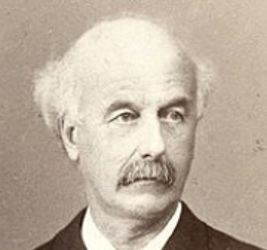
ルイス・ペリー卿(Sir Lewis Pelly)
1868年、カタール・バハレイン戦争後、英国の代表はアール・カリーファ家(Al Khalifa)の支配者と別の協定に署名し、バハレインをアラビア湾の英国の保護領の一部にしました。それは、支配者がイギリス以外の彼の領土を処分することはできず、イギリスの同意無しに外国政府との関係を結ぶことができないことを規定しています。その見返りに、イギリスはバハレインを海上によるすべての侵略から保護し、陸上攻撃の場合に支援を提供することを約束しました。さらに重要なことに、英国は、バハレインのアル=カリーファ族(Al Khalifa)の支配を支持することを約束し、国の支配者としての不安定な地位を安定させました。1880年と1892年の他の協定は、バハレインの保護領の地位をイギリスに確約しました。
In 1868, following Qatari–Bahraini War (1867~1868) (الحرب القطرية البحرينية), British representatives signed another agreement with Al Khalifa rulers, making Bahrain part of British protectorate territories in Arabian Gulf. It specified that the ruler could not dispose of any of his territory except to United Kingdom and could not enter into relationships with any foreign government without British consent. In return British promised to protect Bahrain from all aggression by sea and to lend support in case of land attack. More importantly British promised to support the rule of Al Khalifa in Bahrain, securing its unstable position as rulers of the country. Other agreements in 1880 and 1892 sealed the protectorate status of Bahrain to British.
卓越した貿易の中心地
Pre-eminent trading centre
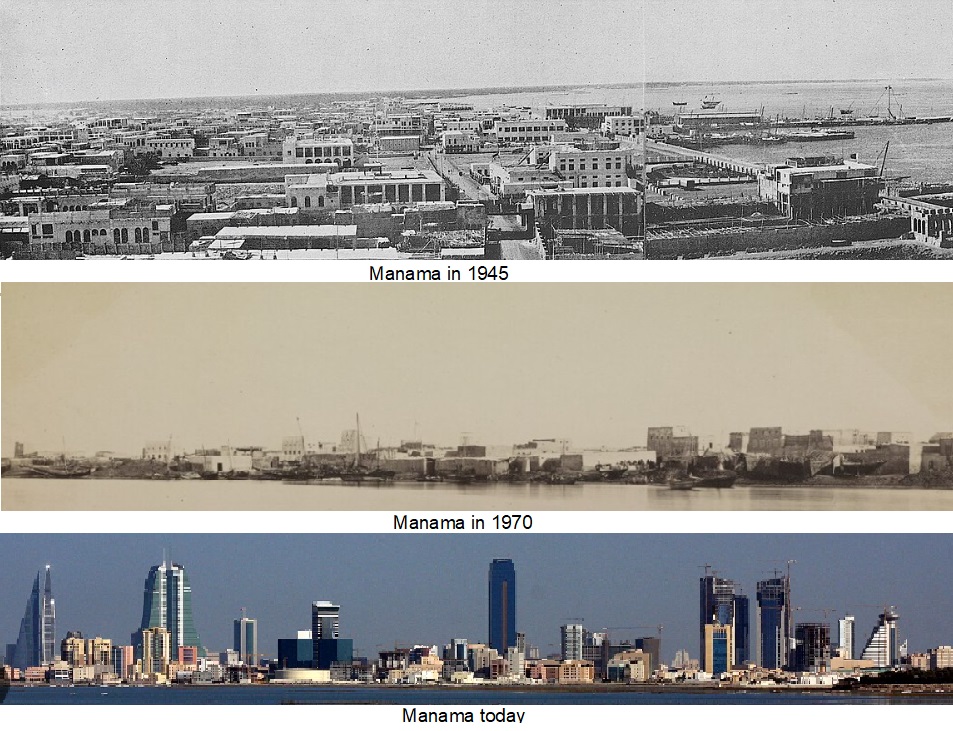
マナーマ(Manama)
平和と貿易は新たな繁栄をもたらしました。バハレインはもはや真珠採取に依存しなくなり、19世紀半ばまでにアラビア湾の卓越した貿易の中心地となり、ライバルのバスラ(Basra) (بصرة)、クウェート(Kuwait) (كويت)、そして最後は1870年代にマスカットMuscat (مسقط)を追い抜きました。同時に、バハレインの社会経済的発展はアラビア湾の他の地域から分岐し始め、部族貿易の中心地から近代的な貿易の中心へと変貌しました。このプロセスは、島で事業を立ち上げた多数のペルシャ人、フワラ(Huwala) (هولة) (イランのアラブ人)やインド人の商人家族の誘致によって促進され、アラビア湾、ペルシャ、インド亜大陸を横断する広大な交易路の網のつながりになりました。1862年のマナーマの同時代の記述は、次のことを発見しました。
Peace and trade brought a new prosperity. Bahrain was no longer dependent upon pearling, and by the mid-19th century, it became the pre-eminent trading centre in Arabian Gulf, overtaking rivals Basra (بصرة), Kuwait (كويت), and finally in the 1870s, Muscat (مسقط). At the same time, Bahrain’s socio-economic development began to diverge from the rest of Arabian Gulf: it transformed itself from a tribal trading centre into a modern one. This process was spurred by the attraction of large numbers of Persian, Huwala (هولة) (Iranian Arabs), and Indian merchant families who set up businesses on the island, making it the nexus of a vast web of trade routes across Arabian Gulf, Persia and Indian sub-continent. A contemporary account of Manama in 1862 found:
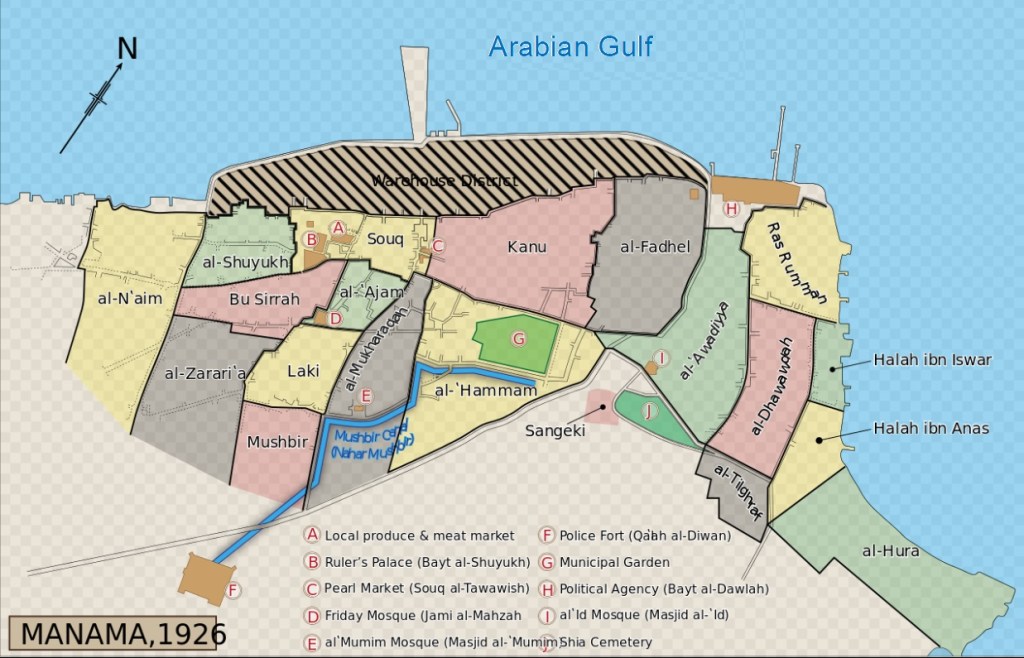
1926年のマナーマの地図 (Map of Manama in 1926)
マナーマの先住民と混ざり合って、多くの見知らぬ人や入植者がおり、そのうちの何人かは何世代にもわたってここに根付き、商業または真珠養殖の利益によって他の土地からここへ引き付けられてきました。それでも、母国の顔付や衣装を多かれ少なかれ保っています。
Mixed with the indigenous population of Manamah are numerous strangers and settlers, some of whom have been established here for many generations back, attracted from other lands by the profits of either commerce or the pearl fishery, and still retaining more or less the physiognomy and garb of their native countries
偉大な貿易家族は、この地域が後に有名になる石油の富よりずっと前に、彼らの莫大な富を持っていたこの期間中に出現しました。これは彼らに広範な権力を与え、最も著名なものの中には、19世紀に英国現地代理人の地位を保持したペルシャのアル=サファール家(Al Safar family)がありました。タル・サファール(Tal Safar)は、1869年からアール・カリーファ家(Al Khalifa)と「非常に緊密な」関係を享受していましたが、アール・カリーファ家(Al Khalifa)が彼らと結婚したことは、ありませんでした。これは、アル=サファール家(Al Safar family)からの支配家族への影響を制限するための政治的理由でした。おそらくアル=サファール家(Al Safar family)がシーア派であったため宗教上の理由に関連している可能性があると推測されていました。
The great trading families emerged during this period having their great wealth long before the oil wealth for which the region would later be renowned. This gave them extensive power, and among the most prominent were Persian Al Safar family, who held the position of Native Agents of Britain in the 19th century. Tal Safar enjoyed an ‘exceptionally close’ relationship with Al Khalifa clan from 1869, although Al-Khalifa never intermarried with them – it had been speculated that this could be related to political reasons (to limit Safars’ influence with the ruling family) and possibly for religious reasons because Safars were Shia.
アル・サファール家(Safar family):以下は、アル・サファール家について紹介する「アラビア湾の都市と国家の歴史-ケンブリッジ」の著者の概要です。
サファール家(الصفر)は、19世紀のアラビア湾で最も著名な商人の家族の1つでした。そのメンバーは、真珠貿易、インド洋商取引、バハレインの地方政治に積極的でした。彼らは、また、彼らの宗教的敬虔さとシーア派(Shia) (شيعة)の奨学金と機関の後援で知られていました。サファール家はイランのファールス州(Fars Province) (محافظة فارس),に起源をたどり、7代シーア派イマーム(7th Shia Imam) (r.765~799)ムーサ・アル=カーディム(موسى الكاظم)の子孫であるシャイク・サファール(ShaykhSafar)の子孫であると主張しました。彼らは、ズバーラ(Zubarah) (زبارة)からアル=カリーファ族(Al Khalifa)が侵攻した後、18世紀後半にバハレインに移住しました。
Safar family: The following is the writer’s outline of what “Histories of City and State in Arabian Gulf – Cambridge” introduces about Al Safar family.
Safar family (ال صفر) was one of the most prominent merchant families in Arabian Gulf during the nineteenth century. Its members were active in the pearl trade, Indian Ocean commerce and the local politics of Bahrain. They were also known for their religious piety and their patronage of Shia (شيعة) scholarship and institutions. Safar family traced its origins to Iranian Fars Province (محافظة فارس), where they claimed descent from a certain ShaykhSafar, a descendant of 7th Shia Imam (r.765~799) Musa al-Kazim (موسى الكاظم). They migrated to Bahrain in the late eighteenth century, following the invasion of Al Khalifa ( آل خليفة) from Zubarah (زبارة).
20世紀初頭の改革
Early 20th century reforms
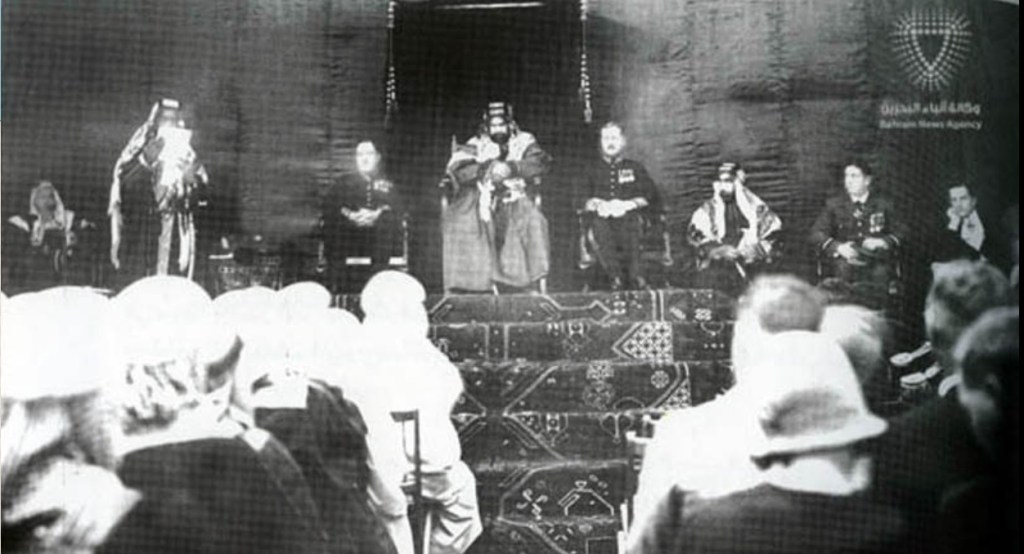
1933年にバハレインのハキム(Hakim) (حكيم)としてのシャイク・イーサー・イブン・アリー・アール・カリーファの戴冠式。
Coronation of Hamad bin Isa Al Khalifa as Hakim of Bahrain in 1933.
バハレインの人々の間の不安は、英国が1892年に領土の完全な支配を公式に確立したときに始まりました。最初の反乱と広範な蜂起は、1895年3月に、当時バハレインの支配者であったシャイク・イーサー・イブン・アリー・アール・カリーファ(Shaykh Isa ibn Ali Al Khalifa) (1869~1923) (الشيخ عيسى بن علي آل خليفة)に対して起こりました。シャイク・イーサー(Shaykh Isa)は、イランとの関係なしに支配したアール・カリーファ家(Al Khalifa) (ال خليفة)出身の最初の人物でした。アラビア湾の英国代表であり、アラビア湾の著者であるアーノルド・ウィルソン卿(Sir Arnold Wilson) (1884~1940)は、この時期にマスカットからバハレインに到着しました。蜂起はさらに発展し、一部の抗議者はイギリス軍によって殺害されました。
Unrest amongst the people of Bahrain began when Britain officially established complete dominance over the territory in 1892. The first revolt and widespread uprising took place in March 1895 against Shaykh Isa ibn Ali Al Khalifa (1869~1923) (الشيخ عيسى بن علي آل خليفة), then ruler of Bahrain. Shaykh Issa (الشيخ عيسى) was the first member of Al Khalifa to rule without Iranian relations. Sir Arnold Wilson (1884~1940), Britain’s representative in Arabian Gulf and author of Arabian Gulf, arrived in Bahrain from Mascat at this time. The uprising developed further with some protesters killed by British forces.
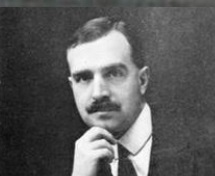
アーノルド・ウィルソン卿 (Sir Arnold Wilson)
バハレインは、1926年から1957年にかけて、シャイク・イーサー(Shaykh Isa)の英国顧問であるチャールズ・ベルグレイヴ(Charles Belgrave) (1894~1969)の事実上の支配下で、大規模な社会改革の時期を経験しました。国内初の近代的な学校は1919年に設立され、アルヒダヤ男子学校(Al-Hiddaya Boys School) (مدرسة الهداية للبنين)が開校し、アラビア湾で最初の女子学校は1928年に開校しました。オランダ改革派教会によって設立されたアメリカンミッション病院は、1903年に働き始めました。他の改革には奴隷制の廃止が含まれますが、真珠採り産業は急速に発展しました。
Bahrain underwent a period of major social reform between 1926 and 1957, under the de facto rule of Charles Belgrave (1894~1969), British advisor to Shaikh Hamad ibn Isa Al-Khalifa (r.1872-1942) (حمد بن عيسى بن علي آل خليفة). The country’s first modern school was established in 1919, with the opening of Al-Hiddaya Boys School (مدرسة الهداية للبنين), while Arabian Gulf’s first girls school opened in 1928. American Mission Hospital, established by Dutch Reform Church, began work in 1903. Other reforms include the abolition of slavery, while the pearl diving industry developed at a rapid pace.
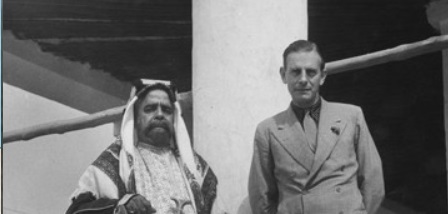
シャイク・サルマーン・ビン・ハマド・アルーカリーファ(Shaikh Salman bin Hamad Al Khalifa) (سلمان بن حمد آل خليفة)とチャールズ・ベルグレイブ
Shaikh Salman bin Hamad Al Khalifa (سلمان بن حمد آل خليفة) and Charles Belgrave,
これらの改革は、支配家族や商人のセクションを含むバハレイン内の強力なグループによってしばしば激しく反対されました。保守派に対抗するために、イギリス人は1923年に支配者であるシャイク・イーサー・イブン・アリー・アール・カリーファ(Shaykh Isa ibn Ali Al Khalifa) (1869~1923) (الشيخ عيسى بن علي آل خليفة)を解任し、息子のハマド・イブン・イーサー・アール・カリーファ(Hamad ibn Isa Al Khalifa) (r.1932~1942) (حمد بن عيسى بن علي آل خليفة)に置き換えました。
These reforms were often vigorously opposed by powerful groups within Bahrain including sections within the ruling family and merchants. In order to counter conservatives, British removed the ruler, against Shaykh Isa ibn Ali Al Khalifa (r.1869~1923) (الشيخ عيسى بن علي آل خليفة) in 1923 and replaced him with his son, Hamad ibn Isa Al Khalifa (r.1932~1942) (حمد بن عيسى بن علي آل خليفة).
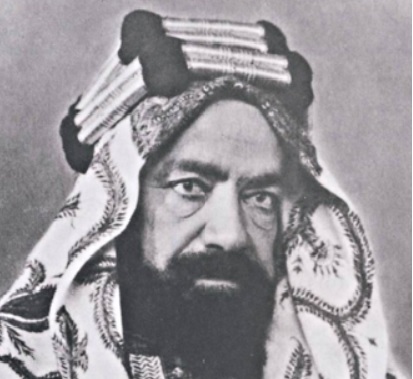
ハマド・イブン・イーサー・アール・カリーファ(Hamad ibn Isa Al Khalifa)
一部のスンニ派家族はバハレインを離れてアラビア本土に向かい、社会改革の聖職者の反対者はサウジアラビアとイランに追放されました。一部の商人や著名な家族の長も同様に追放されました。バハレインの発展に対する英国の関心は、サウジアラビア・ワッハーブ派(Saudi-Wahabi) (الوهابي السعوديとイラン人の野心に対する懸念によって動機付けられました。
Some Sunni families left Bahrain to mainland Arabia, whilst clerical opponents of social reforms were exiled to Saudi Arabia and Iran. The heads of some merchant and notable families were likewise exiled. Britain’s interest in Bahrain’s development was motivated by concerns over the ambitions of Saudi-Wahabi (الوهابي السعودي) and the Iranians.
石油発見の恩恵での近代化
Modernization resulted from Oil Discovery
節索引(Section Index)
バハレインの急速な近代化
Rapid modernisation to Bahrain
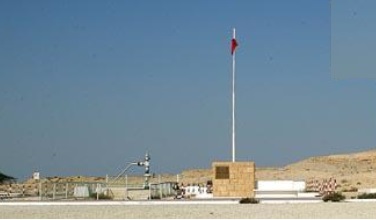
最初の油井、バハレイン (First Oil Well, Bahrain)
バハレイン石油会社(Bahrain Petroleum Company) (شركة نفط البحرين)による1932年の石油の発見は、バハレインに急速な近代化をもたらしました。イギリス海軍が1935年に中東の司令部全体をイランのブーシェフル(Bushehr) (بوشهر)からバハレインに移したことからも明らかなように、イギリスとの関係はより緊密になりました。国が発展するにつれてイギリスの影響力は高まり続け、チャールズ・ベルグレイブ(Charles Belgrave)がシャイク・イーサー(Shaykh Isa)顧問に任命されました。彼はバハレインで近代的な教育システムを確立し続けました。
The discovery of oil in 1932 by Bahrain Petroleum Company (شركة نفط البحرين) brought rapid modernisation to Bahrain. Relations with United Kingdom became closer, as evidenced by British Royal Navy moving its entire Middle Eastern command from Bushehr (بوشهر) in Iran to Bahrain in 1935. British influence continued to grow as the country developed, culminating with the appointment of Charles Belgrave as advisor to Shaykh Isa. He went on to establish a modern education system in Bahrain.
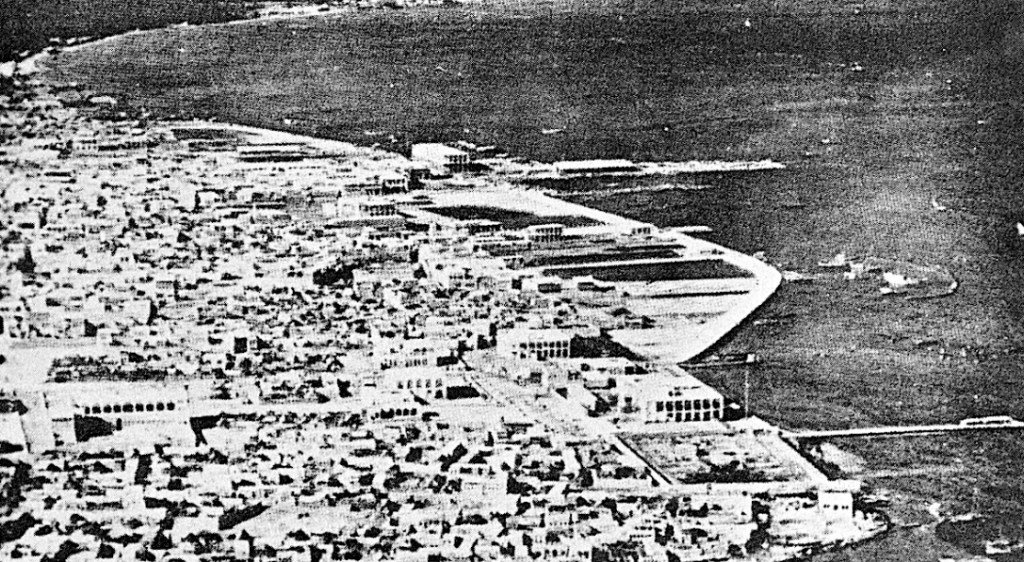
1936年当時のマナーマ (Manama in 1936)
バハレインは、第二次世界大戦(1939~1945)では大英帝国の一部、特に英領インド帝国(1858~1947) (الراج البريطاني)の湾岸居住地(1822~1971)として参加し、1939年9月10日に連合国側に加盟しました。1940年10月19日、4機のイタリアのSM.82爆撃機が連合国の運営する石油精製所を標的に、サウジアラビアのダーラン油田(Dhahran oilfield) (حقول الظهران النفطية)とともにバハレインを爆撃しました。両方の場所で最小限の被害しか引き起こされませんでしたが、攻撃により連合国はバハレインの防御を強化することを余儀なくされ、それが連合国の軍事資源さらに圧迫させました。第二次世界大戦後、反英感情の高まりはアラブ世界全体に広がり、バハレインでの暴動につながりました。1947年のマナーマ(Manama) (منامة)での反ユダヤ暴動は、著名な作家、歌手、会計士、エンジニア、石油会社で働く中間管理職、半島全体で事業を行う繊維商人、自由な専門家を含むユダヤ人コミュニティに目標を定めました。
Bahrain participated in Second World War (1939~1945) as part of British Empire, specifically British Indian Empire (1858~1947) (الراج البريطاني) as a Gulf Residency (1822~1971) (المقيمية السياسية البريطانية في الخليج العربي) on Allied side, joining on 10 September 1939. On 19 October 1940, four Italian SM.82s bombers bombed Bahrain alongside Dhahran oilfield (حقول الظهران النفطية) in Saudi Arabia, targeting Allied-operated oil refineries. Although minimal damage was caused in both locations, the attack forced Allies to upgrade Bahrain’s defences which further stretched Allied military resources. After World War II, increasing anti-British sentiment spread throughout Arab World and led to riots in Bahrain. 1947 anti-Jewish riots in Manama (منامة) focused on Jewish community, which included distinguished writers, singers, accountants, engineers and middle managers working for the oil company, textile merchants with business all over the peninsula, and free professionals.
左翼運動
Leftist movement
労働組合に関連する左派ナショナリスト運動である国民連合委員会(National Union Committee) (NUC) (هيئة الاتحاد الوطني)は、英国干渉の終焉と政治改革を求めて1954年に設立されました。作業現場は頻繁なストライキと時折の暴動に悩まされ、この期間中に数人の死者が出ました。1956 年のスエズ危機の際、三国による侵略から自国を守るエジプト (مصر) を支援する暴動を受けて、イギリスはバハレインでの彼らの存在に対するNUCの挑戦に終止符を打つことを決定しました。
National Union Committee (NUC) (هيئة الاتحاد الوطني), a leftist nationalist movement associated with labour unions, was formed in 1954 calling for the end of British interference and political reforms. Work sites were plagued with frequent strikes and occasional riots including several fatalities during this period. Following riots in support of Egypt (مصر) defending itself against the tripartite invasion during 1956 Suez Crisis, British decided to put an end to NUC challenge to their presence in Bahrain.
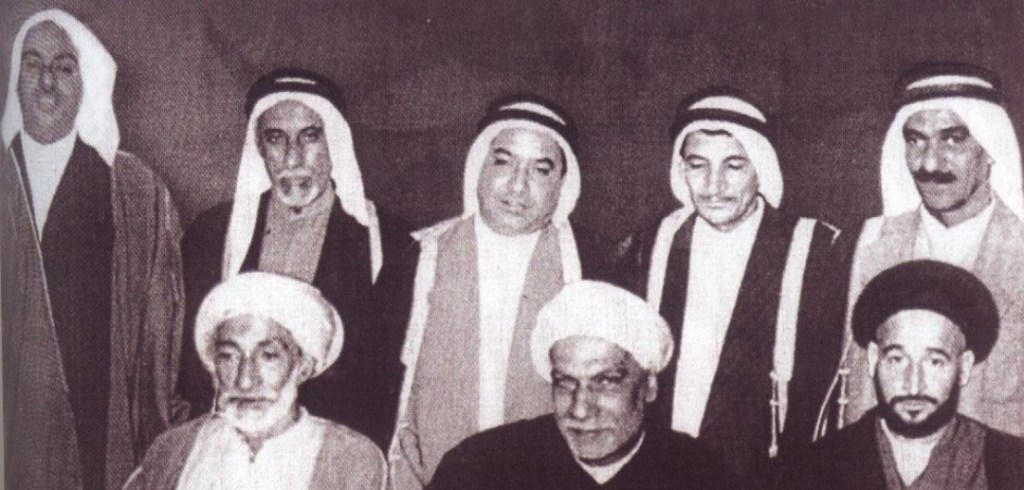
1954年の全国連合委員会メンバー (National Union Committee members in 1954)
1956年のスエズ危機:第二次アラブ・イスラエル戦争(Second Arab–Israeli war) (October 1956~November 1956) (العدوان الثلاثي).とも呼ばれています。
1956 Suez Crisis: It was also called as Second Arab–Israeli war (October 1956~November 1956) (العدوان الثلاثي).
NUCとその分派は違法と宣言されました。その指導者たちは逮捕され、裁判にかけられ、投獄されました。国外に逃れた人もいれば、強制送還された人もいました。
NUC and its offshoots were declared illegal. Its leaders were arrested, tried and imprisoned. Some fled the country while others were forcibly deported.
ストライキと暴動は1960年代に渡って続き、現在はNUCの地下細胞、すなわちバハレイン民族解放戦線(National Liberation Front) (f.1955) (جبهة التحرير الوطني—البحرين)とバハレイン解放人民戦線(Popular Front for Liberation of Bahrain) (1974~2001) (الجبهة الشعبية لتحرير البحرين)、アラブ民族主義運動(Arab Nationalist Movement) (1951~1967) (حركة القوميين العرب).のバハレイン支部(Bahraini section) (1951~1967)の指導下にあります。
Strikes and riots continued during the 1960s, now under the leadership of underground cells of NUC, namely National Liberation Front (جبهة التحرير الوطني—البحرين) and Popular Front for Liberation of Bahrain (1974~2001) (الجبهة الشعبية لتحرير البحرين), Bahraini section of Arab Nationalist Movement (1951~1967) (حركة القوميين العرب).
1965年3月、バハレインにおけるイギリスの存在に対して、3月蜂起(March Intifada) (March~April 1965) (انتفاضة مارس)と呼ばれる民衆暴動が勃発しました。暴動の火付け役は、バハレイン石油会社(Bahrain Petroleum Company)の何百人ものバハレイン人労働者の解雇でした。抗議者と警察の間の時々激しい衝突で数人が死亡しました。
In March 1965, an uprising broke out, called March Intifada (March~April 1965) (انتفاضة مارس), against British presence in Bahrain. The spark of the riots was the laying off of hundreds of Bahraini workers at Bahrain Petroleum Company. Several people died in the sometimes-violent clashes between protesters and police.
 Desert peninsula