45 その他のアラブ族


ページ内目次(In-page table of contents)
| E | その他の部族 | Other Tribes |
| E.1 | 主要な部族 | Other Major Tribes |
| E.1.1 | 地域有力勢力 | Local Principal Tribes |
| E.1.1.a | サキーフ族 | Thaqif |
| ditto | バヌー・サキーフ族 | Banu Thaqif |
| E.1.1.b | ファッラーヒーン族 | Fellahin or Fellaheen |
| E.1.1.c | ハージリー族 | Hajiri |
| ditto | バニー・ハージル族 | Bani Hajir |
| E.1.2 | 旧支配者 | Ex-ruling Families |
| E.1.2.a | イドリーシー族 | Al-Idrisi Tribe |
| E.1.2.b | リヒヤーン族 | Lihyanite |
| ditto | バヌー・リヒヤーン族 | Banu Lihyan |
| E.1.2.c | アッサーフ族 | Al Assaf Family |
| E.1.2.d | スライム家 | Al-Sulaim Family |
| E.1.3 | ハサー地方の商業資本 | Wealthiest Business Families in Al-Hasa |
| E.1.3.a | ウラヤーン家 又は オラヤーン家 | Al-Olayans Family |
| E.1.3.b | クサイビー家 又は ゴセイビ家 | Al-Gosaibi Family |
| E.1.3.c | カーヌー家 又は カーナー家 | Kanoo Family |
E その他のアラブ族
Other Tribes
最近までアドナーン部族系譜(Adnan Genealogy Tribes) (عدنان قبائل الأنساب)でもカフターン部族系譜(Qahtan Genealogy Tribes) (قحطان قبائل الأنساب)でもない部族とされて来た部族も含めてその他のアラブ族と分類しました。
Tribes that had been known as neither Adnan Genealogy Tribes (عدنان قبائل الأنساب) nor Qahtan Genealogy Tribes (قحطان قبائل الأنساب) until recently were also classified as Other Tribes (قبائل أخرى).
E.1 主要な部族
E.1 Major Tribes
主要な部族とは各々の地域で著名で有力な部族、例えば、主要部族とは、各地域の支配部族、大物、財閥、大商人などです。
Major tribes are prominent and powerful tribes such as ruling tribes, tycoons, chaebols, big merchants, etc., in each region.
E.1.1 地域有力勢力
E.1.1 Local Principal Tribes
E.1.1.a サキーフ族
E.1.1.a Thaqif Tribe
サキーフ族(Thaqif Tribe) (ثقيف)は、バヌー・サキーフ族(Banu Thaqif Tribe) (بنو ثقيف)としても知られています。
Thaqif Tribe (ثقيف) is also known as Banu Thaqif Tribe (بنو ثقيف).
ターイフ(Taif) (طائف)には5,000年前から消えたアラブ部族(Lost Arabs or Perishing Arabs) (العرب البائدة)と呼ばれるバヌー・ミフラヒル族(Banu Mihlahil Tribe) (بنو مهلاهيل)、アマーリーク族(Amaliq Tribe) (عماليق)およびサムード族(Thamud Tribe) (ثمود)とそれらの部族に加えて、バヌー・サキーフ族(Banu Thaqif Tribe) (بنو ثقيف)が住んでいたと云われています。そのうちで預言者ムハンマド時代(Era of Prophet Muhammad) (عصر النبي محمد)までターイフ(Taif)に残っていたのは、バヌー・サキーフ族(Banu Thaqif Tribe)だけでした。
It is that Lost Arabs (Perishing Arabs) (العرب البائدة), such as Banu Mihlahil Tribe (بنو مهلاهيل), Amaliq Tribe ( عماليق) and Thamud Tribe (ثمود) had lived in Taif (طائف) since 5,000 years before. Banu Thaqif Tribe (بنو ثقيف) is also said to have lived since then. Among them only Banu Thaqif Tribe remained to live in Taif until Era of Prophet Muhammad (عصر النبي محمد).
バヌー・サキーフ族(Banu Thaqif Tribe)は、アラビア部族(Arabian Tribe)の一つで偶像女神ラート(Al-Lat) (للات)を信仰し、ターイフ(Taif)周囲の肥沃な土地の広大な地域を占有していた農耕部族でした。現在でもターイフ(Taif)市人口の大多数も占める主要部族です。
Banu Thaqif Tribe was one of Arabian Tribes, an agricultural tribe that worshiped idol goddess (Al-Lat) (للات) and occupied vast areas of fertile land around Taif. Banu Thaqif Tribe is still a main tribe that makes up majority of Taif city’s population.

パルミラのバールシャミン神殿の椰子の枝とライオンを持つラート神、西暦1世紀、シリア、ダマスカス
Al-Lāt with a palm branch and lion from the Temple of Baalshamin in Palmyra,1st century AD. Damascus, Syria
バヌー・サキーフ族(Banu Thaqif Tribe)は、自分達の土地を通過する大規模な隊商に保護と役務を提供できる利点を利用して大いに繁栄していました。630年の「フナインの戦い(Battle of Hunayn) (February 630) (غزوة حنين)」から勝利の帰還をした後だった預言者ムハンマド(Prophet Muhammad) (ca.570~632) (محمد رسول الله)は、バヌー・サキーフ族(Banu Thaqif Tribe)の一時的な弱さを利用してターイフ(Taif)にイスラーム(Islam) (إسلام)を受け入れさせる事が出来ると感じて、この市を包囲しました。
Banu Thaqif Tribe prospered greatly by taking advantage of being able to provide protection and services to large caravans passing through its lands. Prophet Muhammad (ca.570~632) (محمد رسول الله), who had made a victorious return from “Battle of Hunayn (February 630) (غزوة حنين)” in 630, felt that he could take advantage of Banu Thaqif Tribe’s temporary weakness to convince Banu Thaqif Tribe to accept Islam (إسلام). And Prophet Muhammad laid siege to Taif city.
重厚な市の外壁と頑丈に閉じられた門が剣、槍と弓でのみ武装した者達では対抗出来ず、この試みは成功しませんでした。しかしながらその一年後に6人のバヌー・サキーフ族(Banu Thaqif Tribe)代表が預言者ムハンマド(Prophet Muhammad)を訪れ、バヌー・サキーフ族(Banu Thaqif Tribe)がイスラーム(Islam)に改宗すると宣言してイスラーム教徒(Muslim)と成りました。
This attempt was unsuccessful, as City’s heavy outer walls and tightly closed gates made it impossible for those armed only with swords, spears, and bows to oppose them. However, a year later, six representatives of Banu Thaqif Tribe visited Prophet Muhammad and declared that Banu Thaqif Tribe will convert to Islam and became Muslims.
E.1.1.b ファッラーヒーン族
E.1.1.b Fellahin Tribe
ファッラーヒーン族(Fellahin Tribe) (فلاحين)は、フェラーヒーン族(Fellaheen)とも転写され、その単数形は、フェラーフ(Fellah) (فلاح)です。ファッラーヒーン(Fellahin Tribe)は、ティハーマ低地(Tihamah Lowland) (أرض تهامة المنخفضة) に住むアフリカ出身の解放農民です。円形の灌木で作った小屋に住み、部族系譜と無縁な定住小農民です。
Fellahin Tribe (فلاحين) is also transcribed as Fellaheen Tribe, whose singular form is Fellah (فلاح). Fellahin Tribe are freed salave farmers originated from Africa living in Tihamah Lowland (أرض تهامة المنخفضة). They are settled peasants who live in circular huts made of shrubs. They have no ties to tribal lineages of Arabs.
ファッラーヒーン(Fellahin Tribe)は、ジーザーン(Jizan) (جيزان)に最も多く、北に行くに連れて減っています。もともとフェラーフ(Fellah) (فلاح)は、アラビア語の「耕作者」に由来し、中東および北アフリカの農民、通常は、農業労働者を意味します。この言葉は、オスマン帝国(Ottoman Empire) (1299~1923) (لدولة العثمانية)によって、広く使われた用語で同じ様な農民は、中東で広く見かけられると言われます。しかし、サウジアラビアでは、ティハーマ低地(Tihamah Lowland) (أرض تهامة المنخفضة)以外ではあまり目立った存在ではありません。
Fellahin Tribes are most numerous in Jizan (جيزان) and decrease towards north. Fellah (فلاح) originally comes from Arabic word “cultivator,” meaning usually an agricultural worker, in Middle East and North Africa. This term was widely used by Ottoman Empire (1299~1923) (لدولة العثمانية), and similar farmers are said to be widely seen in Middle East. However, in Saudi Arabia, it is not very prominent outside of Tihamah Lowland (أرض تهامة المنخفضة).
E.1.1.c ハージリー族
E.1.1.c Hajiri Tribe
ハージル族(Bani Hajir) (هاجر)は、バニー・ハージル族(Bani Hajir) (بني هاجر)としても知られています。なお、Hajirは、Hajerと転写され、ハージル族(هاجر)は、ハージリー族(Al Hajiri Tribe) (هاجري)と読まれることもあります。クウェイトを始め、サウジアラビアを含むアラビア湾岸に広く分散し、アラビア湾岸諸国で大きな勢力を持つ部族です。
Hajir Tribe (هاجر) is also known as Bani Hajir (بني هاجر). Sometime, Hajir is transcribed as Hajer and Hajir Tribe (هاجر) is read as Hajiri Tribe (هاجري). It is a tribe that widely disperse in Arabian Gulf Coast, including Kuwait and Saudi Arabia, and has a large influence in Arabian Gulf Countries.
カフターン・アラブ(Qahtan Arabs) (قحطان عرب)生粋の血統に近く、ダハラーン・ジャヌーブ(Dhahran Al Janoub) (ظهران الجنوب)北北西70km付近のアル=ヒルジャ(al-hirja) (الحرجة)とも呼ばれたサラート・アビーダ(Sarat Abidah) (سراة عبيدة)に長年住み、そこからアラビア湾沿岸に移住して来ています。
Hajir Tribe (بني هاجر) is said to be close to original lineage of Qahtan Arabs (قحطان عرب). Hajir Tribe had lived for many years in Sarat Abidah (سراة عبيدة), also known as al-Hirja (الحرجة), about 70km north-northwest of Dhahran Al Janoub (ظهران الجنوب), before migrating to Arabian Gulf Coast.
E.1.2 旧支配者
E.1.2 Ex-ruling Families
E.1.2.a イドリーシー族
E.1.2.a Al-Idrisi Tribe
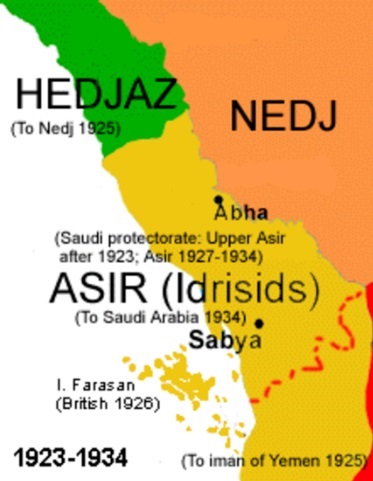
イドリーシー首長国(Idrisid Emirate of Asir) (1908~1930) (إمارة عسير الإدريسية)は、第一次世界大戦中(1914~1918)に大英帝国(Great Britain)の支援を得て、オスマントルコ(Ottoman Empire) (1299~1923) (الدولة العثمانية)に叛乱して、ムハンマド・イブン・アリー・イドリーシー(Muhammad ibn Ali al-Idrisi) (1876~1924) (r.1906~1923) (محمد بن علي الإدريسي)が建国したジーザーン地方(Jizan region) (منطقة جازان)にあった地方政権でした。その首都は、サブヤー(Sabya) (صبيا)ともアブー・アリーシュ(Abu Arish) (بو عريش)とも記述されています。ムハンマド(Muhammad)が亡くなった1924年頃まで栄えました。
Idrisid Emirate of Asir (1908~1930) (إمارة عسير الإدريسية) was founded by Muhammad ibn Ali al-Idrisi (1876~1924) (r.1906~1923) (محمد بن علي الإدريسي). This Emirate was a local government in Jizan region (منطقة جازان). Muhammad revolted to Ottoman Empire (1299~1923) (الدولة العثمانية) under support of Great Britain during World War I (1914~1918) and got independency of Idrisid Emirate of Asir from Ottoman Empire This Emirate was a local government in Jizan region (منطقة جازان). Its capital was recorded either as Sabya (صبيا) or Abu Arish) (بو عريش). This Emirate flourished until around 1924, when Muhammad died.
アシールのイドリーシー首長国(Idrisid Emirate of Asir)
ムハンマド・イブン・アリー・イドリーシー(Muhammad ibn Ali al-Idrisi)は、マグリブ(Maghreb) (المغرب العربي)の地方政権であったイドリース朝(Idrisid dynasty) (788~974) (الدولة الإدريسية)の末裔でした。イドリース朝(Idrisid dynasty)は、「第4代正統カリフ(4th Rashidun Caliph) (r.656 – 661) アリー・イブン・アビー・ターリブ(Ali ibn Abi Talib) (c. 600~661) (علي بن أبي طالب)と預言者ムハンマド(Prophet Muhammad) (ca.570~632) (محمد رسول الله)の娘ファーティマ(Fatimah al-Zuhra) (605 or 615~632) (فاطمة الزهراء)との息子ハサン・イブン・アリー(Al Hassan ibn ‘Ali) (625~669) (الحسن بن علي)の曾孫であるイドリース(Idris I ibn Abd Allah) (r.788~791) (إدريس بن عبد الله)を始祖としています。
Muhammad ibn Ali al-Idrisi is a descendant of Idrisid dynasty (788~974) (الدولة الإدريسية), which was a local government of Maghreb (المغرب العربي). Idrisid dynasty was founded by Idris I ibn Abd Allah (r.788~791) (إدريس بن عبد الله). Idris I is the great-grandson of Al Hassan ibn ‘Ali (625~669) (الحسن بن علي). Al Hassan is a son between Ali ibn Abi Talib (c. 600~661) and Fatimah al-Zuhra (605 or 615~632) (فاطمة الزهراء). Ali is 4th Rashidun Caliph (r.656 – 661) while Fatimah is a daughter of Prophet Muhammad (ca.570~632) (محمد رسول الله).

ムハンマド・イブン・アリー・イドリーシー(Muhammad ibn Ali al-Idrisi)
イドリーシー首長国(Idrisid Emirate of Asir)は、次第にサウジアラビアに吸収されて1934年のターイフ条約(Treaty of Taif) (معاهدة الطائف)で、サウジアラビア領となりました。
Idrisid Emirate of Asir was gradually absorbed into Saudi Arabia and became a Saudi territory in 1934 with Treaty of Taif (معاهدة الطائف).
イスラーム神秘主義哲学(Islamic Sufi philosophy) (الفلسفة الصوفية الإسلامية)スーフィズム(Sufism) (صوفية)に基づく社会秩序を確立したイドリーシーヤ(Idrisiyya) (لطريقة الإدريسية)の創設者アハマド・イブン・イドリース・ファースィー(Ahmad Ibn Idris al-Fasi) (1760~1837) (أحمد بن إدريس الفاسي)は、神秘主義神学者であり、モロッコ(Morocco) (مغرب)、北アフリアとイエメンを旅しました。聖職者(イスラーム法学者(Ulama)(عالم)に反対してイスラームの生き生きとした祈りの形式を民衆に直接伝えようとしたアハマド(Ahmad)は、1760年にモロッコ第二の都市のフェズ(Fez) (فاس)で生まれて1837年にジーザーン(Jizan)のサブヤー(Sabya)で亡くなっています。ムハンマド・イブン・アリー・イドリーシー(Muhammad ibn Ali al-Idrisi)は、アリー・イブン・ムハンマド・イブン・アハマド・イドリーシー(Ali ibn Muhammad ibn Ahmad al-Idrisi) (علي بن محمد بن أحمد الإدريسي)の息子であり、アハマド(Ahmad)の曾孫に当たります。
Ahmad Ibn Idris al-Fasi (1760~1837) (أحمد بن إدريس الفاسي) is founder of Idrisiyya (لطريقة الإدريسية). Ahmad established a social order based on Islamic Sufi philosophy (الفلسفة الصوفية الإسلامية) which he called Sufism (صوفية).
Ahmad was an Islamic Sufi theologian who traveled from Morocco (مغرب) through North Africa to Yemen. He opposed clergies (Islamic jurists (Ulama) (عالم) and tried to convey lively forms of prayer of Islam directly to people.
Ahmad was born in 1760 in Fez (فاس), second largest city in Morocco, and died in 1837 in Sabya, Jizan.
Muhammad ibn Ali al-Idrisi is a son of Ali ibn Muhammad ibn Ahmad al-Idrisi) (علي بن محمد بن أحمد الإدريسي) and a great-grandson of Ahmad.
E.1.2.b リヒヤーン族
E.1.2.b Lihyanite
リヒヤーン族(Lihyanite) (لحيان)は、リフヤーン族(LihyanTribe) (لحيان)とも転写され、バヌー・リヒヤーン族(Banu Lihyan) (بنو لحيان)としても知られています。リヒヤーン族(Lihyanite)については、殆ど分かってはいませんが、「アラブ系譜学では古代アラブのサムード族(Thamud Tribe) (ثمود)の子孫である」との説があります。
Lihyanite (لحيان) is also transcribed as Lihyan Tribe (لحيان) and is also known as Banu Lihyan (بنو لحيان). Lihyanite) is little known, but there is a theory that it is a descendant of Ancient Arab Thamud Tribe (ثمود) in Arab genealogy.
旧約聖書には「古代のリヒヤーン族(Lihyanite)はユダヤ人預言者として登場するエリヤ(Ilyas, Elijah or Elias)の孫リフヤーン・イブン・フザイル(Lihyan ibn Hothail)の息子達であり、リヒヤーン王国(Kingdom of Lihyan) (7th century BC~24 BC) (مملكة لحيان)を建国した古代のリヒヤーン族(Lihyanite)がヒジャーズ(Hijaz) (حجاز)のアドナーン部族(Adnanite)一派のバヌー・フザイル族(Banu Hothail)であった」と述べられていると云います。(C.3.5.b.1リヒヤーン・ビン・フザイル族(Lihyan ibn Hudhayl) (لحيان بن هذيل)参照)。
Old Testament also says, “Ancient Lihyanite were sons of Lihyan ibn Hothail, a grandson of Ilyas (Elijah or Elias), who appeared as a Jewish prophet. Ancient Lihyanite who founded Kingdom of Lihyan (7th century BC~24 BC) (مملكة لحيان) was Banu Hothail, a group of Adnan tribe of Hijaz (حجاز).” (See C.3.5.b.1 Lihyan ibn Hudhayl (لحيان بن هذيل)).
アラビアの系図学者は、「アドナーン部族Adnanite Arabs)のフザイル族(Hothail)子孫は、バヌー・リヒヤーン族(Banu Lihyan)である」と推定している一方で、リヒヤーン族(Lihyanite)自身は、「自分達をサムード族(Thamud Tribe)では無く、ジュルフム族(Jurhum Tribe) (جرهم)(消えたアラブ族(Lost Arabs or Perishing Arabs) (العرب البائدة)の1つ)の子孫のアラブ族であると考えている」と云います。
Arabian genealogists estimate that descendants Hothail Tribe belonging to Adnanite Arabs are Banu Lihyan. On the other hand, Lihyanite themselves described themselves as “not Thamud Tribe, but Jurhum Tribe (جرهم) of Lost Arabs or Perishing Arabs (العرب البائدة)).
E.1.2.c アッサーフ族
E.1.2.c Al Assaf Tribe
アッサーフ族(Al Assaf Tribe) (عائلة العساف)は、古井戸を意味するカスィーム地方(Qasim region) (منطقة القصيم)第3の都市でブライダ(Buraydah) (بريدة)南南西60kmにある古井戸を意味するラッス(Rass) (رس)の支配者家族でした。現在でも閣僚歴任者のイブラーヒーム・アル=アサーフ(Ibrahim Abdulaziz Al-Assaf) (b.1949) (إبراهيم العساف)を輩出する等の有力部族です。
Al Assaf Tribe (عائلة العساف) was ruling family of Rass (رس), meaning old well, located 60 km south-southwest of Buraydah (بريدة), which is third largest city of Qasim region (منطقة القصيم). Even today, it is a prominent tribe that has produced Ibrahim Abdulaziz Al-Assaf (b.1949) (إبراهيم العساف), who had served as several ministers.

ラッス(Rass)
E.1.2.d スライム家
E.1.2.d Al-Sulaim Family
スライム家(Al-Sulaim Family) (آل سليم)は、スライム朝 (Al Sulaim Dynasty) (1817~1907) (سلالة حاكمة آل سليم)を樹立し、1817年からカスィーム地方(Qasim region) (منطقة القصيم)のウナイザ市(Unayzah city) (مدينة عنيزة)を支配し、1907年にイブン・サウード(Ibn Saud) (1876~1953) (ابن سعود)の支配下に入りました。
Al-Sulaim Family (آل سليم) established Al Sulaim Dynasty (1817~1907) (سلالة حاكمة آل سليم). It had ruled Unayzah city (منطقة القصيم) in Qasim region (منطقة القصيم) from 1817, however it came under control of Ibn Saud (1876~1953) (ابن سعود) in 1907.
E.1.3 ハサー地方の商業資本
E.1.3 Wealthiest Business Families in Al-Hasa
ハサー地方(Al-Hasa region) (منطقة الأحساء)の伝統的な商業資本としては、オライヤン家(ウライヤーン)(Al-Olayans) (العليان)、ゴセイビ家(クサイビー)(Al-Gosaibi) (القصيبي)、カーヌー家(カーナー)(Kanoos) (كانا)およびザーミル家(Al-Zamils) (لزامل)が挙げられます。
Traditional commercial capitals of Al-Hasa region (منطقة الأحساء) includes Al-Olayans Family (العليان), Al-Gosaibi Family (القصيبي) and Kanoos Family (كانا) and Al-Zamils Family (لزامل).
E.1.3.aウラヤーン家 又は オラヤーン家
E.1.3.a Al-Olayans Family
オラヤーン・グループ(جموعةالعليان)は、1947年にスリーマーン・オラヤーン(Suliman Olayan)によって設立された多国籍企業で、グローバル投資のポートフォリオを積極的に管理しています。グループの主要親会社であるオラヤーン・インベストメンツ・カンパニー・エスタブリッシュメント(Olayan Investments Company Establishment) (OICE),は、リヒテンシュタイン(Liechtenstein)のファドゥーツ(Vaduz)に本社を置き、ニューヨーク(New York)、ロンドン(London)、ルクセンブルク(Luxembourg)、ウィーン(Vienna)、アテネ(Athens)、リヤード(Riyadh)、シンガポール(Singapore)にオフィスを構えています。
(詳細は「ウラヤーン家 又は オラヤーン家」を参照してください。)
Olayan Group (جموعة العليان) is a multinational enterprise established in 1947 by Suliman S. Olayan, with an actively managed portfolio of global investments. Group’s primary parent company, Olayan Investments Company Establishment (OICE), is headquartered in Vaduz, Liechtenstein having its offices in New York, London, Luxembourg, Vienna, Athens, Riyadh, and Singapore.
For details, see “Al-Olayans Family”.
MENAの投資・運営の親会社であるOlayan Financing Company(OFC)は、リヤード(Riyadh)に拠点を置いています。オラヤーン・グループ(Olayan Group)は、不動産を含む上場株式と未公開株式の両方、および債券に国際的に投資しています。その数十億ドル規模のポートフォリオは、北米、ヨーロッパ、アジア、中東に集中しています。
Group’s parent for MENA investments and operations, Olayan Financing Company (OFC), is based in Riyadh. Olayan Group invests internationally in both public and private equities, including real estate, as well as in fixed income securities. Its multibillion-dollar portfolio is concentrated in North America, Europe, Asia and Middle East.
E.1.3.b クサイビー家 又は ゴセイビ家
E.1.3.b Al-Gosaibi Family
アル=ゴセイビー家(Al Gosaibi family) (عائلة القصيبي)は、サウジアラビアとバハレインの最も古く、最も裕福な貿易商です。家族の歴史は、アラムコ(ARAMCO)、サビック(Sabic)、ジュバイル工業都市(Jubail Industrial City)、そしてサウジ2030 (Saudi 2030)など、地域の経済と政治の発展と絡み合っています。これらだけでなく、アル=ゴセイビー家は、著名な文学者も輩出してきました。
(詳細は「クサイビー家 又は ゴセイビ家」を参照してください。)
Al Gosaibi family(عائلة القصيبي) is an oldest and richest trading families of Saudi Arabia and Bahrain. Family’s history is intertwined with Development of Region’s economy and politics such as ARAMCO, Sabic, Jubail Industrial City, and also Saudi 2030. Not only these, Al Gosaibi family also has produced prominent literary persons.
For details, see “Al-Gosaibi Family”.
アル=ゴセイビー・ファミリーの中核事業は、アフマド・ハマド・アル=ゴセイビー&ブラザーズ(Ahmad Hamad Al Gosaibi & Brothers) (AHAB) (مجموعة أحمد حمد القصيبي وإخوانه)を通じて行われていました。AHABはあらゆる面で収益性の高い事業売上高を享受しているように見えましたが、2009年にAHABの事業は、突然の巨大な地震に遭遇して崩壊したかの様に、70年の歴史を持つ事業は、200億米ドルの危機に瀕した財政破綻を引き起こしました。
Core Business of Al Gosaibi Family had been conducted through Ahmad Hamad Al Gosaibi & Brothers (AHAB) (مجموعة أحمد حمد القصيبي وإخوانه)”. In every aspect, AHAB had been looked like enjoying lucrative business turnover, however AHAB business in 2009 was collapsed at suddenly like encountering huge seismic at risk of US $20 billion, which in turn sparked the financial downfall of the 70-year-old business.
AHABが提出した財務再編提案に対するダンマーム商事裁判所(Commercial Court in Dammam) (المحكمة التجارية بالدمام)の受理(المحكمة التجارية بالدمام)によると、債権者は2021年8月にAHABが提案した和解案に投票で同意した。この和解により、債権者は142の銀行から承認された73億3,000万米ドルの債務請求総額のうち、19億3,000万米ドルでの和解を獲得しました。73億3,000万ドルは、200億米ドルのうちAHABの負担分でした。こうして、AHABは、アラビア湾における最長の債務紛争の1つに終止符を打ち、正常な企業運営に戻っています。
According to Acceptance of Commercial Court in Dammam (المحكمة التجارية بالدمام) for financial restructuring proposal submitted by AHAB, Creditors agreed AHAB proposed settlement by voting in August 2021. By this settlement, creditors got US $1.93 billion out of total approved debt claims of US $7.33 billion from 142 banks. $7.33 billion was AHAB’s portion out of US $20 billion. Thus AHAB ended one of longest debt disputes in Arabian Gulf and had return to its normal operation.
E.1.3.cカーヌー家 又は カーナー家
E.1.3.c Kanoo Family
ユースフ(Yusuf)家の事業は、ユースフ・ビン・アフメド・カーヌー・グループ(Yusuf bin Ahmed Kanoo Group) (يوسف بن أحمد كانو مجموعة)で、YBAカーヌー・グループ(YBA Kanoo Group) (مجموعة كانو) としても知られています。YBAカーヌー・グループ(YBA Kanoo Group)は、1890年に設立された株式非公開の財閥です。アラビア湾岸で最大の家族経営の多国籍企業の1つであり、補完的な事業と戦略的提携関係を持っています。YBA Kanoo Groupは4,000人の従業員を擁し、幅広い分野を網羅しています。事業グループには、Kanoo Capital、Industrial & Energy、Travel、Shipping & Logistics、Real Estateが含まれています。
Yusuf family’s business is Yusuf Bin Ahmed Kanoo Group (يوسف بن أحمد كانو مجموعة). It is also known as YBA Kanoo Group (مجموعة كانو). YBA Kanoo Group is a privately held business conglomerate established in 1890. It is one of largest family-owned multinationals in Arabian Gulf coast, with complementary businesses and strategic partnerships. YBA Kanoo Group has a 4,000-strong workforce, covering a broad range of sectors. Its business groups include: Kanoo Capital, Industrial & Energy, Travel, Shipping & Logistics and Real Estate.
(詳細は、「カーヌー家 又は カーナー家」を参照してください。)
For details, see “Kanoo Family”.
YBA Kanooの最大の部門は工業・エネルギー部門で、2018年に再編され、部門ごとにに焦点を当てた事業から5つの事業部門グループに合理化されました。
YBA Kanoo’s largest division is Industrial & Energy, which was restructured in 2018 to transform from being a sector-focused business and streamlining into five business units groups
 Desert peninsula