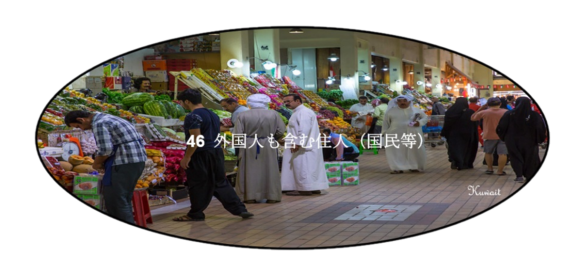
46 外国人も含む住人(国民等)


目次(Index)
| アラビア半島七ヵ国住民の都市生活志向 | Residents favor urban living on Arabian Peninsula |
| アラビア半島七カ国の住人 | Residents of Seven countries on Arabian Peninsula |
| アラビア半島の人口が集中する主要50都市 | 50 most populous cities on Arabian Peninsula |
アラビア半島七ヵ国住民の都市生活志向
Residents favor urban living on Arabian Peninsula
1932年にバハレインで石油が発見されて、その生産が始まった以降は、アラビア半島の国々は基本的には石油・天然ガスの収入で国家財政が賄われてきました。この為に、政府がその富みを国民に分配すると云う特異なレンティア国家体制が出来上がっています。言い換えれば消費社会であり、この事が大都市に人口が集中する大きな原因と成っています。
Since oil was discovered in Bahrain in 1932 and production began, Arabian Peninsula states have basically run their national finances on oil and natural gas revenues. This has created a unique rentier state system in which a government distributes its wealth to its nationals. In other words, it is a extremely consumer society, and this is main reason for concentration of population in urban cities.
国民はもともと遊牧民ベドウインの伝統(Nomadic Bedouins’ tradition) (تقاليد البدويون الرحلを引き継いでいるので、「労働から富が得られる」との概念があまりありませんでした。宗教的に一定の制約の下に奴隷制も認められており、家内労働も家内奴隷に大きく依存してきました。英国等の圧力で奴隷制が廃止されたのは、サウジアラビアとイエメンで1962年のことでした。それでもオマーンでは英国保護領であるにもかかわらず、1970年まで奴隷制を続けていた。1960年のサウジアラビアの人口409万人に対して奴隷は30万人であり、1割近い人口を奴隷が占めていました。
People originally inherited Nomadic Bedouins’ tradition (تقاليد البدويون الرحل), so they did not have much of a concept of “wealth can be obtained through labor.” Slavery was permitted under certain religious restrictions, and domestic labor was also heavily dependent on domestic slaves. Slavery was abolished in Saudi Arabia and Yemen in 1962 under pressure from United Kingdoms and other countries. Nevertheless, slavery continued in Oman until 1970, despite it being a British protectorate. In 1960, there were 0.3 million slaves out of a population of 4.09 million in Saudi Arabia, meaning that slaves accounted for nearly 10% of its population.
その後、労働力として外国人を入国させる為、その監視の為にカファーラ制度(kafala system) (نظام الكفالة)が広く取り入れられてきました。この制度では全ての外国人労働者は、通常は雇用主であり、ビザや法的地位を担当する国内スポンサーを持つ事を義務付けられ、出国するまでスポンサーにビザを保管され、移動や再就職の機会も認められていません。一種の「タコ部屋”forced labour camp”」制度と言えます。労働者が法的な訴えを起こす可能性は、ほとんどないのによるで、雇用主による虐待や性的暴行が起こりがちです。その様な事件が紙面の掲載されることもときどきあります。
外国人乳母に頼る育児も幼児教育やアラビア語教育に弊害を来していました。この様な状況にあるため、「労働」に対する価値観は、「労働」によって現在の繁栄を築いてきた欧米諸国の感覚からは、もっとも遠いところにある価値観であると言えます。
Since then, kafala system (نظام الكفالة) has been widely adopted to monitor entry & exit of foreign labours. Under this system, all foreign workers are required to have a domestic sponsor, usually an employer, who is responsible for their visa and legal status. Their visas are held by their sponsor until they leave country, without opportunity for movement or reemployment. It is a kind of “forced labour camp” system. As workers have little chance of taking legal action, they are prone to abuse and sexual assault done by their employers. Such cases are sometimes published in local papers.
Childcare that relies on foreign wet nurses also has a negative impact either on early childhood education or on Arabic language education. Under those situations, values regarding “labor” are far removed from those of Western countries, which have built their current prosperity through “labor.”
現実には出生率の高さから急増する自国若年層の人口も労働を嫌う傾向が強く、大量失業を生んできました。この為、2013年11月に数千人のエチオピア不法居住者を追放したことに始まり、ソマリア、エチオピア、イエメンからの不法居住労働者を50万人勾留し、国外追放する等を行っています。企業に従業員自国民化を働きかけていますが、効果が無く、窓口業務やレジ等職種、カレーレンタルの様な業種全体を自国民化する政策も取られています。「2030」運動と命名した政策の主要な目的も「若年層や女性」の就業促進です。多くの職業訓練学校、理工系学科の創設が行なわれてはいますが、単純労働や肉体労働などでは、成果が余り上がっていません。コンピューター操作には、抵抗が無いのでインテリジェンス産業を中心に自国民雇用や女性登用に改善がみられていますが、3K労働は引き続き、外国人労働者に頼らざるを得ません。
In reality, young population, which is rapidly increasing due to high birth rate, also has a strong tendency to dislike work, which has led to mass unemployment. For this reason, starting with expulsion of several thousand Ethiopian illegal residents in November 2013, 500,000 illegal workers from Somalia, Ethiopia, and Yemen have been detained and deported. A government has been encouraging companies to recruit employees as local nationals, but to no avail, and policies are being adopted to recruit local nationals for jobs such as counter work and cashiering, as well as entire industries such as curry rental. Main purpose of “2030” movement policy is also to promote employment of “young people and women”. Many vocational training schools and science and engineering departments have been established, however there has been little progress in simple labour and physical labour. There is no resistance to computer operation, so there has been improvement in employment of local nationals and promotion of women, especially in intelligence industry, but 3K labour will continue to require reliance on foreign workers.
この地域の人々の利点は、サウジアラビアを除けば、アラビア半島七ヵ国はクウェイトが1961年まで、アデンが1967年まで、その他は1971年まで英国保護領であったので、英語が広く普及して来ています。前述の石油開発は7姉妹と呼ばれた大手石油企業によって行われ、この地域の技術員を育てた大手石油企業では事務、技術、営業など全ての面でオイル・イングリッシュ(Petro-English)が使われきました。サウジアラビアの産業と財政の核と成っている石油開発もARAMCOが担ってきましので、英語が自然に第二外国語となりました。「他人の言語を学ぶ者は、その狡猾さから保護される」と云うハディース (Hadith) (الحديث النبوي)の一節もその助けと成っています。1963年に設立され、サウジの科学技術の中核と成ったファハド国王石油鉱業大学(KFUPM) (King Fahd University of Petroleum and Minerals) (جامعة الملك فهد للبترول والمعادن)では日常会話も含めてすべてのカリキュラムが英語で行われています。これは21世紀に入って中核大学として新設されたアブドゥッラー国王科学技術大学大学(KAUST) (King Abdullah University of Science and Technology) (جامعة الملك عبد الله للعلوم و التقنية)では特に顕著です。
People’s advantage in this region is that, except for Saudi Arabia, Seven countries of Arabian Peninsula were British protectorates until 1971, Kuwait until 1961, Aden until 1967, and other rest until 1971, so English has become widespread. Oil development mentioned above was carried out by major oil companies called Seven Sisters, and major oil companies that trained engineers in this region. They have used so called Petro-English in all aspects, including administration, technology, and sales. Since ARAMCO was also in charge of oil development, which is the core of Saudi Arabia’s industry and finance, English naturally became second foreign language. A passage from Hadith (الحديث النبوي) that says, “He who learns another language is protected from its cunning” also helps this. At King Fahd University of Petroleum and Minerals (جامعة الملك فهد للبترول والمعادن) (KFUPM), which was established in 1963 and became the core of Saudi science and technology, all curriculum, including daily conversation, is taught in English. This is particularly evident at King Abdullah University of Science and Technology (جامعة الملك عبد الله للعلوم و التقنية) (KAUST), which was newly established as a core university in 21st century.
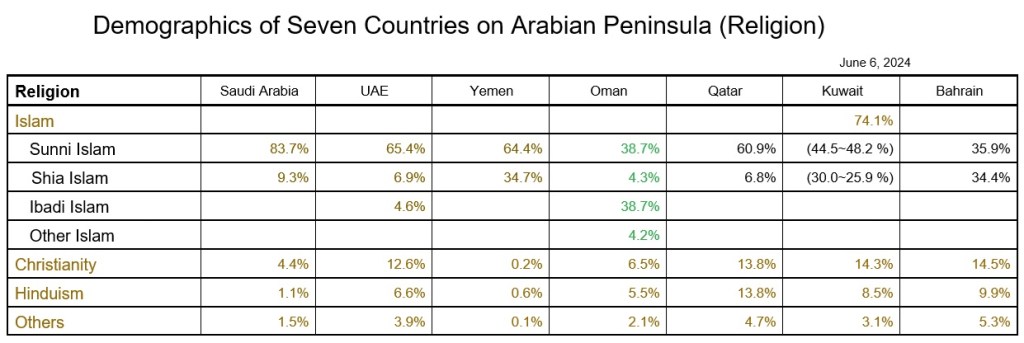
アラビア半島七ヵ国の国民は、バハレインやアラブ首長国連邦等例外的にキリスト教徒やユダヤ教徒がいますが、それ以外の国民は、ほぼ全員がイスラーム教徒です。外国人の宗教に関しては、サウジアラビアの様に信仰は認めても実践は認めない国から、アラブ首長国連邦のように殆ど干渉しない国まで様々です。
イスラーム教もサウジアラビア国民は、スンニー派(Sunni) (سنة)ワッハーブ派主義(Wahhabism) (الدعوة الوهابية)で、シーア派(Shia) (شيعة)は、15%程度で主に東部州のカティーフ(Qatif) (قطيف)やハサー(Hasa) (حسا)で多数を占めています。
アラビア湾岸諸国は、バハレインを除き同じ様にシーア派は、多数ではありません。シーア派が多数を占めるバハレインではシーア派盟主イランの後ろ盾があり、時として政府を脅かす勢いと成ります。
イエメンでは9世紀に成立したシーア派のザイド派(Shiite Zaydism sect) (الطائفة الزيدية من الشيعة)が1962年のイエメン王国(Kingdom of Yemen) (المملكة المتوكلية اليمنية)崩壊まで北イエメンの政権を担っていました。
南北合併以後のその強力な武力勢力であるフーシ派(Houthi) (حوثيون)が2015年1月にはハーディー大統領 (Abd Rabbuh Mansur Hadi) (President 2012~2022) (عبدربه منصور هادي)を退位させ、議会を解散させ、イエメン政府の実権を掌握しました。
同3月のスンニ派アラブ諸国同盟軍(Saudi-led intervention) (التدخل العسكري في اليمن)の空爆に始まる「決定的な嵐作戦(Operation Decisive Storm)」でフーシ派は、撃退され、ハーディー大統領政府は、2017年3月に領土の87%を一時的に奪回して同作戦は終了していますが、内戦状態は依然として続いています。同じシーア派のイスマーイール派(Isma’ilism) (إسماعيلية)はサヌア(Sana’a) (Sana’a)やマアリブ(Ma’rib) (مأرب)のような主要な中心を占めています。
オマーンはハワーリジュ派(Kharijites) (خوارج)のイバード派(Ibadi) (إباضية)が国民の大多数を占め、他の諸国と少し距離があります。
In Seven nations of Arabian Peninsula peoples are almost all Muslim, with exception of Bahrain and United Arab Emirates, where there are Christians and Jews. With regard to religions of foreigners, there are various countries, from Saudi Arabia, which allows their beliefs but does not allow their practices, to United Arab Emirates, which does not interfere much.
In Islam, Saudi Arabian people are Sunni (سنة) and Wahhabist (الدعوة الوهابية), while Shiite (شيعة) make up about 15% of population, mainly in Qatif (قطيف) and Hasa (حسا) in Eastern Province.
In Arabian Gulf countries, except for Bahrain, Shiites are not in majority. In Bahrain, where Shiites make up majority, they are backed by Iran, Shia suzerainty, and sometimes threaten its government.
In Yemen, Shiite Zaydism sect (الطائفة الزيدية من الشيعة), which was established in 9th century, was in charge of its government of North Yemen until collapse of Kingdom of Yemen (المملكة المتوكلية اليمنية) in 1962.
Houthi rebels (المتمردين الحوثيين), a puissance armed force that emerged after merger of North and South, deposed President Abd Rabbuh Mansur Hadi (r. 2012~2022) (عبدربه منصور هادي), dissolved parliament, and seized real power in Yemeni government in January 2015.
Houthis were repelled by Operation Decisive Storm (عملية عاصفة الحزم), which began with air strikes by Saudi-led intervention in March of same year, and President Hadi’s government temporarily recaptured 87% of Yemen territory in March 2017, ending operation, but Yemen civil war continues. Ismaili sect of Shiite Islam, which is de fact Houthi government, has major centres in Sana’a (صنعاء) and Ma’rib (مأرب).
Oman is somewhat distant from rest of other countries, as Ibadi sect (الطائفة الإباضية) of Kharijites constitutes (الخوارج يشكلون) is majority of population.
アラビア半島7カ国は、他の国に比べて若年層が多い特徴があります。これらの国では、出生率が高いということは、移民労働者が少なく、平均年齢が低いことを意味します。逆に、出生率が相対的に低いということは、移民労働者が多く、男女格差が大きいことを意味しています。対照的に、アラビア半島7カ国の為政者は、高齢であり、サウジアラビアとクウェートでは、指導者は長年80代が続いて来ました。
このため、これらの国では国王、皇太子、王室閣僚の若返りを図っています。例としては、カタールのタミム・ビン・ハマド・アール・サーニー国王(King Tamim bin Hamad Al Thani) (b.1980) (تميم بن حمد آل ثاني)やサウジアラビアの皇太子兼首相ムハンマド・ビン・サルマーン(Crown Prince and Prime Minister Mohammed bin Salman) (1985) (محمد بن سلمان).が挙げられます。
Seven Arabian Peninsula countries have a younger population than other countries. Among them. higher birth rate means fewer migrant labours and lower average age. Conversely, relatively lower birth rate means more migrant labours and more larger gender gap. In contrast, leaders of Seven Arabian Peninsula countries are older, and in Saudi Arabia and Kuwait, they have been in their 80s for many years.
For this reason, they are trying to rejuvenate their kings, crown princes, and royal cabinet members. Examples include Qatar’s King Tamim bin Hamad Al Thani (b.1980) (تميم بن حمد آل ثاني) and Saudi Arabia’s Crown Prince and Prime Minister Mohammed bin Salman (1985) (محمد بن سلمان).
アラビア半島の方言については大きくヒジャーズ方言(Hejazi Arabic) (لهجة حجازية)、ナジュド方言(Najdi Arabic) (لهجة النجدية)と湾岸アラビア語(Gulf Arabic) (لهجة خليجية)に分けられます。聾唖者(聴覚障碍者)に対応した手話(Sign Language) (لغة إشارة)も広く使われて来ました。
湾岸アラビア語はイランの影響が強く、「ハ」を「カ」、「カ」を「ガ」と発音するなど特徴があります。例えばスペルの近い「カフジ(Khafji) (خفجي)(中立地帯)」と「ハルジュ(Kharj) (خرج)(リヤードの南)」の違いです。
クウェイトの様に同国人でもペルシア系のアジャム(Ajam) (عجم)(アラブ人以外)ではペルシア語が話されています。この様に表面的には目立たちませんが、アラビア半島では依然として部族社会を強く残しています。バハレインでは同じシーア派でもバハールナ族(Baharna) (بحارنة)とアジャム族(Ajam)に少数派のハサーウィ族(Hassawi) (حساوي)がいまし、スンニー派もアラブ人の他に少数派としてペルシア人、バルーチ人(Baluch) (بلوش)、東アフリカ系などもいます。
Dialects on Arabian Peninsula are largely divided into Hejazi Arabic (دهجة حجازية), Najdi Arabic (لهجة النجدية) and Gulf Arabic (لهجة خليجية). Sign language for deafs (hearing impaired) has also been widely used.
Gulf Arabic is heavily influenced by Iran (Persia), and has characteristics such as pronouncing “ha” as “ka” and “ka” as “ga”. For example, there is a difference between “Khafji (خفجي) (neutral zone)” and “Kharj (خرج) (south of Riyadh)” which are similar in spelling but are pronounced “kahuji” and “haruji” respectively.
In Kuwait, Persian is spoken among Ajam (non-Arabs) of Persian descent. Although it is not noticeable on surface, a tribal community remains strong in Arabian Peninsula. In Bahrain, same Shiite tribes include Baharna (بحارنة), Ajam (بحارنة), and Hassawi (حساوي) minority. In addition to Arabs, Sunnis also have minorities such as Persians, Baluch (بلوش), and East Africans.
アラビア半島七カ国の住人
Residents of Seven countries on Arabian Peninsula
アラビア半島諸国に入ると朝から礼拝を呼び掛けるアザーン(Adhan) (أذان)の声が響き、イスラームの国 (Islamic state) (دولة الإسلامية)に居る事を自覚させられます。
男性は、殆ど白いディスターシャ(dishdash) (دشداشة)、女性はほぼ全員、頭からすっぽり被った黒いアバーヤ(abaya) (عباية)を身に着けています。その白黒以外には出稼ぎの外国人の多さが目立ちます。買い物などで町に出てみると、英語で殆ど用事は足せるし、交通標識や案内板はアラビア語の他に英語が併記されています。老人よりも子供の姿が多いことが特徴的に目に付きます。
政治的な体制を述べる前にその様な外国人も含む住人についてのあらましを住人の数、民族、宗教、話されている言葉などについてまとめてみました。
Enterring in any of Arabian Peninsula countries, Adhan (أذان) calls for prayer from early morning. That makes you realize in Islamic state (دولة الإسلامية).
Most of men wore white dishdashes (دشداشة), and almost all women completely wore black abaya (عباية) from their head. Other than black and white, number of immigrant labours who have gone to work is conspicuous. Going out to town for shopping, you can do most of your errands in English, and traffic signs and information boards are written in English in addition to Arabic. It is characteristic that there are more children than old people.
Before describing political system, number of residents, ethnicity, religion, spoken language, etc. are summarized here.

Native People and Immigrate Workers living in seven countries on Arabian Peninsula
アラビア半島七カ国の人口等
Demographics of Seven Countries (Population)

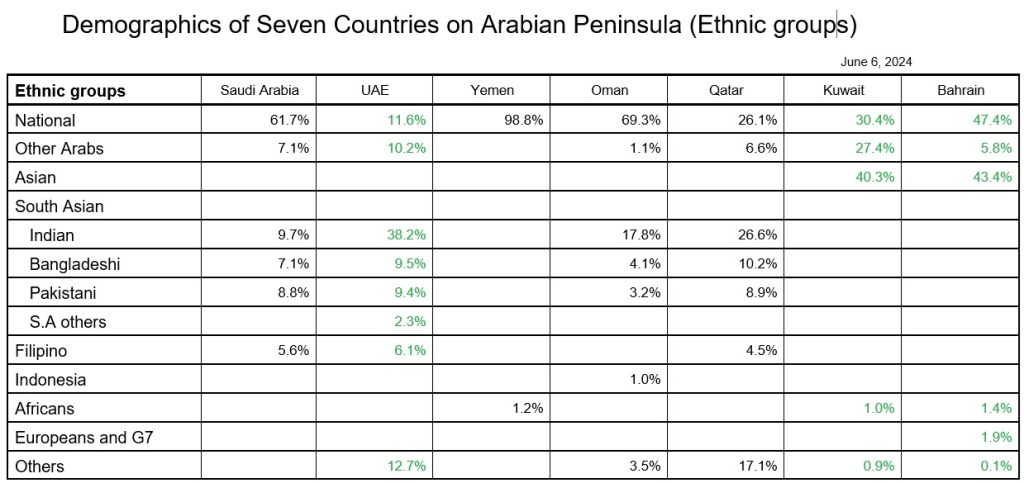
アラビア半島七カ国に居住する民族
Demographics of Seven Countries (Ethnic groups)
アラビア半島七カ国で信仰されている宗教
Demographics of Seven Countries (Religion)
アラビア半島七カ国で使用されている言語
Languages currently spoken in Seven Countries
Languages currently spoken in Arabian Peninsula
June 6, 2024
| Arabic | ||
| Modern Standard | اللغة العربية الفصحى الحديثة | Used in literature, academia, mass media, law and legislation |
| Najdi Arabic | لهجة النجدية | Syrian, Najdi, Rub’ al-Khali Deserts and vicinities |
| Hejazi Arabic | لهجة حجازية | Hejaz region in Saudi Arabia |
| Gulf Arabic | لهجة خليجية | Arabic people around Coasts of Arabian Gulf |
| Bahrani Arabic | لهجة بحرانية | Shia villages in Qatif (S.A), Bahrain, Omanand |
| Sanaani Arabic | لهجة صنعانية | Sana’a city and its surroundings |
| Ta’Izzi-Adeni | لهجة تعزية عدنية | spoken primarily in Yemen |
| Hadrami Arabic | لهجة حضرمية | Hadhrami people living in Hadhramaut |
| Tihami Arabic | لهجة التهامية | Tihamah coastal plain in Yemen |
| Omani Arabic | لهجة عمانية | Al Hajar Mountains and its neighboring of Oman |
| Dhofari Arabic | لهجة ظفارية | Around Salalah in Oman’s Dhofar Governorate |
| Shihhi Arabic | اللغة الشحرية | Areas upland from Salalah in Dhofarn of Oman |
| Arabian Semitic | اللغة العربية السامية | |
| Faifi | الخولانية | Fifa Mountains in Southwestern Saudi Arabia |
| Mehri | مهرة | Al-Mahra Governorate and Socotra in Yemen |
| Razihi | اللغة الرازحية | Vicinity of Jabal Razih in far northwestern Yemen |
| Soqotri | اللغة السقطرية | Socotra Arch. of Yemen in Guardafui Channel |
| Shehri | اللغة الشحرية | Jibbali areas in eastern upland of Salala of Oman |
| Hobyót | اللغة هوبيوت | A small area near Yemen-Oman border |
| Sign Language | لغة إشارة | Visual-manual modality to convey meaning |
| Other Arabic | ||
| Egyptian Arabic | لهجة مصرية | Biggest Arabic dialect in Egypt |
| Levantine Arabic | لهجات شامية | Also called Shami (شامي) in Levant |
| Palestinian Arabic | لهجة فلسطينية | A Levantine Arabic spoken by Palestinians |
| Sudanese Arabic | لهجة سودانية | Sudan & parts of Egypt, Eritrea, Ethiopia, Chad |
| Syrian Arabic | لهجات سوريا | Levantine Arabic varieties spoken in Syria |
| Libyan Arabic | لهجة ليبية | a variety of Arabic spoken in Libya & neighboring |
| Mesopotamian Arabic | لهجة عراقية | Arabic dialect in Mesopotamian basin of Iraq |
| Africans | ||
| Swahili | اللغة السواحلية | Tanzania, Kenya and Mozambique |
| Amhara, Ethiopian | اللغة الأمهرية | Ethiopian lingua franca from Amharic in north |
| Tigrigna | اللغة التغرينية | Eritrea and northern Ethiopia’s Tigray Region |
| Somali | اللغة الصومالية | an Afroasiatic language by Somalis |
| South Asians | ||
| Bengali | اللغة البنغالية | Bangladesh and Indian state of West Bengal |
| Punjabi | اللغة البنجابية | Punjab region of Pakistan and India |
| Urdu | اللغة الأردية | National language and lingua franca of Pakistan |
| Malayalam | مالايالي | Malayalis in Kerala, Lakshadweep & Puducherry |
| Hindi | اللغة الهندية | Official Indian language and lingua franca in North |
| Gujarat | كجرات | Gujarat state of Western India |
| Telugu | اللغة التيلوغوية | Indian states of Andhra Pradesh and Telangana |
| Sindhi | اللغة السندية | Sindh province of Pakistan |
| Tamil | اللغة التاميلية | Tamil Nadu & Puducherry of India, and Sri Lanka |
| Sinhalese | اللغة السنهالية | Sinhalese people of Sri Lanka |
| Luwati | اللغة اللواتية | Originating Sindh but it had a presence in Oman |
| Nepali | اللغة النيبالية | Official, most widely spoken, language of Nepal |
| Rohingya | اللغة الروهينغية | Rohingya people of Rakhine State of Myanmar |
| South East Asians | ||
| Tagalog | اللغة التاغالوغية | Tagalog people of Philippines |
| Malay | اللغة الملايوية | an Austronesian of Maritime Southeast Asia |
| Indonesian | اللغة الإندونيسية | Official and national language of Indonesia |
| Kerinci | كيرينسى | Kerinci & Sungai Penuh of Sumatra in Indonesia |
| Thai | اللغة التايلندية | Thailand official language with Mon origin |
| Persian (Iran) | اللغة البشتوية | Northwest Pakistan and south & east Afghanistan |
| Balochi | اللغة البلوشية | East Iran, Balochistan of Pakistan & Afghanistan |
| Farsi | فارسی | Used officially within Iran, Afghanistan & Tajikistan |
| Hazaragi | هزارة غى | Mainly Hazaristan region in central Afghanistan |
| Pashto | اللغة البشتوية | Northwest Pakistan, south and east Afghanistan |
| Kurdish | اللغة الكردية | Northern Persia (W/E),Turkey, Iraq and Syria |
| Kumzari | اللغة الكمزارية | Southwestern Persia, Musandam of Oman & UAE |
| Armenian | اللغة الأرمنية | Official language of Republic of Armenia |
| Neo-Assyrian Aramaic | آرامية آشورية حديثة | Ex-Assyrian heartland, Lebanon and Armenia |
アラビア半島七カ国で使用されている言語の話者数
Demographics of Seven Countries (Languages)
Demographics of Seven Countries on Arabian Peninsula (Languages)
June 6, 2024
| Languages | Saudi Arabia | UAE | Yemen | Oman | Qatar | Kuwait | Bahrain |
| Arabic | |||||||
| Modern Std. | Official | Official | Official | Official | Official | Official | Official |
| Najdi Arabic | 43.6% | 0.9% | 1.9% | 6.0% | |||
| Hejazi Arabic | 30.6% | 3.9% | 1.0% | ||||
| Gulf Arabic | 2.9% | 13.6% | 0.1% | 16.1% | 28.7% | 33.0% | 9.6% |
| Bahrani Arabic | 0.4% | 51.8% | |||||
| Sanaani Arabic | 0.8% | 43.8% | |||||
| Ta’Izzi-Adeni | 0.6% | 0.6% | 27.7% | 0.3% | 0.3% | ||
| Hadrami Arabic | 6.4% | ||||||
| Tihami Arabic | 0.6% | 15.0% | |||||
| Omani Arabic | 0.4% | 3.1% | 0.5% | 42.5% | 0.5% | ||
| Dhofari Arabic | 2.6% | ||||||
| Shihhi Arabic | 0.2% | 1.3% | |||||
| Arabian Semitic | |||||||
| Faifi | 0.1% | ||||||
| Mehri | 0.1% | 0.6% | 1.8% | 0.6% | |||
| Razihi | 0.2% | ||||||
| Soqotri | 0.2% | 0.4% | |||||
| Shehri | |||||||
| Hobyót | |||||||
| Sign Language | 0.5% | 0.2% | 1.0% | 0.5% | 0.2% | 0.2% | |
| Other Arabic | |||||||
| Egyptian Arabic | 1.8% | 10.3% | 0.1% | 1.5% | 1.9% | 9.4% | |
| Levantine Arabic | 0.8% | 2.1% | 0.2% | 0.4% | 31.8% | 6.7% | |
| Palestinian Arabic | 1.2% | ||||||
| Sudanese Arabic | 0.5% | 0.8% | 1.3% | 0.4% | 1.9% | ||
| Syrian Arabic | 0.8% | ||||||
| Libyan Arabic | 0.5% | ||||||
| Mesopotamian A. | 0.5% | 0.1% | 0.4% | ||||
| Africans | |||||||
| Swahili | 0.1% | 1.1% | |||||
| Amhara | (Ethiopian) 0.1% | 2.2% | |||||
| Tigrigna | |||||||
| Somali | 0.4% | 1.5% | |||||
| South Asians | |||||||
| Bengali | 4.0% | 0.8% | 4.1% | ||||
| Punjab | 2.4% | 0.8% | |||||
| Urdu | 2.2% | 1.5% | 6.1% | 4.5% | |||
| Malayalam | 3.3% | 4.6% | 2.7% | 3.6% | |||
| Hindi | 0.5% | 40.4% | 1.1% | 0.3% | 31.2% | ||
| Gujarat | 1.0% | 2.0% | |||||
| Telugu | 2.0% | ||||||
| Sindhi | 0.6% | ||||||
| Tamil | 0.2% | 0.3% | 1.0% | 2.5% | |||
| Sinhalese | 0.7% | 1.9% | |||||
| Luwati | 0.9% | ||||||
| Nepali | 1.0% | ||||||
| Rohingya | 1.3% | 0.5% | |||||
| South East Asia | |||||||
| Tagalog | 2.8% | 3.1% | 1.9% | 4.3% | 4.2% | 2.0% | |
| Malay | 0.3% | 0.1% | |||||
| Indonesian | 0.6% | ||||||
| Kerinci | 1.5% | ||||||
| Thai | |||||||
| Persian (Iran) | |||||||
| Balochi | 0.1% | 4.0% | 11.8% | 1.9% | |||
| Farsi | 0.7% | 3.2% | 0.1% | 1.4% | 9.7% | 1.3% | 12.9% |
| Hazaragi | 1.0% | ||||||
| Pashto | 5.5% | ||||||
| Kurdish | 0.1% | 3.5% | |||||
| Kumzari | 0.1% | ||||||
| Armenian | 0.3% | 0.2% | |||||
| Neo-Assyrian | (Aramaic) | 0.2% | |||||
| Turkish | 0.1% | 0.2% | 0.2% | 0.1% | |||
| Russian | |||||||
| Chinese | 0.3% | 0.3% | 0.1% | ||||
| Korean | 0.2% | ||||||
| Europeans and G7 | 0.4% | 0.1% | 0.3% | 1.9% | 0.9% | 2.0% | |
| Others | 2.5% | 1.7% | 1.8% | ||||
| English | Lingua franca | Lingua franca | Lingua franca | Lingua franca | Lingua franca | Lingua franca | Lingua franca |
記 (Note)
過去に政府が恣意的に人口を水増しする傾向があったことや、宗教人口の割合が公表を控えていることなどから、実際の数値と異なる可能性も否定できません。また、各国政府が実施する国勢調査結果は市町村ごとに集計されており、大都市圏の人口調査の様相とは異なります。そのため、各都市の人口集計と外国の研究機関による大都市圏の人口評価には若干の相違があります。これらの表は、国連経済社会局人口推計、米国中央情報局の発表、政府による国勢調査などをもとに筆者がまとめたものですが、住人の傾向は分かった頂けると思います。
Because of tendency of a government to arbitrarily inflate its census at some times in past and proportion of religious population is refrained from being made public, it cannot be ruled out that there may be differences from actual figures.
In addition, census results conducted by respective governments are aggregated for each municipality and differ from aspect of searching metropolitan populations. Therefore, there is some difference between population aggregation of each city and population assessment of metropolitan areas by foreign research bodies. These tables were compiled based on estimates by United Nations Department of Economic and Social Affairs Population and publication of Central Intelligence Agency, USA, governmental censuses etc. by author, but demographic trend can be seen from them.
上記図表の緑色の数値は、米国CIA World Factbookの発行に基づいています。
Green figures, in above tables, are based on publication of US CIA World Factbook.
上記図表の茶色の数値は、国連経済社会局の人口部の推計に基づいて、2024年5月にCountrymeterによって発表されます。
Brown figures , in above tables, are released by “Countrymeter” in May 2024, based on estimates from Population Division of United Nations Department of Economic and Social Affairs.
各言語コミュニティの話者数に関する包括的なレポートは、筆者のオンライン調査に関する限り、Joshua Projectレポート(https://joshuaproject.net/)でのみ入手でき、筆者は、このレポートを使用してこの人口統計を作成しました。その主な理由は、この報告書のデータが、国連経済社会局人口局の推計値に沿って、7カ国それぞれの集計結果とほぼ同じであるためです。
A comprehensive report on speakers’ number in each Language Community was only available in Joshua Project report (https://joshuaproject.net/) as far as Writer’s online research, then Writer had used this report to prepare these demographics. Main reason to do so is that data from Joshua Project report are almost identical to aggregate results for each of seven countries in line with estimates of United Nations Department of Economic and Social Affairs Population Division.
データの入手先が適用している年次が異なるために、この表の「人口(Populations)」、「民族(Ethnic groups)」、「宗教(Religions)」、「言語(Languages)」相互には多少の差異がありますので、ご注意ください。
Please mind that there are some mutual discrepancies between “Population”, “Ethnic groups”, “Religion” and “Languages ” in these Demographics, because data sources apply different years.
アラビア半島の人口が集中する主要50都市
50 most populous cities on Arabian Peninsula
アラビア半島七カ国では何れの国も人口の都市集中が際立ちます。どの国も沙漠が耕作地に比べて領土の殆どを占め、伝統的に農業の営めるオアシスや隊商交易で潤った商業都市に人口が密集していた上に1932年に発見され、発展した石油産業がこの傾向にさらに拍車をかけたと言えます。イエメンでは高地農業が発展してきたために、例外的に人口の都市集中が比較的少ないと言えます。
「人口の分布はヒジャーズ(Hijaz) (حجاز)とイエメン(Yemen) (يمن)等サラワート山脈(Sarawat Mountains) (جبال السروات)(紅海側)が多く、アラビア湾岸がそれに次ぎ、ナジュド(Najd) (نجد)を含む中央部は比較的少なく、それもリヤード(Riyadh) (رياض)に集中しています。
下表は、2024年のアラビア半島主要50都市の推計人口で、下図がそれらの都市の位置です。9,950万人を少し超えるアラビア半島七ヵ国の都市住人の2,710万人およびそれを取りまく住人がこの50都市と周辺に住み、人口の殆どが都市圏に集中しています。
In each of Seven countries on the Arabian Peninsula, population concentration is pronounced in urban areas. In all these countries, deserts occupy most of their lands compared to cultivated areas. Traditionally, population has clustered around oases suitable for agriculture or prosperous commercial cities fueled by caravan trade. Additionally, discovery in 1932 and subsequent development of oil industry have further intensified this trend. Yemen stands as an exception due to advancement of highland agriculture, resulting in relatively lower urban population concentration.
Distribution of population is as follows: Hijaz and Yemen, including Sarawat Mountains (on Red Sea side), have highest population density. Arabian Gulf coast follows, while central region, including Najd, has relatively fewer inhabitants. Even within sparsely populated Najd, Riyadh remains a great focal point of urban population concentration.
Table below presents estimated population of 50 major cities on Arabian Peninsula in 2024, and map illustrates locations of these cities. Of approximately 99.5 million residents across Seven Arabian Peninsula countries, 27.1 million and their associate population live in these 50 cities, emphasizing concentration of population in urban centers.

Remote sensing picture of Arabian Peminsula at Night
アラビア半島7か国の主要50都市
50 Major cities of Seven countries on Arabian Peninsula
| No | 都市名 | City Name | اسم المدينة | Country | Population |
| 1 | リヤード | Riyadh | رياض | Saudi Arabia | 4,205,961 |
| 2 | ジェッダ | Jeddah | جدة | Saudi Arabia | 2,867,446 |
| 3 | サヌア | Sanaa | صنعاء | Yemen | 1,937,451 |
| 4 | メッカ | Mecca | مكة | Saudi Arabia | 1,323,624 |
| 5 | マディーナ | Medina | مدينة | Saudi Arabia | 1,300,000 |
| 6 | ドバイ | Dubai | دبي | United Arab Emirates | 1,137,347 |
| 7 | スルターナ | Sultanah | سلطانة | Saudi Arabia | 946,697 |
| 8 | マスカット | Muscat | مسقط | Oman | 797,000 |
| 9 | ダンマーム | Dammam | دمام | Saudi Arabia | 768,602 |
| 10 | アル=アフマディ | Al Ahmadi | الأحمدي | Kuwait | 637,411 |
| 11 | ホデイダ | Al Hudaydah | حديدة | Yemen | 617,871 |
| 12 | タイズ | Ta’izz | تعز | Yemen | 615,222 |
| 13 | アブダビ | Abu Dhabi | أبو ظبي | United Arab Emirates | 603,492 |
| 14 | アデン | Aden | عدن | Yemen | 550,602 |
| 15 | シャールジャ | Sharjah | شارقة | United Arab Emirates | 543,733 |
| 16 | ターイフ | Ta’if | طائف | Saudi Arabia | 530,848 |
| 17 | タブーク | Tabuk | تبوك | Saudi Arabia | 455,450 |
| 18 | ハルジュ | Kharj | خرج | Saudi Arabia | 425,300 |
| 19 | アル=アイン | Al Ain | العين | United Arab Emirates | 408,733 |
| 20 | ブライダ | Buraydah | بريدة | Saudi Arabia | 391,336 |
| 21 | ハミース・ムシャイト | Khamis Mushait | خميس مشيط | Saudi Arabia | 387,553 |
| 22 | ドーハ | Doha | دوحة | Qatar | 344,939 |
| 23 | ホフーフ | Hofuf | هفوف | Saudi Arabia | 293,179 |
| 24 | ムバッラズ | Mubarraz | مبرز | Saudi Arabia | 290,802 |
| 25 | ライヤーン | Rayyan | ريان | Qatar | 272,465 |
| 26 | ハファル・バーティン | Hafar Al-Batin | حفر الباطن | Saudi Arabia | 271,642 |
| 27 | ハーイル | Ha’il | حائل | Saudi Arabia | 267,005 |
| 28 | ナジュラーン | Najran | نجران | Saudi Arabia | 258,573 |
| 29 | ムカッラー | Mukalla | مكلا | Yemen | 258,132 |
| 30 | スィーブ | Seeb | سيب | Oman | 237,816 |
| 31 | ジュベール | Jubayl | جبيل | Saudi Arabia | 237,274 |
| 32 | イッブ | Ibb | إِبّ | Yemen | 234,837 |
| 33 | アジュマーン | Ajman | عجمان | United Arab Emirates | 226,172 |
| 34 | アブハー | Abha | أبها | Saudi Arabia | 210,886 |
| 35 | ヤンブー | Yanbu | ينبع | Saudi Arabia | 200,161 |
| 36 | コバル | Khobar | خبر | Saudi Arabia | 165,799 |
| 37 | ハワリー | Hawalli | حولي | Kuwait | 164,212 |
| 38 | サラーラ | Salalah | صلالة | Oman | 163,140 |
| 39 | ザマール | Dhamar | ذمار | Yemen | 160,114 |
| 40 | バウシャル | Bawshar | بوشر | Oman | 159,487 |
| 41 | アルアル | ʿArʿar | عرعر | Saudi Arabia | 148,540 |
| 41 | サールミーヤ | Salimiyah | سالمية | Kuwait | 147,649 |
| 43 | マナーマ | Manama | منامة | Bahrain | 147,074 |
| 44 | サバーハ・アッ=サーリム | Sabah as Salim | صباح السالم | Kuwait | 139,163 |
| 45 | サカーカー | Sakakah | سكاكا | Saudi Arabia | 128,332 |
| 46 | ラアス・アル=ハイマ | Ras al-Khaimah | رأس الخيمة | United Arab Emirates | 115,949 |
| 47 | スハール | Sohar | صحار | Oman | 108,274 |
| 48 | スワイク | Suwayq | سويق | Oman | 107,143 |
| 49 | ジーザーン | Jizan | جيزان | Saudi Arabia | 105,198 |
| 50 | クライヤート | Qurayyat | قريات | Saudi Arabia | 102,903 |
June 6,2024
50 Major cities of Seven countries on Arabian Peninsula (Location Map)

 Desert peninsula