



目次(Index)
前書き
Preface
石油依存経済からの脱却についてのアラビア半島七カ国の政策・方針についてはイエメンを除き、各国とも国家構想を進めています。その詳細は、イエメンを除きを第50章 依存経済からの脱却 で紹介しましたサウジ構想2030、UAEエネルギー戦略2050、オマーン構想2040、カタール国家構想2030、クウェイト構想2035およびバハレイン構想2030に述べられています。この章では産業基盤であることも含めて、アラビア半島七カ国の原油・ガス産業の現状について述べて行きます。
Seven Arabian Peninsula countries, except Yemen, are pursuing national visions for moving away from oil-dependent economies. Details of these visions, except Yemen, are described in Saudi Vision 2030, UAE Energy Strategy 2050, Oman Vision 2040, Qatar National Vision 2030, Kuwait Vision 2035, and Bahrain Vision 2030, which were introduced in Chapter 50 Transition from Oil Dependence. So, this chapter describes current situation of oil and gas industry in Seven Arabian Peninsula countries as main industrial base.
アラビア半島七ヵ国においては原油・ガス産業は、最も大きな産業で有り、それぞれの国の国家歳入の殆どを賄って来ています。その原油・ガス産業について各国を比較する場合、専門的な立場から各国に共通する項目を比較する資料を探しました。結果的にはアメリカ合衆国エネルギー情報局(EIA)が各国のEnergy状況の現状を報告している「国別分析概要」を利用させて頂くことにしました。
Oil and gas industry is a dominated main industry in Seven countries of Arabian Peninsula, and has provided almost all of national revenue of each country. When comparing oil and gas industries of each country, I searched such Materials for comparing common items between countries from expertise standpoint. As its result, I finally found EIA’s Country Analysis Brief as suitable material for me to use for my purpose. It is a report on current energy situation of each country by U.S. Energy Information Administration (EIA) of U.S. government.
国別分析概要は、Yemen に関しては2020年11月13日またOmanに関しては、2019年1月7日以降の改正されていないので、出来る現状に近い数値に入れ替えていますし、その他、私自身が調べた内容も随所に加味して変更してあります。従って、EIAの国別分析概要の記述を引用したり、流用したりした部分も少なくは有りませんが、基本的には、アラビア半島七ヵ国を比較する為の枠組みとして利用させていただきました。
Country Analysis Brief for Yemen has not been updated since November 13, 2020, and for Oman it has not been updated since January 7, 2019, so I replaced them with the most recent figures possible, and I have also made changes taking into account my own research in various places. Therefore, although there are many parts where I have quoted or reused information from the EIA Country Analysis Brief, I have basically used it as a framework for comparing the seven countries of the Arabian Peninsula.
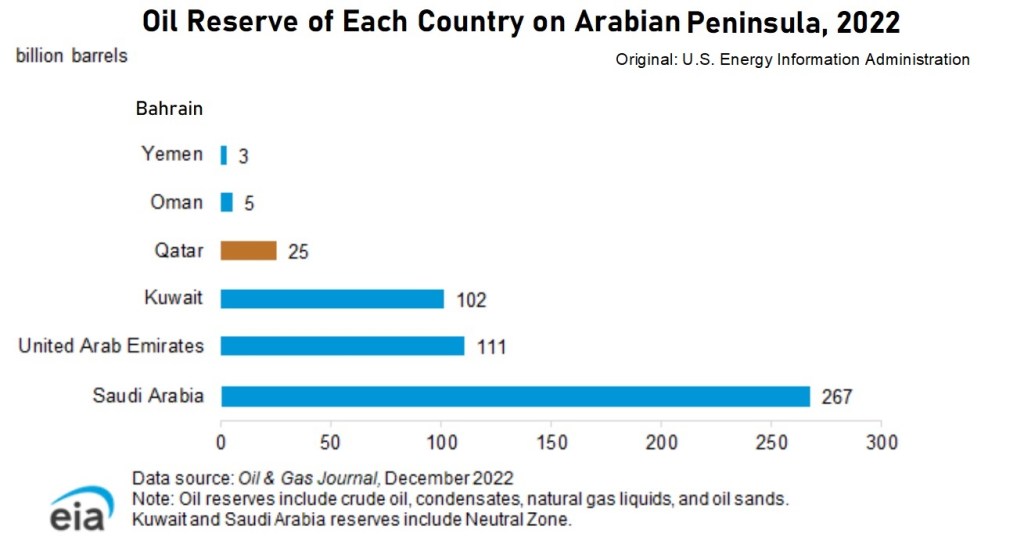
アラビア半島七ヵ国の原油操業は、1931年にバハレイン石油会社 (BAPCO)(現在は国営)が1932年5月31日にバハレイン油田(アワーリー油田)を発見して以来、続々と油田が開発・操業し、20世紀を通じ、現在に至るまで世界の原油。ガスの供給地域としての確固たる地位を築いて来ました。原油にしてもガスにしても天然資源ですから枯渇することは避けられませんが、アラビア半島七ヵ国全体としては、二次回収その他さまざまな技術革新や新たな油田、ガス田の発見・開発によって下記のEIAのグラフに示すように埋蔵量引いては生産量が維持されています。
Since discovery of Bahrain Field (Awali Field) by Bahrain Petroleum Company (BAPCO) (presently own by Bahrein government) on May 31, 1932, 7 countries of Arabian Peninsula have been developing and operating oil and gas fields one after another, and have established a solid position as world’s crude oil and gas supply territory throughout 20th century and up to present. As both crude oil and gas are natural resources, they will inevitably run out, but as a whole, 7 countries of Arabian Peninsula have maintained their reserves and productions as shown in EIA graph below, thanks to secondary recovery and other technological innovations, as well as discovery and development of new oil and gas fields.
油田、ガス田の発見は、下に示す表の様に21世紀に入っても続いていますし、この表には記載していませんが、既存の油田・ガス田から新たな油層・ガス層の発見も続いています。その顕著な例は、カタールの海上にあるノースガス田です。
新たな油層・ガス層の発見の代表的なのが、バハレインのカリージ・アル=バハレイン油田とサウジアラビアのジャフラ・ガス田です。カリージ・アル=バハレイン油田には800億バレルの原油が埋蔵されていると推定されています。日本の原油需要日量330万バレルとすると、60~70年分に相当します。ジャフラ・ガスには、200 trillion scf(立法フィート)のガスが埋蔵されていると推定されているので、日本の天然ガス需要を年間3.0trillion scfとするとやはり60~70年分に相当します。注目すべきなので両方共の非在来型油田・ガス田であることです。
Their discovery of oil and gas fields has continued into 21st century, as shown in a table below. And although not listed in this table, new oil and gas reservoirs are also being discovered in existing oil and gas fields. A notable example is North Gas Field offshore Qatar.
Representative discoveries of new oil and gas fields are Khalij al-Bahrain Field in Bahrain and Jafurah gas field in Saudi Arabia. Khalij al-Bahrain Field is estimated to have 80 billion barrels of crude oil. Assuming Japan’s crude oil demand is 3.3 million barrels per day, this is equivalent to 60 to 70 years’ worth of oil. Jafurah gas field is estimated to have 200 trillion scf (cubic feet) of gas, which is also equivalent to 60 to 70 years’ worth of gas if Japan’s natural gas demand is 3.0 trillion scf per year. What is noteworthy is either of them is an unconventional oil or gas field.
New major discoveries in 21 century
| Field | Reserve | Production |
| Khalij al-Bahrain Field | Discovered: 2018 | Started: Under Study |
| Bahrain | Reserve: 80 billion barrels | Capacity: |
| Offshore | Significant gas reserve | Gas |
| Unconventional (Shell Oil) | ||
| Jafurah gas field | Discovered: 21 century | Start: 2024 expected |
| Saudi Arabia | Reserve: 200 trillion scf | Capacity: by 2036 |
| Empty Quarter | Gas 2.2 billion scfd | |
| Unconventional and non-associated gas field | Gas liquids 550,0000bpd | |
| South Ghawar Gas Field | Discovered: 21 century | Started: 2023 |
| Saudi Arabia | Reserve: | Capacity: 2028 |
| Empty Quarter | Gas 273 billion scfy | |
| Condensate 14 million bpy bpy (barrels per year) | ||
| Al-Nokhatha Field | Discovered: 21 century | Started: |
| Kuwait | Reserve: 3.2 billion barrels | Capacity: (Oil 2,800 bpd) |
| Offshore (east Failaka Is.) | Gas 5.1 trillion scfd | (Gas 247 mm scfd) |
| Kidan Gas field | Discovered: 2008 | Started: |
| Saudi Arabia | Reserve: 8 trillion scf estimated | Capacity: |
| Empty Quarter | a high sulfur content | Gas 90 million scfd |
| near Shaybah oil field | ||
| Jebel Ali Gas Field | Discovered: 2020 | Started: 2023 (expected) |
| United Arab Emirates | Reserve: 8 trillion scf | Capacity: 136 billion scfy |
| Onshore | ||
| Gas Field | ||
| Mabrouk North East Field | Discovered: 2018 | Started: |
| Oman | Reserve: | Capacity: 182 billion scfy |
| Onshore | Gas 0.5 billion scfd | |
| Oil and Gas Field | ||
| bpy (barrels per year | scfy (scf/year) | |
| bpd (barrels per day) | scf (standard cubic feet) | scfd (scf/day) |
非在来型油田・ガス田は、シェル・オイルやシェル・ガスまたはタイト・オイルやタイト・ガスとも呼ばれ、水圧破砕や蒸気圧入等の技術を用いて、油層・ガス層に割れ目を設ける等、油やガスが移動できるようにしなければならないので、採油や採ガスの費用が非常に高価であることです。この為、バハレインでは開発方式を検討するとともに開発業者を探しているところです。一方、サウジアラビアのジャフラ・ガス田では既に開発に着手し、一部では試験的な生産が開始されています。非在来型のこれらの様な油田・ガス田の発見は、これからも有望だと考えられますが、地球温暖化防止政策の下で、これらの開発にどのように整合性を取って行くかが、技術や資金調達以前に解決すべき大きな課題と成っています。
Unconventional oil and gas fields, also called Shale Oil and Shale Gas or Tight Oil and Tight Gas, are very expensive to extract using techniques such as fracking or steam injection, etc. in oil and gas layers to allow oil and gas to move. For this reason, Bahrain has still been considering development methods and searching for developers. Meanwhile, development has already begun in Saudi Arabia’s Jafurah gas field, and trial production has already begun in some areas. Discovery of unconventional oil and gas fields such as these is expected to continue in future, but how to harmonize these developments with global warming prevention policies is a major issue that must be resolved before technology or funding is even considered.
サウジアラビアの油田・ガス田
Oil and Gas Fields of Saudi Arabia
アラブ首長国連邦の油田・ガス田
Oil and Gas Fields of United Arab Emirates
イエメンの油田・ガス田
Oil and Gas Fields of Yemen
オマーンの油田・ガス田
Oil and Gas Fields of Oman
カタールの油田・ガス田
Oil and Gas Fields of Qatar
クウェイトの油田・ガス田
Oil and Gas Fields of Kuwait
バハレインの油田・ガス田
Oil and Gas Fields of Bahrain
 Desert peninsula