Winds blowing on the Arabian Peninsula


アラビア半島の砂丘は風成砂丘で、その形成は、風の作用に大きく左右されます。
The dunes of the Arabian Peninsula are aeolian dunes, those formations are highly dependent on the actions of the winds.
Winds blowing in the Kidan area of the southeastern region
Winds blowing in the littoral zone of the Gulf of Aden and the Arabian Sea
季節風
アラビア半島における主たる風の発生は、季節風に起因しています。季節風は、「陸風・海風すなわち陸は温まり易く冷め易い、その一方で海は温まり難く冷めにくい」ので夏には陸が暖められるので風は海から陸へ、冬には海が暖かいので陸から海へと流れる風で、モンスーンと呼ばれています。因みにモンスーンの語源は、アラビア語の季節マウスィム(موسم)だと言われています。
monsoon
The main source of winds on the Arabian Peninsula is monsoon. The principle of monsoon is that “land breeze / sea breeze, that is, land is easy to warm and cool, while sea is hard to warm and cool”. In summer, land is heated and its temperature is high, therefore wind flows from sea to land. On the other hand, in winter, sea is hard to cool and it is warm, consequently wind flows from land to sea. The etymology of monsoon is said to be the Arabic season (mawsim) (موسم).
貿易風
これに次ぐのが地球規模で起きる風の循環です。アラビア半島の付け根部分が、貿易風と偏西風が分岐する「馬の緯度」に当たるので、アラビア半島は貿易風地帯にあります。大まかには季節風が卓越しますが、風は常に貿易風によって北東から南西へと押されています。
trade winds (easterlies)
Next effective wind to monsoon is global wind cycle. The root zone of the Arabian Peninsula belongs to “horse latitude” where trade winds (easterlies) and westerlies (anti-trades) branch off. As such, the peninsula is located in the trade winds (easterlies) zone. Roughly, monsoons predominate, however the winds are always pushed from northeast to southwest by trade winds (easterlies).
偏西風
偏西風については、アラビア半島は、その領域にはないのですが、ヨーロッパ・アルプスの影響を受け、地中海を通じてアラビア半島に渡ってくる風があります。その風が「アラビア湾に向かって移動し、ルブア・ハーリー沙漠を通って南と南西にスイングする」とされています。
westerlies (anti-trades)
As for westerlies (anti-trades), the Arabian Peninsula is not in that area, but under the influence of Europe Alps, there are winds that travel through the Mediterranean to the Arabian Peninsula. Those winds are said to “move towards the Arabian Gulf and swing south and southwest through the Rub’ al Khali.”
アラビア湾岸の風
一般的にアラビア半島全体での卓越風向は西から北西ですが、地域によって多少異なっています。
アラビア湾側では乾いたシャマール(شمال north)と呼ばれる北西からの北風が夏の卓越風向であり、5月から吹き始めて、7月上旬に最大になります。シャマールの風が時速40〜50キロ(最大100キロ)の速度で数週間吹き続けることもあり、クウェイトからアラブ首長国連邦にかけてのアラビア湾沿岸地帯に砂嵐を巻き起こします。
日中は砂嵐を発生させますが、夜には風も落ち着きます。また、ダンマームを過ぎて南のルブア・ハーリー沙漠に入ると風域も広がり、勢いも落ちて砂を広く堆積させます。
このシャマールも7月には吹き止み、風の穏やかな8月となります。夏のもう一つ卓越風は、サムーム(シムーン) (سموم)(毒素)と呼ばれる南から吹く風で、熱くて完全に乾燥しています。
9月からは地中海の低気圧が東へと相次いで通過し、北アラビアから南はラアス・タヌーラ付近まで勢力を張るようになります。10月、11月は涼しい気候への変わり目で、アラビアでの秋と言えます。
風向きは変化を増し、雨が11月から4月まで時折降り、そのピークは12月、1月です。その2か月がアラビアの冬で地域的な嵐や強風が吹くことも少なく無くありません。日中でも寒いことが多い時期です。
coastal winds of Arabian Gulf
Generally, the prevailing wind direction for the entire Arabian Peninsula is from west to northwest, but it varies slightly from region to region.
On the Arabian Gulf side, dry northwestern north wind called Shamal (شمال north) is the predominant summer wind direction, starting in May and peaking in early July. Shamal winds can continue to blow at speeds of 40-50 km/h (up to 100 km/h) for weeks, causing sandstorms in the littoral zone of the Arabian Gulf from Kuwait to United Arab Emirates.
Sandstorms occur during the day, but winds calm down at night. Also, after passing Dammam and entering the Rub’al Khali in the south, wind area expands, momentum drops, and sand accumulates widely.
Shamal will also stop blowing in July, and it will be followed by August when the wind is calm. Another prevailing wind in summer is southerly wind called Simoom (سموم) (toxins toxin), which is hot and completely dry.
From September, a cyclone (a low pressure system) coming from the Mediterranean will pass one after another to east, and from northern Arabia to the south, they will spread to the vicinity of Ras Tanura. October and November are transitions to cooler climates and can be said as fall in Arabia.
Winds direction change, with occasional rains from November to April, peaking in December and January. Those two months are winter in the Arabian Peninsula, and there are many regional storms and strong winds. It is often cold even in the day.
内陸地方の風
北西地方のジャウフ州での気候の際だった特徴は風です。
冬は東からの吹く風が多く、特に南部では北東から南西に向かう典型的な冬の風(冬のシャマール)が吹きます。
春は、タブーク州を含め西から吹く風が多い時期です。
これらの風は、トゥワイク山脈に沿って弧型を描いて南に向かい、ルブア・ハーリー沙漠に入るとさらに西南西へと転じてゆきます。
これは、トゥワイク山脈、タウロス山脈、ザグロス山脈およびハジャル山脈に囲まれた空域での北東から吹いている貿易風の働きだと、思えます。
夏は熱く乾いたこの北西地方に冬に成ると南東からの風が雨をもたらします。これと対照的に北や西からは一般的に厳しく寒い風が吹きます。
この風がナジュド地方のリヤードに達した頃にはその殆どの水分が奪われてしまっています。従ってこの北や西からの風がリヤドに降雨をもたらす事は殆どありません。
ナジュド地方では「サムーム(سموم)(毒素)」と呼ばれる夏の卓越風が南から吹き、熱く完全に乾燥しています。
冬には、名前は夏と同じに「シャマール(شمال north)」と呼ばれる冷たい乾いた風が北方の遠く中央アジアから吹いて来ます。
シャマールは冬の終わりには地中海東部から進んでくる低気圧に遮られます。
この冬の終わりにやってくる低気圧の風がナジュドに乏しい雨を生み出します。この雨が沙漠の植生を生き返らせる最も貴重な春の雨となります。
紅海側の内陸では冬には紅海を通り抜けて雨を運んで来る北西風が吹きます。
南に下がると夏にも南からのモンスーンが吹き、豊かな雨の恵みを運んで来ます。従って北部では降雨は冬の間に受け取るのに対して、アシール南部などでは80 %の降雨を夏に受けています。
Inland winds
In the Jawf province of the northwestern region, it is the wind that is a striking feature of the climate.
In winter, there are many winds that blow from east, and especially in its southern part, the typical winter wind, so called winter Shamal, blows from northeast to southwest .
Spring is the time when there is a lot of winds from west, together with those of the Tabuk province.
These winds arc south along the Jebel Tuwaiq and turn further west-southwest upon entering the Rub’ al Khali.
This seems to be the work of trade winds (easterlies) blowing from northeast in the airspace surrounded by the Jebel Tuwaiq, the Taurus Mountains, the Zagros mountains and the Hajar mountains.
When winter comes in this hot and dry northwestern region during summer, wind from southeast brings rain. In contrast, north and west winds are generally harsh and cold.
By the time those winds reach Riyadh in the Najd region, most of their moisture has been deprived. Therefore, this north and west wind rarely causes rainfall in Riyadh of the Najd region.
In summer of this region, a prevailing wind called Simoom (سموم) (toxins) blows from south and its climate is hot and completely dry.
In winter, a cold and dry wind, called “Shamal (شمال north) as the same name as in summer, blows from such a far north as the central Asia.
At end of winter, a cyclone comes from the eastern Mediterranean and blocks Shamal.
A cyclones wind produces poor rain in the Najd region. Even if it’s poor, it is the most valuable spring rain to revive desert vegetations.
On the Red Sea side, northwesterly wind blows inland in winter and carries rain.
As descending to south, monsoon from south blows in summer and carries blessings of abundant rain. While rainfall is during winter in the north region, 80% of rainfall is received during summer in the southern part of the Asir region, etc.
南東部キダン地方の風
アシール地方とルブア・ハーリー沙漠を挟んで東に対峙し、アブダビ国境南でオマーン国境西の近いキダン(كــد ن)中心とした地方があります。そこでの天然ガス開発のために行われた風向調査ではこの地域の風の59%が北の角度(北東、北、北西)から来ていることを示しました。これは基本的にシャマール(夏と冬の両方で発生)とハブーブの風でした。 また、ソース又はサムームの風は、2番目(26%)で、東および南東方向から来ていました。南風としてはさらに南西からのハムシーン(7%)が記録されています。(参照: Dr. Ali Madan Al-Ali, Journal of Earth Science and Engineering 5(2015)372-381))
Winds blowing in the Kidan area of the southeastern region
There is a region centered on Kidan (كــد ن) located south of the Abu Dhabi border and near west of the Oman border. The Kidan area confronts east of the Asir region across the Rub’al Khali. A wind direction survey had been conducted to develop natural gas there. This survey showed that 59% of wind in the area comes from north angles (northeast, north and northwest).They are basically the winds called as “shamal(الشمال)” (occurring in both summer and winter) and/or “haboob(الـهـبوب)”. Also, the wind called as “saus” and/or “simoom(السموم)” were the second place (26%), coming from the east and southeast directions. A southerly wind, called as “kamsin(الخمسين)” coming from southwest is recorded 7%. (Reference: Dr. Ali Madan Al-Ali, Journal of Earth Science and Engineering 5 (2015) 372-381).
南部アデン湾・アラビア海の風
アラビア半島南部のアデン湾やアラビア海の冬の季節風は、北東から南西に向かう風です。
夏の季節は、湿度の高い南西モンスーンが吹き、時として強風を伴います。
この強風は、ハーリフ(خارف)と呼ばれ、ルブア・ハーリー沙漠の南端まで広がり、一連のピラミッド型および線形の砂丘の形成に役立っています。
Winds blowing in the littoral zone of the Gulf of Aden and the Arabian Sea
In the littoral zone of the Gulf of Aden and the Arabian Sea, winter monsoon blows from northeast to southwest.
In the summer season, the humid southwest monsoon (mawsim = season) blows, sometimes accompanied by strong winds.
This strong wind, called kharif (خارف), extends to the southern periphery of the Rub’ al Khali and assists to form a series of pyramidal and linear dunes.
紅海岸ティハーマ地方の風
紅海沿岸のティハーマ地方では、この地方における小規模な風成砂丘を除けば、風成砂丘の形成に大きくは関わりませんが、紅海に吹く風について触れておきます。
紅海は、大地溝帯一部であり、両側を高い尾根に挟まれた長さ2,300キロに及ぶ細長い盆地状になっています。その幅は最も広い場所でも355キロにしか過ぎません。
もう一つの特徴は亜熱帯乾燥地帯のサハラ沙漠(الصحراء الكبرى)とアラビア半島と、2つの沙漠に囲まれているため、年間蒸発量が2メートルを超えています。
この補充は唯一の外洋との接続水路である南端のバブエルマンデブ海峡(باب المندب)から流入で補われています。
この様な地勢のために紅海に吹く風は、アラビア半島に吹く風とは、その影響は、受けるものの異なっています。
2017年5月12日付のキング・アブドゥッラー科学技術大学(KAUST)のレポートによると「紅海に吹く風は次の4種類がある」とされています。
(1)地中海から紅海に北西風が吹きこんできます。夏季にはエーゲ海沿岸地域で発生する乾燥した強い北風のエテジアン風によって強められる上に、紅海では5月から10月までの夏の間は、南東風の吹かないので、この北西風が、紅海での卓越風向となります。特に、地中海の嵐が通過した後など、強い北西風がシナイ半島の西側を通り抜け、南向きに吹き、時には紅海の南端に達することもあります。
(2)11月から4月までの冬の間にアラビア半島に吹くシャマール(北東の季節風)は、サラワート山脈南部の2,000~3,000メートルの山嶺およびエチオピア高原の1,500~4,000メートルの山々に阻まれて、アデン湾で風向がそらされ、紅海をその軸に沿って北西に進む南東風に変えられます。この南東風が流域南部で強く、北向きに次第に弱くなりますが、紅海の中ほどでは 地中海からの北西風に対抗でき、紅海収束帯を作り出します。
Winds in the Tihama region
The Tihamah region is the littoral zone of the Red sea. Winds are not significantly involved in a formation of an aeolian dune except for a small one. Because it is a peculiar wind area, I would like to mention winds in the Red sea.
The Red sea is a part of the great rift valley, and forms a 2,300-kilometer-long elongated basin sandwiched between high ridges on both sides. Its width is only 355 kilometers, even in its widest areas.
Another feature is that it is surrounded by two huge deserts, the Sahara desert (اصحراء الكبرى) and the Arabian Peninsula, in the subtropical arid region. So, annual evaporation exceeds more than 2 meters.
This replenishment is supplemented only by inflow from the strait of the Bab-el-Mandeb (باب المندب) at the southern end.
Due to such characteristic terrain, winds that blows in the Red sea are affected differently from winds that blows in the Arabian Peninsula.
According to a report by KAUST (King Abdullah university of science and technology) dated May 12, 2017, “There are four types of winds blowing in the Red sea.
(1) Northwesterly wind blows from the Mediterranean sea into the Red sea. In summer, it is strengthened by dry and strong northerly etesian wind that occurs in the littoral zone of the Aegean sea. Since in the Red sea, southeasterly wind does not blow during summer from May to October, this northwesterly wind will be predominant wind-direction in the Red sea. Strong northwesterly winds pass through the west coast of the Sinai Peninsula, blowing southward and sometimes reaching the southern tip of the Red Sea, especially after Mediterranean storm.
(2) Shamal (northeast monsoon) that blows in the Arabian Peninsula during winter from November to April is blocked both by the 2,000-3,000 m ridges in the southern Sarawat mountains and the 1,500-4,000 m mountains in the Ethiopian highlands. Then, wind direction is diverted in the Gulf of Aden, turning the Red sea as southeasterly wind that travels to northwest along its axis. This southeasterly wind is strong in the southern part of the basin and gradually weakens northward. In the middle of the Red Sea it can counter northwesterly wind from the Mediterranean sea, creating Red sea convergence zone.
(3)アフリカ側では、クンフザのほぼ対岸に位置するトカル山峡(طوكر)に6月から9月にかけて、夏の間は、毎日、総観規模の風力発生システムによって西風が吹きつけます。この風は、狭い地峡に集まることでジェット化され、さらに、紅海岸での海陸風発生や滑降風効果によって加速されます。これらのトカル山峡風は東向きに吹き、しばしば沙嵐を伴います。一般的に紅海の盆地状地形のために南部へと向きを変えます。
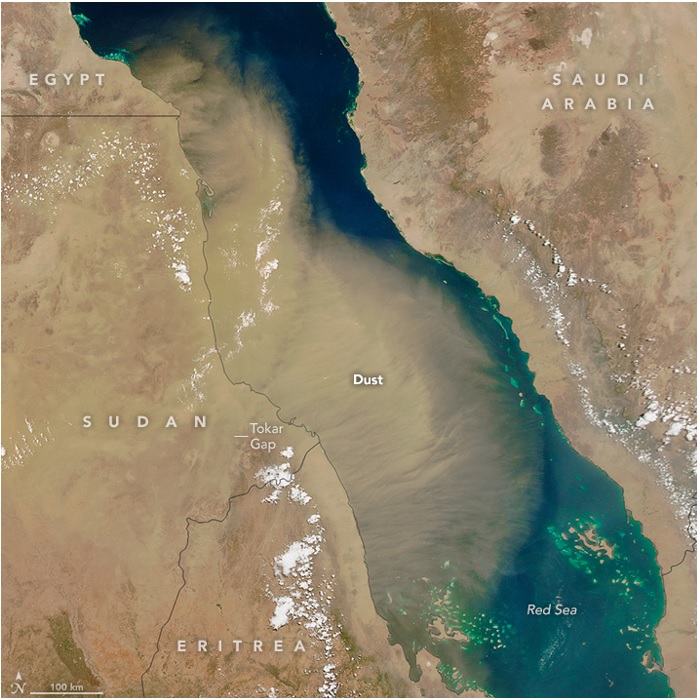
Dust blowing from Tokar Gap, presented by NASA on June 15, 2016
(3) On the African side, wind power generation system of synoptic scale meteorology blows westerly wind every day from June to September on the Tokar gap (طوكر) located on the opposite coast of Qunfudhah. This wind is jetted by gathering in the narrow isthmus, and is further accelerated by occurrence of sea breeze or onshore breeze on the Red sea coast and katabatic wind effect. Tokar gap wind blows eastward, often accompanied by dust storms. It generally turns south due to the basin-like terrain of the Red sea.
(4)紅海北部ではアラビア半島の冬場の季節風(北東シャマール)は、サラワート山脈に阻まれています。しかし、時折、サラワート山脈北部の山峡から強い集中ジェットが紅海に吹き込み、北部地域に局所的に影響を及ぼします。
(4) In winter the Sarawat mountains blocks monsoon (northeast Shamal) blowing into the northern Red sea coast of the Arabian Peninsula. However, from time to time, strong concentrated jets blow into the Red sea coast from several narrow isthmus of the Sarawat mountains, affecting the northern region locally.
 Desert peninsula